Kuwait Lifts Force Majeure, Boosting Oil to Asia

Morning Intelligence – The Gist


Morning Intelligence • Friday, June 19, 2026

The Gist View

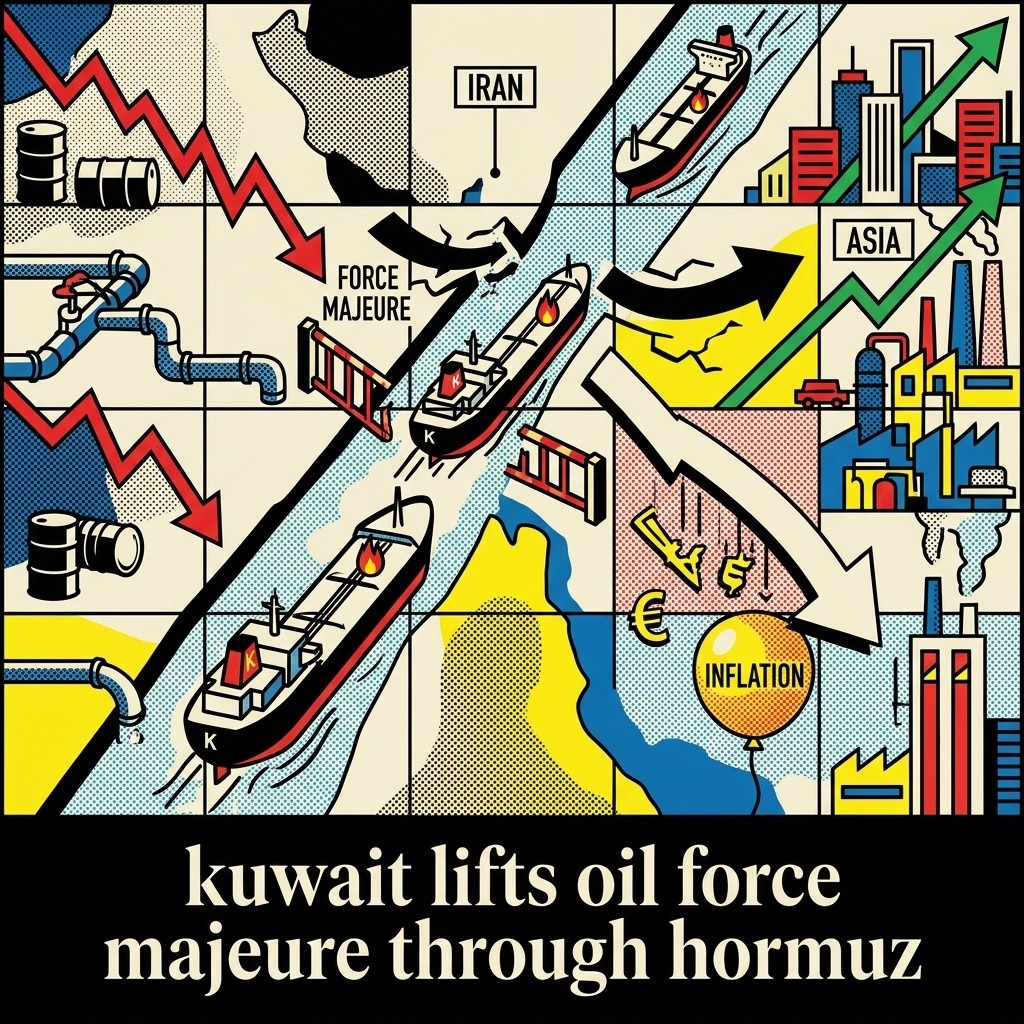
Kuwait Petroleum Corporation lifted its force majeure Thursday, restoring the 20% of global oil historically transiting the Strait of Hormuz. Markets are bypassing US-Iran diplomatic posturing, pricing this crude surge as a massive disinflationary stimulus for developing economies.

Europe cannot absorb this windfall due to its rigid trade protectionism. The European Commission stalls tariff recalibrations because it gains leverage over states reliant on central subsidies. This delay punishes domestic manufacturers, while Asian markets prepare to absorb the 70% of baseline flows expected to recover.

As flagged regarding Federal Reserve Chair Kevin Warsh’s aggressive inflation stance, external central banks are rapidly adapting. “Physical supply normalization is likely to lag the market’s reaction by months,” rewarding traders with immediate arbitrage while consumers wait — Discovery Alert, 2026.

The Gist AI Editor

The Global Overview

The Hormuz Stimulus

The resumption of shipping in the Strait of Hormuz, unlocking 80 million barrels of crude, acts as the year’s most significant unlegislated tax cut for energy-importing developing nations (Bloomberg). Markets are pricing this as a massive disinflationary shock; emerging equities have hit record highs, not due to diplomatic optics, but because lower energy inputs structurally boost margin expansion for global south manufacturers. Capital is actively rotating into emerging markets, front-running a sustained cooling of global energy prices that Western capitals have yet to fully digest.

The Cost of Protectionism

SpaceX’s clash with EU spectrum regulators illustrates the “sovereignty tax”—where prioritizing domestic control over high-performance infrastructure introduces systemic latency (FT). By favoring European operators, the bloc risks crippling current connectivity in critical theaters like Ukraine, proving that regional regulatory alignment often trades operational security for bureaucratic control, ultimately undermining the continent’s own digital resilience.

Capital’s Pivot to Hard Tech

Chinese unicorn Momenta’s $9 billion valuation ahead of a $1 billion Hong Kong IPO highlights where institutional money is moving (WSJ). This isn’t speculative AI; it is a bet on the “hard” stack—autonomous logistics. It signals that global capital is fleeing general-purpose tech hype to fund infrastructure that builds domestic industrial capability.

The Labour Stress Test

Andy Burnham’s parliamentary win signals a pivot in UK politics (Bloomberg). For investors, this transitions the UK outlook from “predictable malaise” to “contested policy,” as Prime Minister Starmer now faces a viable internal rival, introducing a layer of political volatility that markets are currently underpricing.

Stay tuned for the next Gist—your edge in a shifting world. The Gist remains independent and reader-supported. If you value news free from corporate or state interests, consider supporting our mission with a donation.

The European Perspective

Trade Frictions and Economic Scars

The CEPR structural gravity model confirms that Covid-era border closures were not merely health mandates but blunt economic instruments. While global trade volume dropped roughly 23% in 2020Q2, the impact was asymmetrical. Because land-linked European economies rely on road and air freight, they faced outsized, permanent scarring compared to regions reliant on seaborne trade, which remained largely fluid (CEPR). This structural reality exposes the fragility of land-based trade corridors: bureaucratic barriers on physical mobility effectively decoupled integrated supply chains, a lesson that should define future contingency planning.

The Hormuz Disinflationary Dividend

President Trump’s 14-point preliminary pact with Iran is triggering a rapid capital rotation (Politico, Le Monde). By effectively unlocking the Hormuz Strait for 80 million barrels of energy, this de-escalation acts as a massive, unlegislated tax cut for energy-importing emerging markets. As capital rotates away from the US dollar—pulling back from near 2-year highs against the Yen—global equities are touching record levels. The market is pricing a rapid disinflationary wave, signaling that geopolitical de-escalation is currently the most potent stimulus available (Politico).

The Cost of Diplomatic Sidelining

Brussels’ tentative back-channel outreach to Moscow underscores a growing recognition of diplomatic fragmentation. Despite renewing sanctions for 12 months—shifting from the previous six-month cadence—European leaders fear being marginalized in imminent peace negotiations (Guardian). This strategic uncertainty forces a difficult balancing act: maintaining economic support for Kyiv while acknowledging that regional leverage is eroding as non-EU powers steer the conflict’s endgame (Politico, ZDF).

Digital Protectionism vs. Hard Security

SpaceX’s warnings that EU spectrum quotas endanger Ukrainian satellite connectivity exemplify the ongoing conflict between regional digital sovereignty and operational reality. Europe’s push for autonomous digital ecosystems often collides with a foundational reliance on US-led infrastructure (Politico). The systemic trade-off is clear: rigid regulatory barriers designed to protect the EU tech market are simultaneously handicapping the continent’s ability to project hard power in immediate security theaters.

Tournament Logistics as Infrastructure

The 2026 World Cup serves as an unintentional stress test for urban transit systems. In Mexico, early tournament progression has highlighted how localized transit failures bottleneck regional logistics, forcing municipal authorities to pivot from passive monitoring to active, high-frequency crowd-flow management—a microcosm of how large-scale events disrupt municipal stability regardless of the sporting outcome (ZDF).

Catch the next Gist for the continent’s moving pieces.
🎙️ Listen to this edition as a podcast Listen


The Gist is an independent daily digest: AI-curated, human-directed, unapologetically liberal (how it’s made). Hundreds of sources, only what matters. Subscribe free or listen to the podcast.


Comments

Leave a Reply

Your email address will not be published. Required fields are marked *

This site uses Akismet to reduce spam. Learn how your comment data is processed.