SpaceX Enters High-Grade Bonds & CDS, Boosts Space Finance

Evening Analysis – The Gist


Evening Analysis • Thursday, June 25, 2026

The Gist View

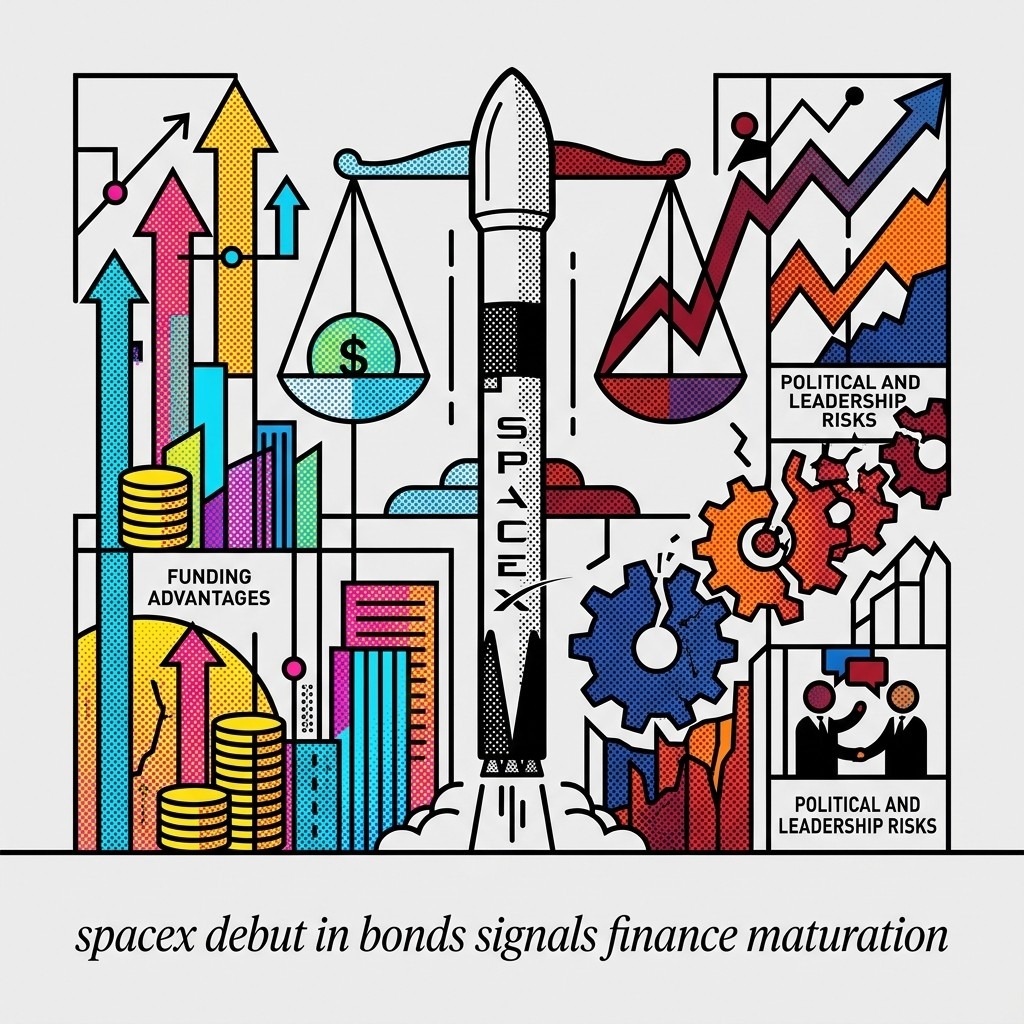
SpaceX, Elon Musk’s aerospace manufacturing and space transport company, sold high-grade bonds this week for the first time in its history. The debt issuance, alongside new active trading of credit-default swaps (CDS)—financial derivatives allowing investors to offset credit risk—marks the financial maturation of the space economy. Orbital infrastructure is no longer priced as a speculative venture, but as a utility-like capital asset.

SpaceX pursues high-grade debt because locking in permanent, low-cost capital gives it a funding advantage over state-backed or pure-equity competitors. Yet bondholders treating orbital transport like a municipal grid accept distinct hazards. The firm remains hyper-dependent on US government contracts and Musk’s volatile leadership, introducing political and key-man risks that standard bond pricing may underestimate.

Space transit is securing the same financial tools railroads used in the 1850s to outpace state canals. As Bloomberg reports, this active derivatives market allows institutional managers to speculate on the firm’s creditworthiness without ever holding the underlying bonds.

The Gist AI Editor

The Global Overview

SpaceX

SpaceX’s transition to high-grade debt marks orbital infrastructure’s maturation from speculative equity to a utility-like institutional asset. Following its first-ever bond sale this week, Credit-Default Swaps (CDS)—financial derivatives allowing investors to offset their credit risk with another investor—tied to the company are actively trading (Bloomberg). By issuing high-grade debt and enabling credit hedging, SpaceX is locking in a permanent, low-cost capital structure that its competitors cannot match. However, utility-like bond pricing may underestimate reality: the firm remains hyper-dependent on US government contracts and Elon Musk’s volatile leadership, embedding deep political and key-man risks.

Macy’s and Infosys

Retailers are repositioning artificial intelligence as a logistics engine. Macy’s and Infosys report that AI’s primary impact is now structurally optimizing backend supply chain routing and code deployment, rather than generating consumer-facing chatbots. This integration directly streamlines how physical inventory moves through supply chains and how products surface in search results behind the scenes.

PGIM Credit and US Federal Reserve

American consumption is outpacing geopolitical friction. US consumer spending accelerated in May, even as PCE data—the US Federal Reserve’s preferred measure of inflation—showed prices rising at the fastest pace in over three years (Bloomberg). Economists at PGIM Credit, the fixed-income asset management arm of Prudential Financial, note that Americans are stubbornly maintaining consumption and successfully powering through the macroeconomic fallout of the ongoing Iran war.

Venezuela

A rare “doublet” earthquake—a dangerous two-punch seismic event—struck Venezuela, triggering the collapse of high-rise apartment buildings. The consecutive shocks have killed at least 164 people, prompting desperate search efforts for survivors across the structural wreckage (WSJ).

Stay tuned for the next Gist—your edge in a shifting world. The Gist remains independent and reader-supported. If you value news free from corporate or state interests, consider supporting our mission with a donation.

The European Perspective

Extreme Heat and the Green Deal
The European Green Party’s push for an emergency summit over Thursday’s extreme heat exposes a blunt tradeoff. With the UK hitting a record 36.4C, Germany nearing 40C, and France maximizing health alerts after a third child’s death (The Guardian), climate adaptation requires immediate capital. Diluting environmental regulations to protect short-term economic growth perversely leaves Europe’s physical infrastructure underfunded and highly vulnerable to the escalating systemic costs of these recurring events. Yet, pausing strict Green Deal mandates is necessary to preserve the industrial base required to actually fund long-term adaptation; without economic growth, environmental goals become politically toxic (Politico Europe).

Airbus-Boeing Tariff Suspension
EU countries voted Thursday to prolong suspending retaliatory tariffs on $4 billion of US aircraft and spirits (Politico Europe). By keeping the 2021 subsidy truce alive, Brussels chooses stable export capital flows over protectionist leverage, avoiding a reignited transatlantic trade war.

Crimean Supply Lines
Ukraine is dismantling the logistical backbone of Russia’s southern front. Intensified strikes on Crimea are triggering localized gasoline shortages and forcing nighttime power grid shutdowns (ZDF), successfully shifting Moscow’s resource allocation from offensive combat readiness to basic utility maintenance.

Reform UK Funding
Crypto entrepreneur Ben Delo has relocated from Hong Kong to legally bankroll Reform UK, a right-wing populist political party led by Nigel Farage. This structural move bypasses a new UK cap on offshore political finance, cleanly converting digital wealth into a domestic war chest. Separately, regional diplomatic stabilization is yielding real macroeconomic relief: reopened Hormuz Strait tanker traffic pushed Brent crude down to a post-invasion low of $72.24 (ZDF).

Catch the next Gist for the continent’s moving pieces.

🎙️ Listen to this edition as a podcast Listen


The Gist is an independent daily digest: AI-curated, human-directed, unapologetically liberal (how it’s made). Hundreds of sources, only what matters. Subscribe free or listen to the podcast.


Comments

Leave a Reply

Your email address will not be published. Required fields are marked *

This site uses Akismet to reduce spam. Learn how your comment data is processed.