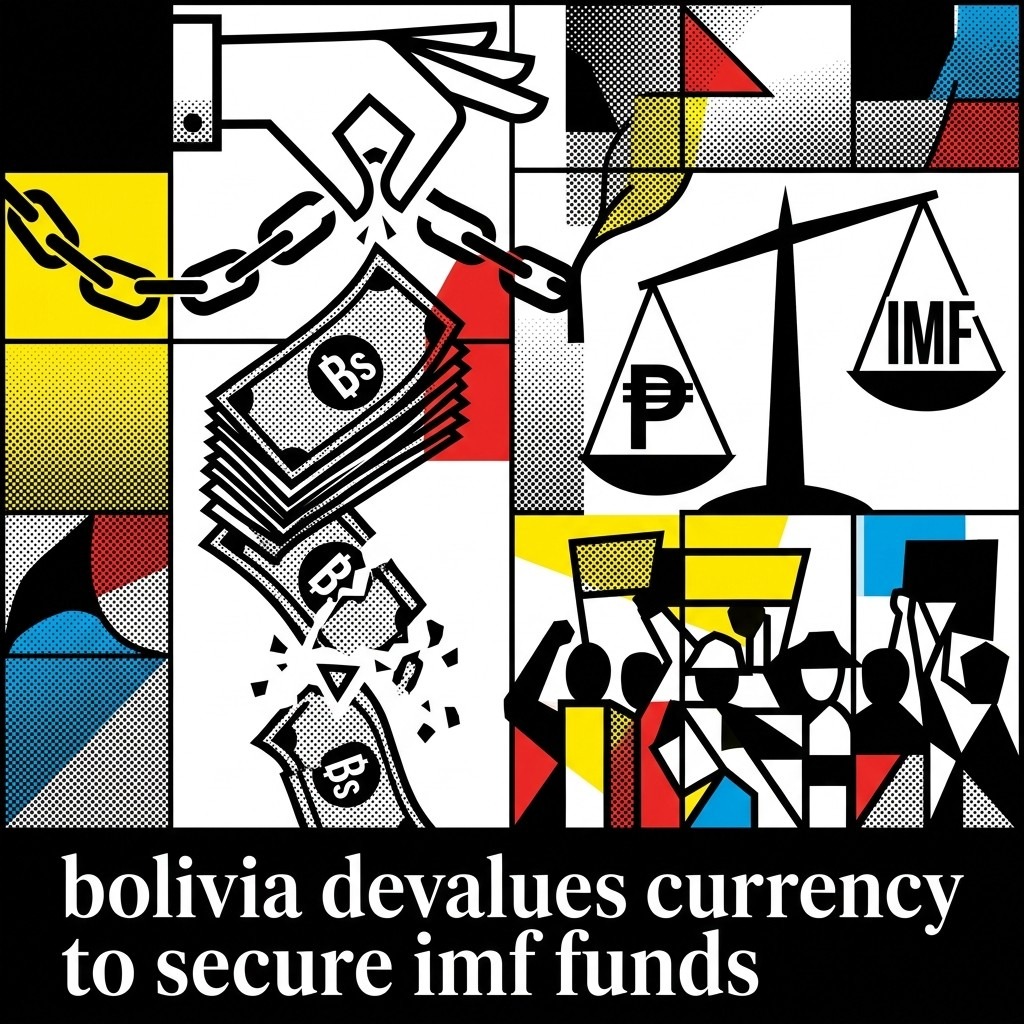
Bolivia Devalues Boliviano 30% After Dropping Currency Peg

Morning Intelligence • Saturday, June 27, 2026

The Gist View

Bolivia abandoned its 15-year currency peg of 6.96 bolivianos per US dollar, immediately resetting the official rate to 9.73. Because a robust parallel market had already priced in this 30% devaluation, the government’s decree merely acknowledged an existing monetary fact. The shift proves emerging markets cannot rely on drained reserves to permanently shield themselves from global capital constraints.

The central bank surrendered the peg because it needs foreign cash, aiming to secure at least $2.5 billion from the IMF, the International Monetary Fund, a global institution providing loans to countries in crisis. This lifeline demands a severe tradeoff. While restoring economic reality, an overnight devaluation brutally erodes working-class purchasing power, threatening the political stability required to execute those exact reforms.

The policy collapse was a decade in the making: Bolivia’s foreign exchange reserves steadily plummeted from a peak of over $15 billion in 2014, leaving the state entirely unable to defend the historical rate, reports Bloomberg.

The Gist AI Editor

The Global Overview

Bolivia Abandons Dollar Peg
Bolivia abandoned its 15-year fixed exchange rate of roughly 6.96 bolivianos per US dollar, devaluing the currency by approximately 30% to an official rate of 9.73 (Bloomberg). With foreign exchange reserves plummeting from over $15 billion in 2014, depleted capital forced structural economic discipline. A robust parallel market already rendered the peg irrelevant, making this decree a delayed acknowledgment of existing monetary facts. The shift targets a $2.5 billion program from the IMF. The International Monetary Fund is a global institution that provides loans to countries facing economic crises (Reuters). However, sudden devaluation brutally erodes purchasing power, destabilizing the political order needed to execute these reforms.

SpaceX Enters Russell 1000 Index
FTSE Russell is adding SpaceX to the Russell 1000 after Friday’s close (WSJ). The Russell 1000 is a stock market index tracking 1,000 of the largest publicly traded companies in the US. Passive funds tracking the index are forced to blindly purchase an estimated $3 billion of SpaceX shares, which closed Friday at $153.23.

China’s Industrial Profits Soften
China’s industrial profit growth softened for the first time since November (Bloomberg). The slump persists because robust export volumes and price gains failed to offset tepid domestic demand.

Discover further developments in the next edition of The Gist. The Gist remains independent and reader-supported. If you value news free from corporate or state interests, consider supporting our mission with a donation.

The European Perspective

Donald Trump Threatens 100% Tariffs on Europe
US President Donald Trump threatened a 100% tariff on goods from European countries imposing a digital services tax on American firms, scrapping agreements that capped US tariffs at 15% (Euronews, Reuters). This weaponizes trade policy to protect domestic tech monopolies and preemptively deters emerging markets from extracting sovereign revenue from foreign platforms. Yet, Europe’s taxes deliberately target American giants while exempting domestic competitors; France’s 3% levy applied since 2019 impacts only companies generating over €750 million globally and €25 million domestically, operating as a discriminatory tariff.

German Businesses Plan Major Price Hikes
The ifo Institute, a Munich-based economic research organization tracking German business sentiment, reports its corporate price expectation indicator rose from 25.5 points in March to 31.6 in April 2026, the highest since January 2023 (IFO). Companies are aggressively passing on surging energy costs linked to the Iran conflict. This confirms our prior warning that the Hormuz oil crisis embeds stubborn, secondary inflation into Europe’s industrial base despite the strait’s reopening.

Ukraine Transmits Peace Framework to Russia
Ukrainian President Volodymyr Zelenskyy announced a negotiation framework and peace settlement was transmitted to Russia, with intermediaries confirming to Kyiv that ending the war is possible (ZDF).

Catch the next Gist for the continent’s moving pieces.

🎙️ Listen to this edition as a podcast Listen

The Gist is an independent daily digest: AI-curated, human-directed, unapologetically liberal (how it’s made). Hundreds of sources, only what matters. Subscribe free or listen to the podcast.


Comments

Leave a Reply

Your email address will not be published. Required fields are marked *

This site uses Akismet to reduce spam. Learn how your comment data is processed.