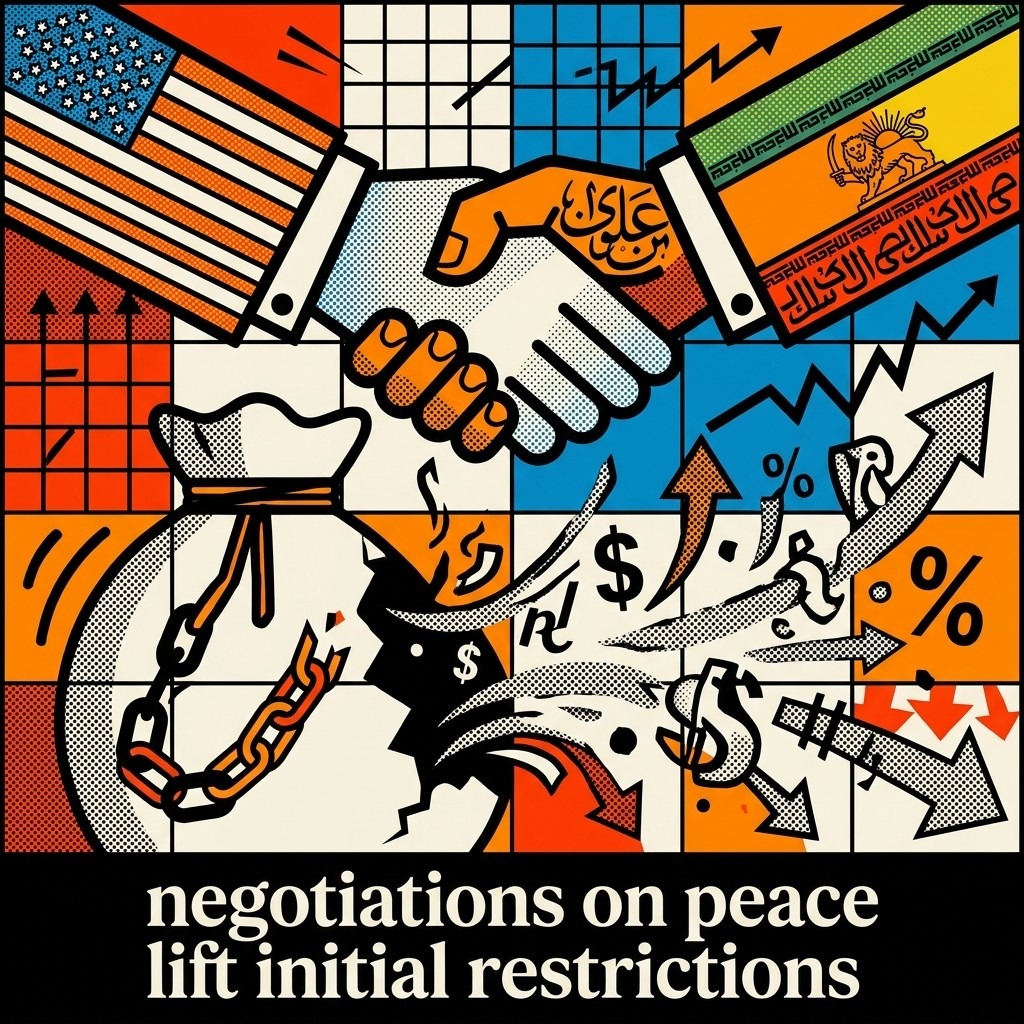
US-Tehran Peace Talks Begin, Sanctions Partially Lifted

Evening Analysis • Sunday, June 28, 2026

The Gist View

On June 17, 2026, the Trump administration and Tehran signed a Memorandum of Understanding—a non-binding agreement outlining terms for a forthcoming treaty—establishing a 60-day negotiating window to end hostilities. This unwinding of decades of Iranian sanctions reveals Washington now treats economic statecraft not as a durable anchor of global security, but as a volatile, short-term transactional lever.

To secure this window, the US Treasury Department issued a two-month license allowing Iran to produce, sell, and deliver oil without US penalties on buyers. Averting a broader Middle East collapse and stabilizing energy flows is arguably worth the immediate compliance whiplash. Yet global banks demand regulatory predictability because they absorb the severe financial penalties of any misstep. Lenders must now price US foreign policy as an unpredictable variable rather than a stable baseline.

Assessing this sudden patchwork of new permissions and old restrictions, law firm Gibson Dunn warns the reversal has created a “head-spinning situation” for governments and financial institutions.

The Gist AI Editor

The Global Overview

Trump’s U-Turn on Iran Sanctions

Trump’s reversal of Iranian sanctions replaces institutional predictability with transactional whiplash, degrading US economic statecraft. On June 17, 2026, the US and Iran signed a Memorandum of Understanding—a non-binding agreement outlining the terms of a forthcoming contract or treaty—establishing a 60-day negotiating window to end hostilities (CBS News). A two-month Treasury license lets Iran produce and sell oil without buyer penalties. Averting a regional collapse and stabilizing energy flows is arguably worth the cost of banking compliance whiplash. Yet this sudden unwinding creates a “head-spinning situation” (Bloomberg), forcing global banks to treat US financial policy as a volatile variable rather than a stable baseline (Gibson Dunn). Separately, despite our prior assessment that moderates were stabilizing US politics, debates over the socialist wing’s dominance in the Democratic Party prove the ideological power struggle remains unresolved.

State Mandates for Personal Finance Education

Thirty-nine US states now require high schoolers to complete a personal finance course to graduate, up from just one in 1998 (Bloomberg).

AI Integration in Law Enforcement

Axon Enterprise—a major American technology company dominating the police body-camera and non-lethal weapons market—is increasingly staking its market valuation and executive compensation on a tech-driven vision centered around AI law enforcement solutions (WSJ).

Stay tuned for the next Gist—your edge in a shifting world. The Gist remains independent and reader-supported. If you value news free from corporate or state interests, consider supporting our mission with a donation.

The European Perspective

UK-Australia Trade Agreement

The post-Brexit agricultural reality exposes a public choice dilemma: concentrated domestic producers bear the immediate shock of free trade, while supermarkets capture the margins. British beef farmers report losing <strong>roughly £400 per animal</strong> to cheaper Australian meat (The Guardian). This results from the UK-Australia free trade agreement phasing in tariff-free agricultural imports. Despite falling wholesale livestock values—typically <strong>£2,000 to £3,000 per animal</strong>—UK retail beef prices remain broadly unchanged. Intermediaries absorb the price differential; consumers see no savings while farmers face margin collapse. Granted, food security is a state interest; offshoring baseline meat production introduces unnecessary supply chain fragility during systemic crises.

European Defense Autonomy

Ahead of the NATO summit, German Foreign Minister Johann Wadephul (CDU—the Christian Democratic Union, Germany’s center-right conservative party) stated Europe must take on significantly more military responsibility (ZDF). This structural mandate responds directly to the US continuing its strategic shift toward the Pacific.

Russian Security and Climate Resilience

Following escalated Ukrainian airstrikes, President Vladimir Putin vowed on <strong>June 28</strong> to guarantee Russia’s border security (ZDF). Meanwhile, as record temperatures exceeding <strong>40C</strong> expand into Poland and Czechia (The Guardian), the heatwave confirms our view that Europe’s immediate priority must be funding physical climate resilience rather than relying solely on mitigation.

Catch the next Gist for the continent’s moving pieces.

🎙️ Listen to this edition as a podcast Listen

The Gist is an independent daily digest: AI-curated, human-directed, unapologetically liberal (how it’s made). Hundreds of sources, only what matters. Subscribe free or listen to the podcast.


Comments

Leave a Reply

Your email address will not be published. Required fields are marked *

This site uses Akismet to reduce spam. Learn how your comment data is processed.