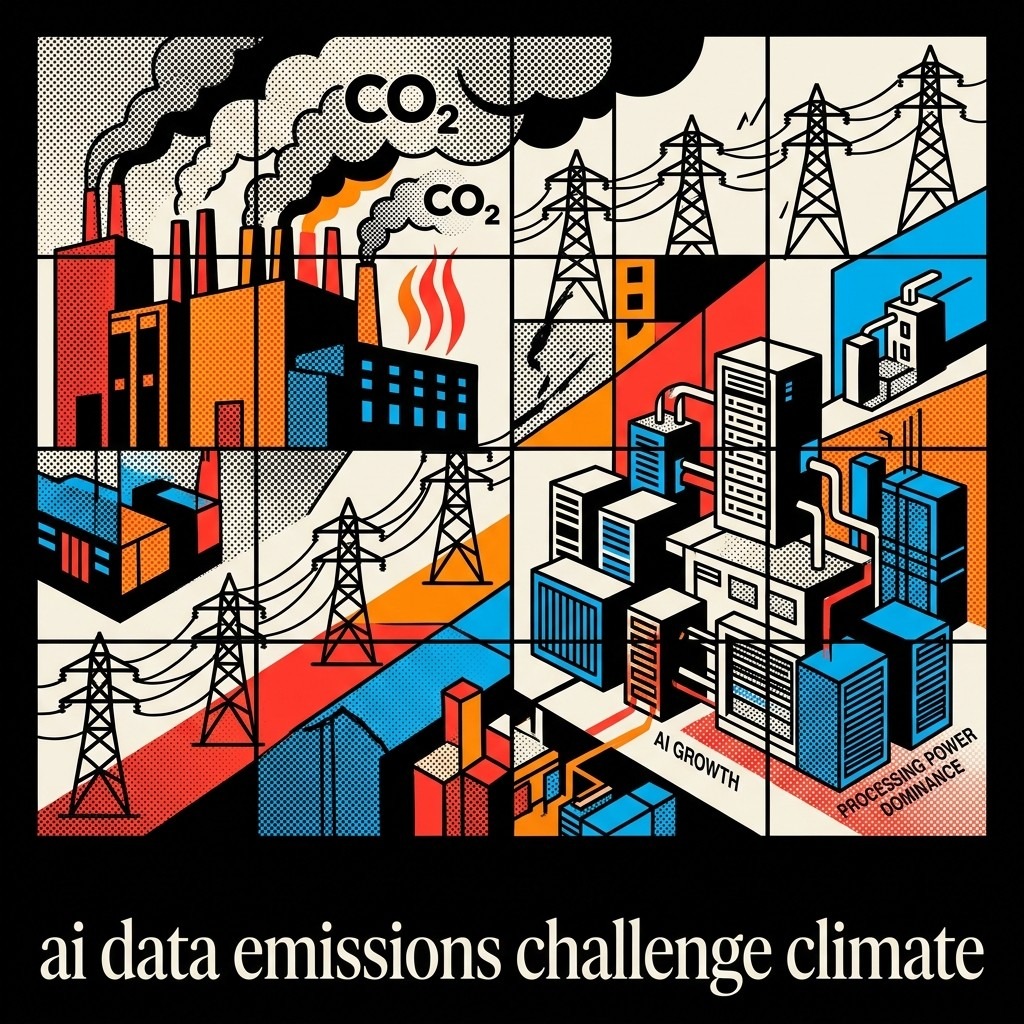
AI Growth Drives 286M Tonnes CO2 Emissions in Data Centers

Evening Analysis • Tuesday, June 30, 2026

The Gist View

Global data centers emitted 286 million tonnes of carbon dioxide in 2025, driven heavily by the rapid scaling of artificial intelligence infrastructure. This calculation by Allianz Trade, a multinational trade credit insurer, highlights a collision with the physical limits of global energy grids. Governments face a fundamental tradeoff between maximizing technological supremacy and meeting climate commitments.

Tech firms build these facilities because establishing an early monopoly on processing power secures outsized future revenues. Policymakers regulating AI purely as a software safety issue entirely miss the massive physical footprint required to sustain it. AI optimization could eventually improve grid efficiency and accelerate the discovery of renewable energy deployment, but future gains cannot solve today’s electricity bottlenecks.

The digital economy cannot escape the physical world. As The Straits Times notes, this expansion mirrors the 1990s dot-com boom, where laying early internet infrastructure triggered massive electricity spikes long before hardware efficiency finally caught up.

The Gist AI Editor

The Global Overview

AI Expansion Collides with Grid Constraints

A study by Allianz Trade, a multinational insurance company, estimates global data centers emitted 286 million tonnes of carbon dioxide in 2025, driven heavily by artificial intelligence infrastructure scaling (The Straits Times). Policymakers regulating AI purely as software miss the massive physical grid baseload required, forcing a tradeoff between technological supremacy and climate commitments. However, AI optimization could eventually improve grid efficiency and accelerate renewable deployment to offset this initial footprint.

US Monetary Policy Forces Institutional Interventions

The Japanese yen descended to a four-decade low against the US dollar ahead of Federal Reserve Chair Kevin Warsh’s remarks at Sintra, the European Central Bank’s annual policy forum (Bloomberg). Sustained high US interest rates systematically devalue foreign currencies and strain sovereign debt. This forces international institutions to artificially expand liquidity to prevent emerging-market defaults triggered by external shocks like the Iran Hormuz crisis, prompting a Democratic push for a $650 billion International Monetary Fund capacity expansion (Bloomberg).

Prediction Markets Mainstream Retail Capital

Kalshi, a US-based exchange where retail investors trade contracts on future event outcomes, secured World Cup knockout round advertising alongside Coca-Cola and Visa (Bloomberg). FIFA already partners with ADI Predictstreet, an entity tied to the Abu Dhabi royal family. This direct integration demonstrates how speculative trading platforms leverage global sports monopolies to secure mainstream retail capital.

Stay tuned for the next Gist—your edge in a shifting world. The Gist remains independent and reader-supported. If you value news free from corporate or state interests, consider supporting our mission with a donation.

The European Perspective

EU Foreign Policy Chief Kallas Meets Erdoğan

By sending EU High Representative Kaja Kallas to meet Turkish President Recep Tayyip Erdoğan ahead of the July 7-8 NATO summit in Ankara, the European Union prioritizes transactional security over democratic oversight. Accompanied by Enlargement Commissioner Marta Kos and Migration Commissioner Magnus Brunner (Politico), Kallas signals a strict package deal: economic access in exchange for border control and NATO cooperation. Still, Erdoğan routinely leverages his NATO veto for domestic political wins, keeping Turkey an unpredictable partner.

Denmark Funds Ukrainian Defense Procurement

Denmark announced a military aid package for Ukraine worth 4.4 billion DKK, roughly 589 million Euros (ZDF). Notably, 1.3 billion DKK flows through the ‘Danish model’—a military aid framework where donor funds directly finance Ukraine’s domestic defense procurement rather than exporting foreign-manufactured equipment. This structural shift bypasses Western defense contractors, directly capitalizing Kyiv’s sovereign industrial base.

French Heatwave Exhausts Mortuary Infrastructure

Our warning that extreme temperatures would cripple physical systems is materializing in France, where a severe heatwave has exhausted refrigerated mortuary capacity. Paris undertaker Zouhaier Hertelli notes funeral homes are fielding panicked requests from police desperately seeking space. This systemic failure forces immediate capital reallocation for basic municipal climate adaptation.

Catch the next Gist for the continent’s moving pieces.

🎙️ Listen to this edition as a podcast Listen

The Gist is an independent daily digest: AI-curated, human-directed, unapologetically liberal (how it’s made). Hundreds of sources, only what matters. Subscribe free or listen to the podcast.


Comments

Leave a Reply

Your email address will not be published. Required fields are marked *

This site uses Akismet to reduce spam. Learn how your comment data is processed.