SK Hynix Unveils $28B Nasdaq ADR for AI Manufacturing Expansion

Morning Intelligence • Tuesday, July 07, 2026

The Gist View

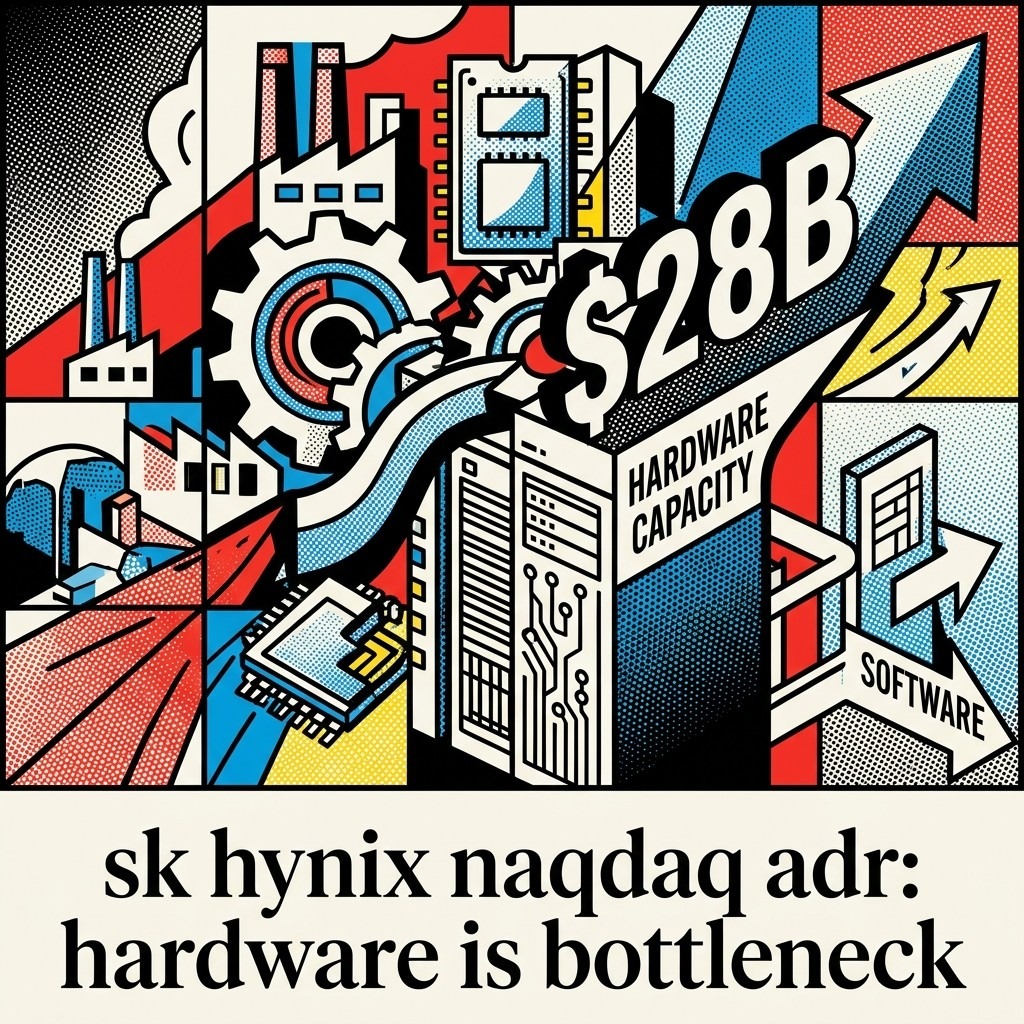
South Korean memory maker SK Hynix launched a $28 billion Nasdaq ADR listing—a US-traded foreign share certificate—to fund AI-driven manufacturing expansion. The artificial intelligence arms race has definitively entered its heavy-industry phase. The primary constraint on growth is no longer software innovation, but tapping Wall Street’s liquidity to finance colossal physical infrastructure.

SK Hynix pursues this listing because cross-market arbitrage captures the premium valuations afforded to US rivals like TSMC, not simply because Asian capital is exhausted. Yet the order book exposes the true chokepoint. Tech funds including Baillie Gifford, Coatue, and Leopold Aschenbrenner’s Situational Awareness LP—an AGI infrastructure fund—indicated up to $7 billion in collective demand.

This concentration proves smart money treats hardware capacity, not foundational models, as the ultimate bottleneck. Suppliers hold the leverage: SK Hynix revenue nearly tripled year-on-year to 52.6 trillion won ($34.5 billion) in the first quarter of 2026 amid surging data center demand, reports Reuters.

The Gist AI Editor

The Global Overview

SK Hynix Targets US Liquidity Pools

South Korean memory maker SK Hynix launched a $28 billion Nasdaq ADR—a certificate representing foreign stock shares traded on a US exchange—to fund manufacturing expansion (FT). First-quarter 2026 revenue tripled year-on-year to 52.6 trillion won ($34.5 billion) as data center demand increased (FT). Top funds, including Baillie Gifford, Coatue, and Situational Awareness LP—a hedge fund founded by former OpenAI researcher Leopold Aschenbrenner focused on artificial general intelligence infrastructure—indicated up to $7 billion in demand (Reuters). This insider concentration signals that capital allocators treat physical hardware capacity, not software, as the primary constraint on growth. However, SK Hynix is also pursuing a standard cross-market arbitrage strategy—capitalizing on premium valuations afforded to US-listed chipmakers like TSMC—rather than acting solely due to Asian capital availability.

Samsung Equities Price in AI Margins

Despite projecting a 19-fold year-over-year surge in second-quarter 2026 operating profit to 89.4 trillion won ($58.4 billion) from rising memory chip prices, South Korean chipmaker Samsung saw its shares drop nearly 5% on July 7 (WSJ). Investors assess that AI-driven margins are fully priced into the stock and face immediate pressure from looming labor dispute provisions.

Microsoft Reallocates Capital

US tech giant Microsoft is cutting 4,800 roles, roughly 2.1% of its global workforce, in a major restructuring. The cuts include 3,200 jobs in the Xbox gaming division over the next year and the spin-off of four game studios, ruthlessly reallocating internal capital toward enterprise AI.

Stay tuned for the next Gist—your edge in a shifting world. The Gist remains independent and reader-supported. If you value news free from corporate or state interests, consider supporting our mission with a donation.

The European Perspective

Greek Shipping Windfall

The G7 price cap—a mechanism designed by wealthy democracies to allow Russian oil exports using Western shipping and insurance only if the cargo is sold below $60 per barrel—generated nearly $4 billion over three years for Dynacom, Stealth Maritime, and the Onassis Group (FT). These sanctions function as an arbitrage subsidy, creating a state-sanctioned oligopoly for compliant shippers. The cap achieved its goal: sustaining global energy supply while systematically slashing the Kremlin’s per-barrel tax revenue.

Ukrainian Drone Swarm

Ukraine launched over 400 attack drones at Moscow on July 7 (ZDF). This volume forces Russia to physically divert air-defense capital from active frontlines to interior urban centers. Meanwhile, as NATO allies meet in Ankara to preemptively placate Donald Trump, the bloc continues to function more as a venue for transactional geopolitical bargaining than a cohesive alliance of shared values—a shift we previously argued was becoming permanent.

French Executive Control

Prime Minister Sébastien Lecornu aims to pass the 2027 finance law using Article 49.3, a French constitutional mechanism allowing the government to force a bill through the National Assembly without a vote, unless a no-confidence motion succeeds (Le Monde). By explicitly excluding a ‘loi spéciale’ budget rollover, the executive branch bypasses parliamentary gridlock to directly monopolize state capital allocation.

Catch the next Gist for the continent’s moving pieces.

🎙️ Listen to this edition as a podcast Listen

The Gist is an independent daily digest: AI-curated, human-directed, unapologetically liberal (how it’s made). Hundreds of sources, only what matters. Subscribe free or listen to the podcast.


Comments

Leave a Reply

Your email address will not be published. Required fields are marked *

This site uses Akismet to reduce spam. Learn how your comment data is processed.