SK Hynix’s $26.5B U.S. Debut Breaks Alibaba’s Record

Evening Analysis • Friday, July 10, 2026

The Gist View

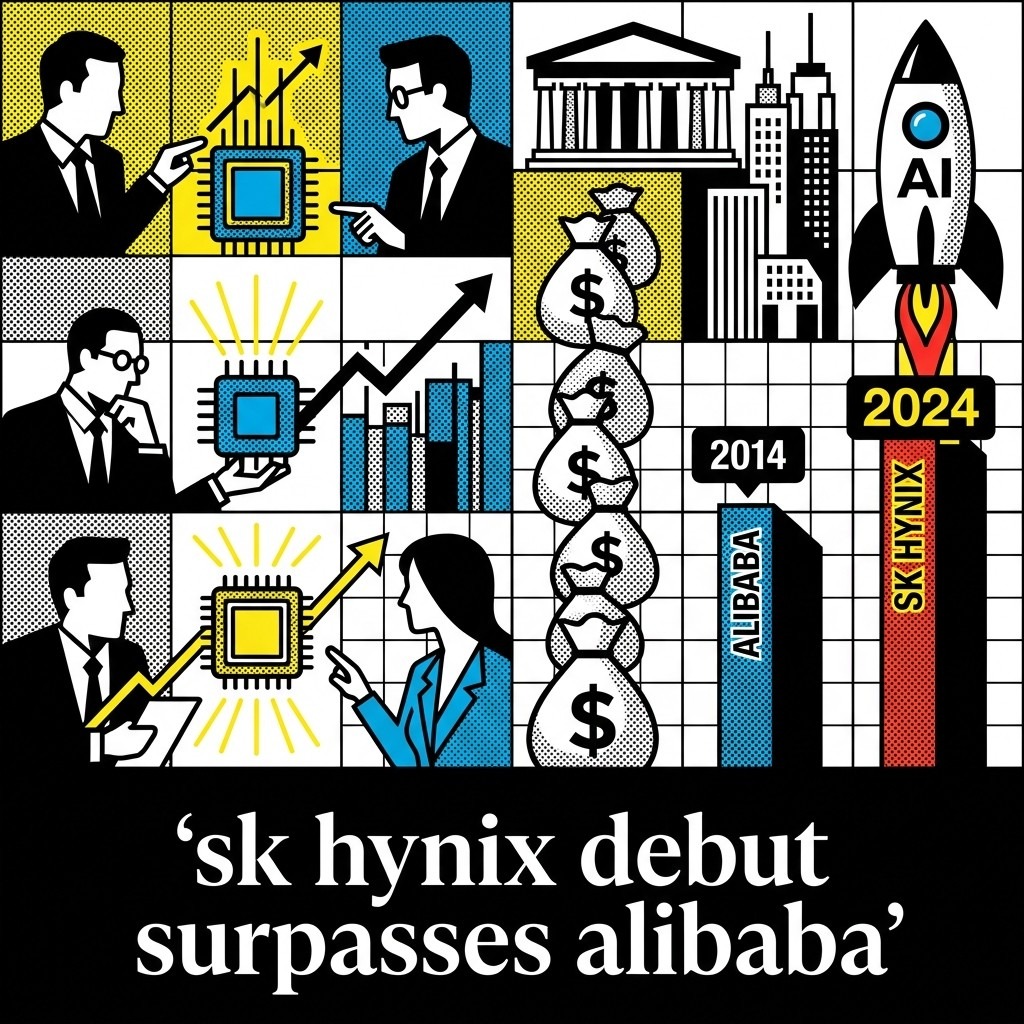
South Korean chipmaker SK Hynix raised $26.5 billion on July 10 by pricing its listing at $149 per American Depositary Share—a dollar-denominated equity share of a foreign company on a U.S. exchange. This record debut demonstrates that the massive capital requirements of the global artificial intelligence build-out can only be financed by Wall Street’s deep liquidity, sidelining regional exchanges as secondary players.

The offering was over seven times oversubscribed, trailing only SpaceX’s $75 billion stock sale last month. SK Hynix pursues New York capital because it gains the funding needed for its Yongin semiconductor cluster and Cheongju packaging plant without crushing its domestic exchange. Seoul still rewards foundational tech innovation—SK Hynix’s domestic shares have surged over 200% this year—but regional markets simply cannot absorb these multi-billion-dollar infrastructure demands.

Until this week, the absolute ceiling for a foreign entity tapping U.S. public markets was set by Alibaba’s $25 billion debut in 2014, according to Bloomberg.

The Gist AI Editor

The Global Overview

SK Hynix Nasdaq Debut

By raising $26.5 billion on July 10, SK Hynix proved only U.S. capital markets possess the liquidity to finance the AI expansion’s massive infrastructure demands (Bloomberg). Priced at $149 per American Depositary Share—a U.S. dollar-denominated equity share of a foreign-based company available for purchase on an American exchange—the seven-times oversubscribed listing trails only SpaceX’s $75 billion IPO (FT). By securing funds for South Korea’s Yongin and Cheongju facilities, the firm accesses global capital to expand without depleting its domestic exchange (Reuters). Still, SK Hynix’s Seoul-listed shares surged over 200% this year, proving regional markets can successfully support foundational technology before a global listing.

Chinese Orbital Logistics

On July 10, the China Aerospace Science and Technology Corporation (CASC)—the state-owned main contractor for China’s space program—successfully recovered the first stage of a Long March 10B orbital rocket during its maiden flight. The booster’s controlled vertical descent into a net-based capture system on a South China Sea maritime platform establishes direct sovereign capabilities in reusable space logistics.

Strategic Realignment

Anthropic appointing Ben Bernanke to its Long-Term Benefit Trust validates our observation that AI model builders are adopting quasi-constitutional governance structures to preempt state regulation. Geopolitically, President Trump formally declaring the U.S.-Iran diplomatic ceasefire over confirms our prior warning: recent U.S. sanctions reversals were merely a tactical pause rather than a durable de-escalation (Politico).

Stay tuned for the next Gist—your edge in a shifting global system. The Gist remains independent and reader-supported. If you value news free from corporate or state interests, consider supporting our mission with a donation.

The European Perspective

European Commission targets Meta’s user experience design

The European Commission preliminarily ruled the ‘addictive design’ of Meta’s Facebook and Instagram breaches the Digital Services Act (DSA)—a sweeping European Union regulation governing platform accountability (Politico). Regulators targeted interface features like infinite scroll and auto-play, claiming they shift users’ brains into ‘autopilot mode’ (European Commission). Meta faces fines up to 6% of global annual revenue if it fails to modify the targeted user experience features (Bloomberg). By leveraging the DSA against these mechanics, the EU transforms subjective psychological theories into binding compliance, functionally transferring software product decisions to Brussels. The DSA was sold as a safeguard against illegal content, but now claims jurisdiction over user engagement itself. By defining ‘autopilot mode’ as a systemic risk, regulators can retroactively deem any highly successful UX illegal. However, Meta deliberately engineered these core features to exploit psychological vulnerabilities and maximize screen time for ad revenue, imposing unpriced mental health externalities on European citizens.

UK Treasury designates U.S. cloud giants as critical third parties

The UK Treasury formally designated U.S. tech companies Microsoft, Google, Amazon, and Oracle as ‘critical third parties.’ This subjects their cloud infrastructure to direct financial regulatory scrutiny to improve systemic resilience. Both regulatory moves rely on reclassifying standard tech operations—software user experience and cloud hosting—as systemic vulnerabilities, allowing the state to assert direct oversight over foreign tech monopolies.

Expect the next Gist for further structural shifts.

🎙️ Listen to this edition as a podcast Listen

The Gist is an independent daily digest: AI-curated, human-directed, unapologetically liberal (how it’s made). Hundreds of sources, only what matters. Subscribe free or listen to the podcast.


Comments

Leave a Reply

Your email address will not be published. Required fields are marked *

This site uses Akismet to reduce spam. Learn how your comment data is processed.