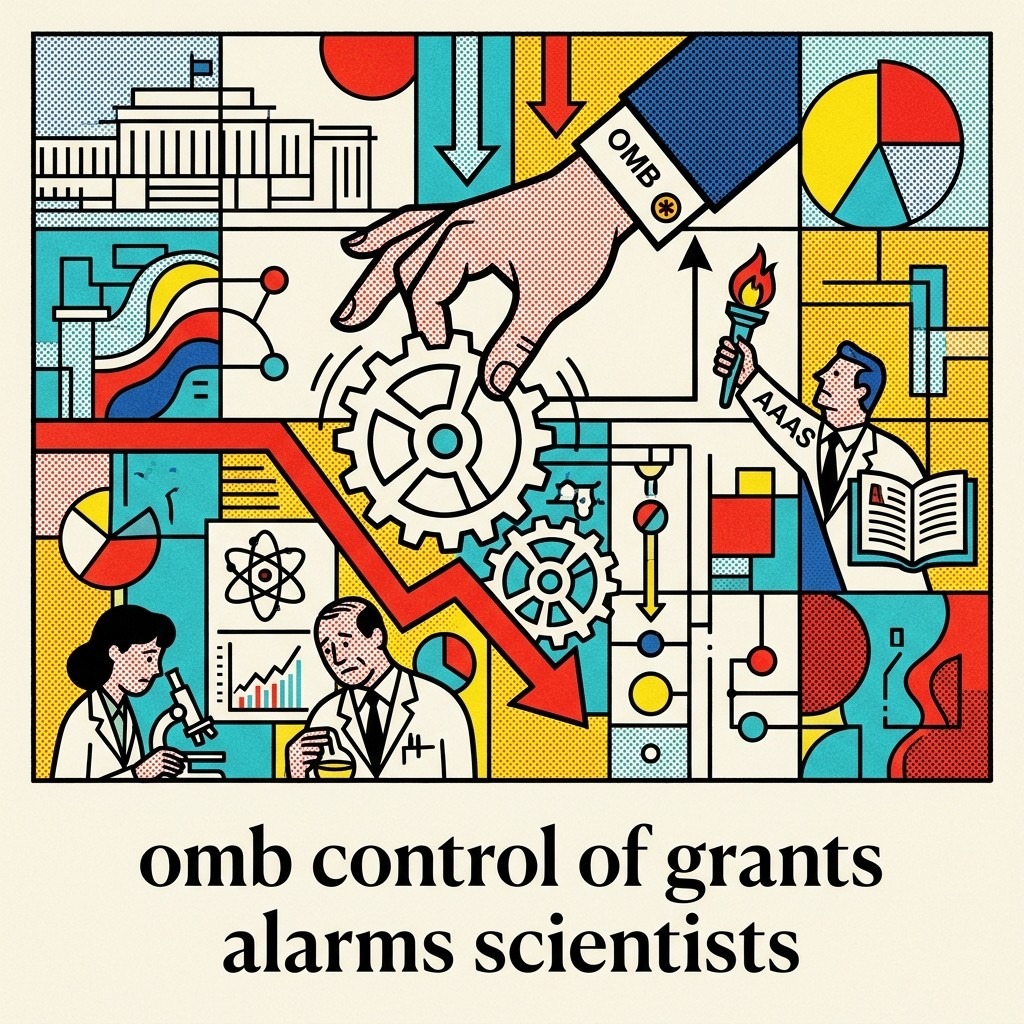
OMB Proposes Grant Oversight Shift, AAAS Criticizes Move

Evening Analysis • Sunday, July 12, 2026

The Gist View

The Office of Management and Budget (OMB), the largest office within the US President’s Executive Office, proposed rewriting 2 CFR Part 200—the rules governing federal grants—to shift oversight of $1.1 trillion from independent peer-review to political appointees. This marks a profound institutional pivot. The White House now views decentralized science funding as a political vulnerability demanding direct executive control.

Consolidating oversight increases democratic accountability over taxpayer funds, curbing academic administrative sprawl. Yet the rewrite weaponizes research. Administrations gain immediate leverage by steering capital toward favored projects, while scientists lose the independence required for high-risk discovery. The American Association for the Advancement of Science (AAAS), a prominent US non-profit, condemned the move as a power grab by the OMB director.

The public comment period closes on July 13, 2026. Subordinating inquiry to executive patronage carries steep costs; as Marginal Revolution noted, centrally directed science historically fails to match the technological breakthroughs generated by decentralized competition.

The Gist AI Editor

The Global Overview

OMB Centralizes Federal Science Funding

The Office of Management and Budget (OMB), the largest office within the Executive Office of the US President, proposed rewriting 2 CFR Part 200, the regulatory framework for federal financial assistance and research grants (Marginal Revolution). Transferring oversight of $1.1 trillion from independent peer-review to political appointees by July 13, 2026, the move was condemned by the American Association for the Advancement of Science (AAAS), a prominent American non-profit scientific organization. This turns funding into a zero-sum political tool, discouraging high-risk innovation by favoring administration priorities. Conversely, consolidating oversight increases democratic accountability over taxpayer funds, curbing academic administrative sprawl. Like Zelenskyy’s Ukrainian cabinet reshuffle, this treats direct executive control as a superior substitute for decentralized expertise, viewing institutional independence as an obstacle.

Geopolitical and Capital Realignments

South Carolina Republican Senator Lindsey Graham died Saturday, July 11, 2026, at age 71, removing an advocate for US military alliances and Russian sanctions (WSJ). President Trump’s weekend threats to ‘decimate’ Iran escalated the protracted standoff in the Strait of Hormuz, confirming our view that recent sanctions reversals were a tactical pause, not de-escalation (Bloomberg). Hedge-fund manager Brad Gerstner is launching politically-themed youth investment accounts, hyping Trump-aligned assets to route retail capital into partisan financial vehicles (WSJ).

Stay tuned for the next Gist—your edge in a shifting world. The Gist remains independent and reader-supported. If you value news free from corporate or state interests, consider supporting our mission with a donation.

The European Perspective

Ukrainian Prime Minister Resigns
President Volodymyr Zelenskyy ousted Prime Minister Yulia Svyrydenko on July 12, 2026, ending her tenure since July 2025 and shifting the Cabinet into caretaker status (Politico Europe, PBS, UNITED24 Media, TVP World). Zelenskyy cited an ‘updated political strategy’. This structural churn prevents bureaucratic rigidity and ensures strict alignment with current battlefield realities. However, frequent overhauls create chronic administrative delays for Western aid coordination, eliminating the institutional memory required for technocratic post-war reconstruction planning. Serhii Koretskyi, CEO of Naftogaz—Ukraine’s state-owned oil and gas monopoly—is the reported frontrunner for the post.

Oberhausen Fiscal Strain
Germany’s Oberhausen replaced a former steel site employing 32,000 workers with a retail mall housing 250 stores and restaurants (Deutsche Welle). Despite generating service-sector jobs, low average wages and declining tax revenues are now collapsing municipal finances, proving retail consumption cannot replace heavy industrial capital generation to sustain public services.

Mariano Rajoy Criticizes French Team
Former Spanish Prime Minister Mariano Rajoy claimed the French national football team possesses ‘no French players’ (Politico Europe). Ahead of the July 14, 2026 World Cup match, Spanish and French executives swiftly condemned the remarks, isolating legacy cultural provocations to protect bilateral diplomatic relations.

UK Regulators Target Vehicle Widths
European cars expand one centimeter wider every year, leaving fewer than half of new UK cars able to fit standard parking spaces (The Guardian). This physical infrastructure mismatch spurs demands to cap passenger vehicle widths below the existing 2.55-meter limit for Heavy Goods Vehicles, stopping automakers from passing increased spatial costs onto municipalities.

Catch the next Gist for the continent’s structural developments.

🎙️ Listen to this edition as a podcast Listen

The Gist is an independent daily digest: AI-curated, human-directed, unapologetically liberal (how it’s made). Hundreds of sources, only what matters. Subscribe free or listen to the podcast.


Comments

Leave a Reply

Your email address will not be published. Required fields are marked *

This site uses Akismet to reduce spam. Learn how your comment data is processed.