DeepSeek Raises $7.4B, Hits $50B Valuation, No Voting Rights

Morning Intelligence • Tuesday, July 14, 2026

The Gist View

DeepSeek, a Chinese artificial intelligence startup, closed a $7.4 billion funding round that grants external investors zero voting rights over its direction. The deal pushes the company’s valuation past $50 billion and proves that frontier AI development has definitively decoupled from traditional venture oversight. Global capital markets are now transferring absolute power to a new class of unchecked tech incumbents.

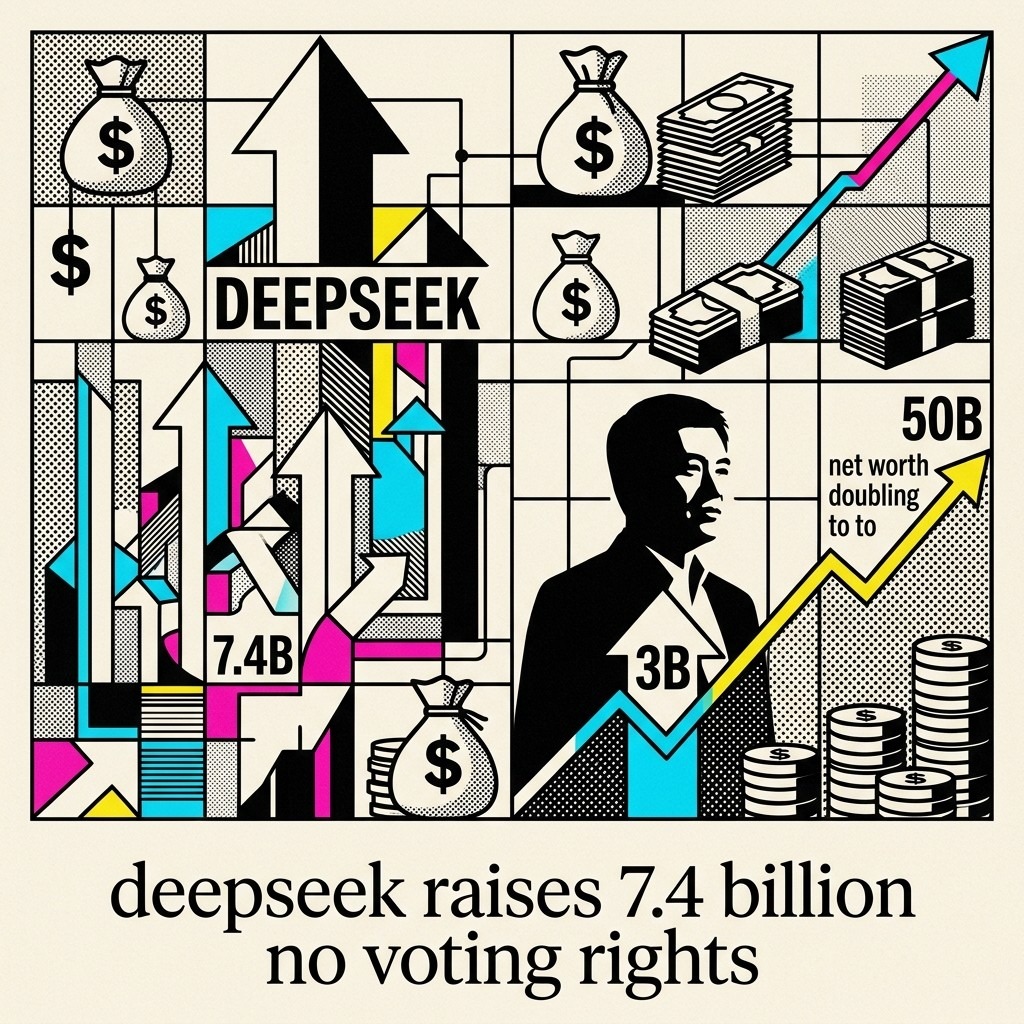
Founder Liang Wenfeng personally contributed approximately $3 billion to the round, drawn from High-Flyer, his quantitative hedge fund. By financing 40 percent of the raise himself, Liang insulates DeepSeek from the constraints venture capitalists typically impose on high-cash-burn labs. Investors accept the mandated five-year lock-up because exclusion from the artificial intelligence race costs more than surrendering corporate governance. This absolute founder control does carry a distinct benefit: it prevents the short-term commercial pressure that forces labs to abandon long-term scientific breakthroughs for immediate enterprise monetization.

The transaction doubled Liang’s net worth to roughly $16.7 billion, according to Bloomberg.

The Gist AI Editor

The Global Overview

DeepSeek Founder Leverage

DeepSeek closed a $7.4 billion funding round, passing a $50 billion valuation (Bloomberg, Crypto Briefing). Founder Liang Wenfeng injected $3 billion from his quantitative hedge fund, doubling his net worth to $16.7 billion. By personally funding 40 percent of the round, Liang insulated the startup from venture constraints, enforcing a five-year lock-up with zero voting rights for external investors. While this prevents the commercial pressure that forces labs to abandon long-term breakthroughs for immediate monetization, it proves frontier AI development has decoupled from traditional oversight, transferring absolute power to unchecked tech incumbents.

South Korean FX Liberalization

South Korea raised its 2026 growth forecast to 3.0 percent to accelerate AI mega projects (WSJ). To finance this capacity, the government will relax foreign-exchange rules for capital transactions in the second half of the year, eliminating institutional bottlenecks to deepen overseas use of the won.

China Semiconductor Exports

China’s exports surged 27 percent in June 2026, driving a $125.6 billion surplus fueled by AI semiconductor demand and US retailers front-loading inventory (WSJ). The protracted Strait of Hormuz standoff has escalated dramatically beyond shipping harassment, with the US imposing a 20 percent cargo toll and striking Iranian military sites for a third consecutive night (Bloomberg). This confirms our warning that previous sanctions reversals were merely tactical, forcing retailers to secure inventory immediately rather than optimize for shipping costs.

Stay tuned for the next Gist—your edge in a shifting world. The Gist remains independent and reader-supported. If you value news free from corporate or state interests, consider supporting our mission with a donation.

The European Perspective

EU Recovery Facility
The macroeconomic bump from the Recovery and Resilience Facility (RRF, the European Union’s post-pandemic structural investment fund) masks a structural reckoning. An assessment by the Centre for Economic Policy Research (CEPR, a European network of economists) shows immediate GDP gains in Italy, Spain, and Greece (CEPR). Substituting centralized debt for domestic productivity defers reform; front-loaded liquidity reduces pressure on southern capitals to deregulate labor markets. Yet, rising gross fixed capital formation suggests funds upgrade long-term potential output.

German Welfare Cuts
Karin Prien of the Christian Democratic Union (CDU, Germany’s main center-right conservative party) will cut the Unterhaltsvorschuss—a German state maintenance advance paid to single parents when the other parent fails to pay child support. Halting payments at 16 instead of 18 executes the Merz government’s aggressive social spending cuts (ZDF).

UK Retail Sentiment
June 2026 UK consumer spending rose 1.9% year-on-year via World Cup pub takings (The Guardian). Trailing 3% inflation, this reflects economic pessimism, not retail recovery.

Italian Nuclear Bill
Minister Adolfo Urso urged Parliament to advance a nuclear energy bill (Il Sole 24 Ore), pivoting Rome toward atomic power amid European supply pressures.

Catch the next Gist for the continent’s moving pieces.

🎙️ Listen to this edition as a podcast Listen

The Gist is an independent daily digest: AI-curated, human-directed, unapologetically liberal (how it’s made). Hundreds of sources, only what matters. Subscribe free or listen to the podcast.