New York Halts Hyperscale Data Center Permits, AI at Risk

Evening Analysis • Tuesday, July 14, 2026

The Gist View

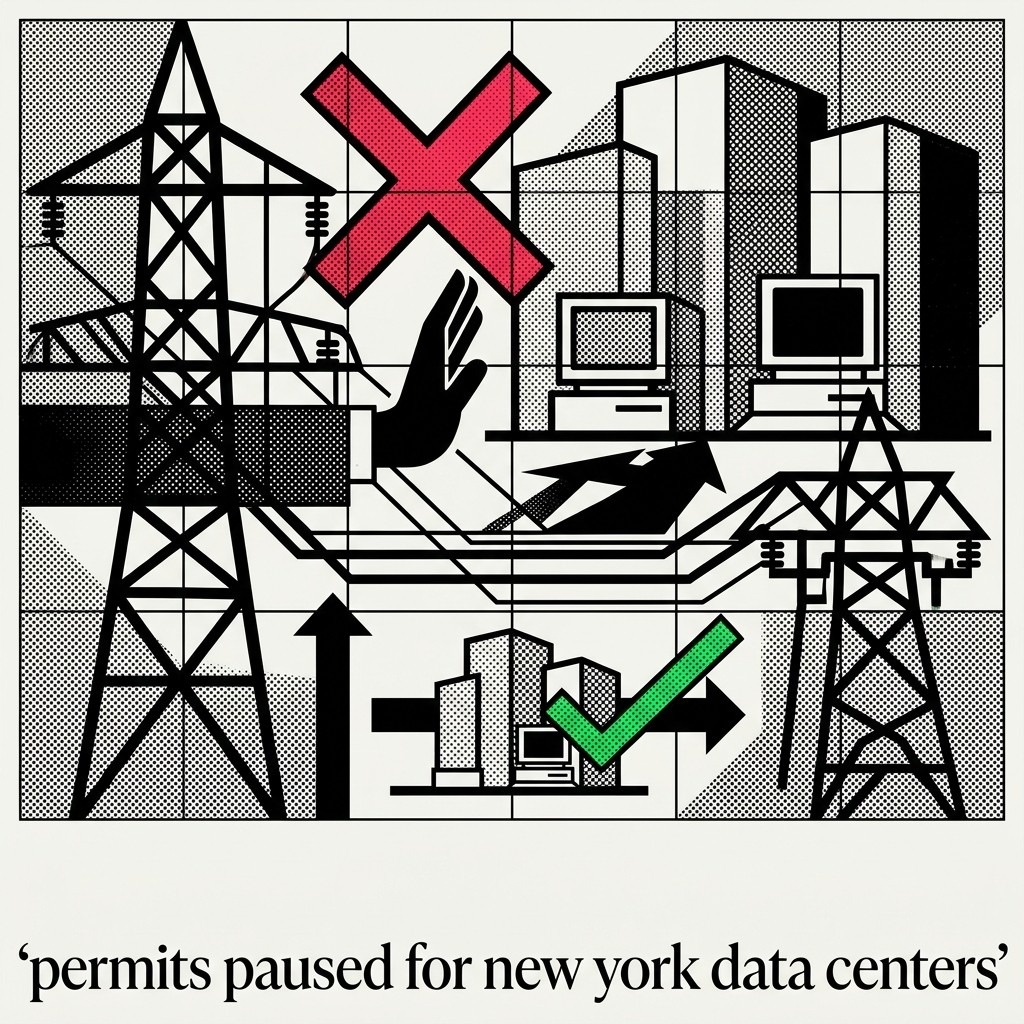
On Tuesday, New York Governor Kathy Hochul signed an executive order freezing environmental permits for new hyperscale data centers for up to one year, The Washington Post reports. The moratorium, the first in the US, targets facilities drawing over 50 megawatts. By halting AI infrastructure to protect immediate grid capacity, regulators prioritize short-term utility stability over the physical capital required to anchor technological growth.

State officials halt these projects because they lose political capital if grid stress spikes local energy prices. A 50-megawatt facility threatens to sharply increase costs for local ratepayers while providing minimal direct employment. Yet this ban penalizes highly efficient, large-scale compute operations, ignoring New York’s broader failure to approve new baseline power generation.

The freeze effectively offshores New York’s slice of the AI economy. Other jurisdictions calculate this trade-off differently: in April, Maine’s governor vetoed a similar data center moratorium to preserve incoming capital investment, according to Forbes.

The Gist AI Editor

The Global Overview

New York AI Data Centers

Governor Kathy Hochul paused environmental permits for one year for data centers exceeding 50 megawatts (The Washington Post; The Guardian). Enacting the first US statewide ban (Forbes), New York prioritizes immediate grid stability over foundational technological infrastructure. This offshores the state’s AI economy role and penalizes efficient compute facilities, ignoring local failures to build baseline power. However, these facilities do threaten to sharply increase ratepayer energy costs while providing minimal direct employment.

USMCA Trade Pact Non-Renewal

The Office of the United States Trade Representative (USTR) will not renew the United States-Mexico-Canada Agreement (USMCA)—the free trade pact replacing NAFTA—for a 16-year term (Chatham House). Forcing annual reviews until a potential 2036 expiration exposes cross-border capital to perpetual political friction. With Mexican export tariffs averaging 3.4 percent against China’s 22 percent (Chatham House), this structural uncertainty shifts institutional leverage to US policymakers.

Wall Street Trading Boom

JPMorgan, Goldman Sachs, Citigroup, and Bank of America posted record stock trading earnings driven by the AI sector frenzy and the SpaceX IPO (FT). Major financial incumbents continue to consolidate the immediate capital generated by frontier technology speculation.

Strait of Hormuz Tensions

President Trump abandoned a 20 percent fee on Strait of Hormuz cargo for Gulf trade deals (WSJ). This confirms the tariff was tactical leverage, though active US-Iran missile exchanges guarantee severe supply chain risks persist (FT).

Stay tuned for the next Gist—your edge in a shifting world. The Gist remains independent and reader-supported. If you value news free from corporate or state interests, consider supporting our mission with a donation.

The European Perspective

EU Trade Defenses

EU enforcer Denis Redonnet informed Members of the European Parliament (MEPs) Tuesday that dialogue with Beijing will not suffice to address trade imbalances (Euronews). The Commission plans unilateral measures against Chinese imports before an October deadline set by Commissioner Maroš Šefčovič. This explicit pivot bypasses the World Trade Organization framework, indicating Brussels is abandoning rules-based trade to shield domestic incumbents. Restricting supply effectively forces consumers to subsidize uncompetitive industries. Conversely, Chinese state subsidies artificially depress export prices, creating an unlevel playing field that threatens to permanently hollow out Europe’s strategic manufacturing base if left unchecked.

German Grid Resistance

Rapid data center construction in Germany’s Rhein-Main region faces mounting citizen resistance due to reliance on fossil-fuel power plants (ZDF). Rejecting these physical externalities limits local grid expansion, systematically prioritizing immediate utility stability over the physical capital required for technological growth.

House of Lords Reform

An inquiry into Britain’s upper chamber proposes firing absentee peers, timed to align with the impending premiership of Andy Burnham, the incoming UK Prime Minister (Politico Europe). This restructuring consolidates legislative power by purging dormant political actors to clear procedural bottlenecks.

Sciences Po Expansion

Sciences Po is exploring a Brussels campus to attract students pursuing European affairs (Politico Europe). This geographic maneuver embeds academic credentialing directly inside the EU regulatory hub to recapture human capital and tuition revenue.

Catch the next Gist for the continent’s moving pieces.

🎙️ Listen to this edition as a podcast Listen

The Gist is an independent daily digest: AI-curated, human-directed, unapologetically liberal (how it’s made). Hundreds of sources, only what matters. Subscribe free or listen to the podcast.


Comments

Leave a Reply

Your email address will not be published. Required fields are marked *

This site uses Akismet to reduce spam. Learn how your comment data is processed.