China’s GDP Grows 4.3% in Q2 2026, Weakest Since 2022

Morning Intelligence • Wednesday, July 15, 2026

The Gist View

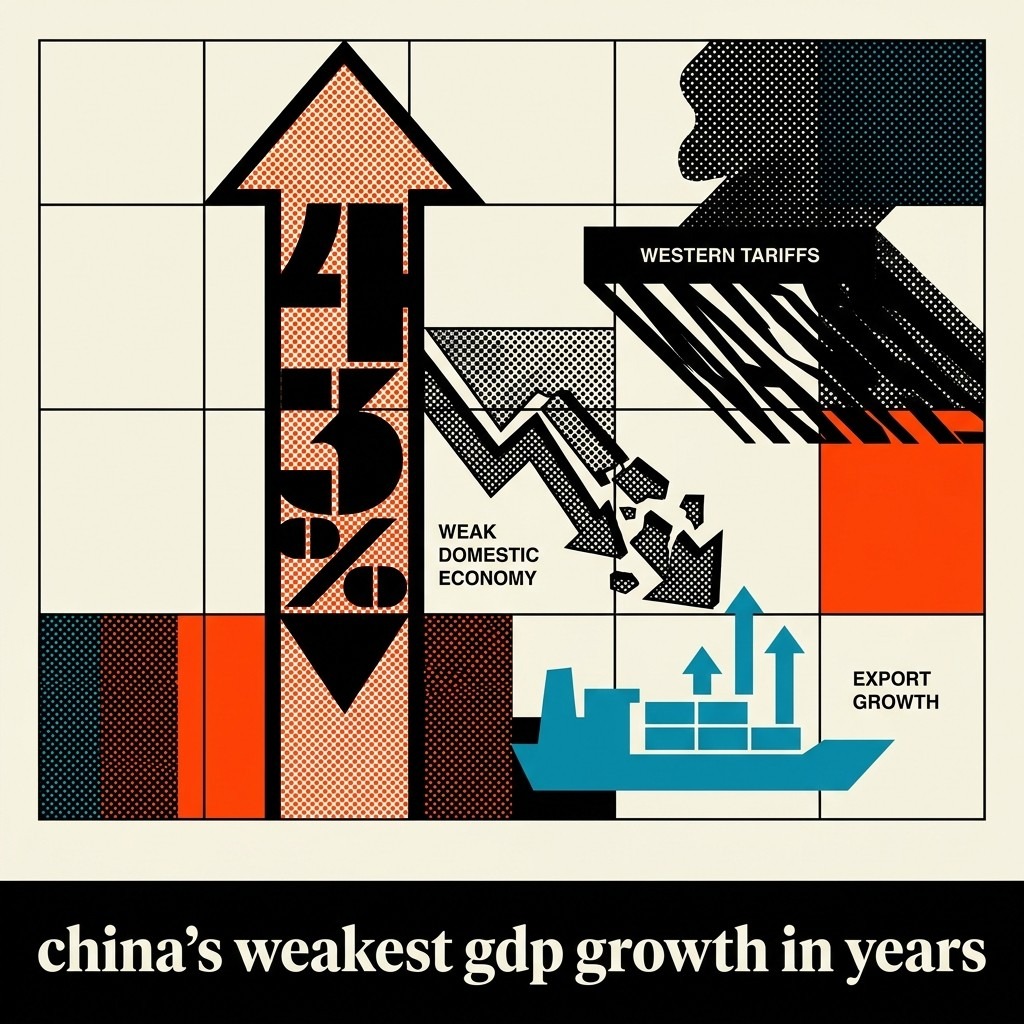
China’s Gross Domestic Product — the total monetary value of goods and services produced within a country — expanded 4.3% in the second quarter of 2026, its weakest pace since 2022. The Wall Street Journal notes this weak growth figure was driven by a dismal domestic economy that offset a surge in exports. Beijing’s pivot toward state-subsidized exports to compensate for a collapsing consumer market guarantees a fierce protectionist backlash.

By prioritizing industrial overcapacity over domestic market liberalization, China actively invites the Western tariffs that will ultimately choke its growth. Beijing relies on export-driven manufacturing because it leverages the country’s comparative advantage, avoiding the inflationary debt-traps of Western-style consumer stimulus. Yet this model hits a hard limit: the government can mandate factory output, but it cannot mandate consumer demand, and foreign democracies will not indefinitely absorb the resulting surplus.

Japan’s own export-led manufacturing boom ended when the 1985 Plaza Accord forced an involuntary currency appreciation, proving that surplus economies remain strictly captive to the tolerance of their buyers.

The Gist AI Editor

The Global Overview

China’s Export Strategy Faces Structural Limits

China’s Gross Domestic Product—the total monetary value of goods and services produced within a country—expanded 4.3% in the second quarter of 2026, its weakest pace since 2022 (WSJ). The weak growth figure was driven by a dismal domestic economy that offset a surge in exports. Export-driven manufacturing leverages China’s strongest comparative advantage and avoids the inflationary debt-traps of Western-style consumer stimulus. However, this slowdown exposes a structural limit: you cannot mandate consumer demand, and foreign markets will not indefinitely purchase the resulting industrial overcapacity. Beijing’s structural pivot toward state-subsidized exports to compensate for a collapsing domestic consumer market guarantees the coordinated Western protectionism that will ultimately choke its long-term growth.

European Health Tech Secures US Capital

Neko Health, a body-scanning preventative healthcare startup founded by Spotify’s Daniel Ek, raised $700mn for its US expansion, quadrupling its valuation to almost $7bn (FT). This capital flow demonstrates how European tech founders bypass local funding constraints, relying instead on the scale of US financial markets to fund hardware innovation.

US Consolidates Aerospace Alliances

The Republic of Serbia will sign the Artemis Accords—a US-led international agreement outlining best practices for space exploration and cooperation—on July 16, 2026, at NASA Headquarters. NASA Deputy Administrator Matt Anderson and Serbia’s Minister of Foreign Affairs Marko Đurić will host the signing ceremony. Conversely, renewed US-Iran missile exchanges confirm that tactical interventions remain insufficient to secure shipping lanes, cementing elevated maritime trade costs (Politico).

Stay tuned for the next Gist—your edge in a shifting world. The Gist remains independent and reader-supported. If you value news free from corporate or state interests, consider supporting our mission with a donation.

The European Perspective

Centre for Economic Policy Research Drug Procurement

The Centre for Economic Policy Research (CEPR, a network of European economists) proposes replacing 27 national pharmaceutical negotiations with a single EU buyer setting one Single Market wholesale price (CEPR). Consolidating procurement into a monopsony exchanges national pricing disparities for union-wide bureaucratic delays. While the current system allows pharmaceutical companies to exploit cross-country pricing externalities, decoupling innovator revenue from national payments shifts the regulatory friction from corporate negotiations to internal EU side-transfers, turning medical access into an intra-union dispute over capital distribution.

Ukrainian Strikes on Russian Logistics

Ukraine is degrading Russia’s fuel supply chains. Drone forces hit 116 Russian vessels in the Sea of Azov over nine days to restrict Moscow’s shadow fleet (The Guardian). Concurrently, military strikes on the Gazprom Neftekhim Salavat and Afipsky oil refineries in Bashkortostan and Krasnodar ignited fires, forcing Russian transport officials to consider diverting cargo operations.

Rhineland-Palatinate Flood Accountability

Following the 2021 Ahrtal flood catastrophe, which caused 185 deaths and 33 billion euros in damages, Minister-President Gordon Schnieder formally apologized for the government’s failure to protect citizens (ZDF). This delayed accountability highlights ongoing institutional gaps, as regional municipalities struggle to secure the capital required to rebuild physical infrastructure.

Catch the next Gist for further structural shifts across the continent.

🎙️ Listen to this edition as a podcast Listen

The Gist is an independent daily digest: AI-curated, human-directed, unapologetically liberal (how it’s made). Hundreds of sources, only what matters. Subscribe free or listen to the podcast.


Comments

Leave a Reply

Your email address will not be published. Required fields are marked *

This site uses Akismet to reduce spam. Learn how your comment data is processed.