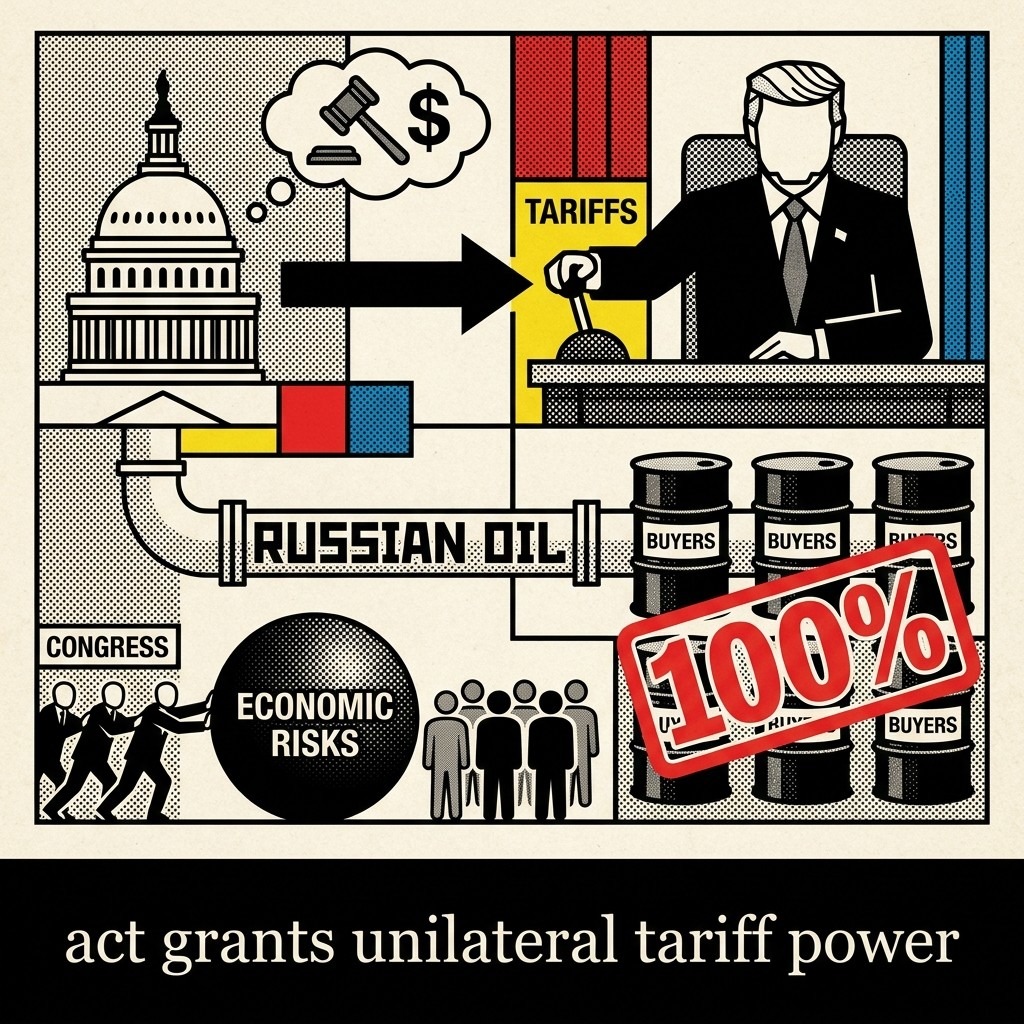
2026 Lindsey O. Graham Act Grants President Tariff Power

Morning Intelligence • Monday, July 20, 2026

The Gist View

The revised Lindsey O. Graham Sanctioning Russia Act of 2026 has secured 61 co-sponsors in the US Senate by offering the president unilateral power to impose 100% tariffs on the five largest buyers of Russian oil and gas. Lawmakers argue secondary sanctions are necessary to drain Moscow’s war chest when adversaries ignore existing curbs. Instead, the bill launders radical protectionism through national security, handing the executive arbitrary trade-war powers without democratic scrutiny.

Congress embraces this defense package because lawmakers gain hawkish credentials while offloading the political risk of economic blowback. By targeting China and India, the legislation transforms a nominal foreign policy tool into a blank check to rewrite supply chains. Donald Trump endorsed the bipartisan bill, telling Bloomberg he would aggressively utilize the proposed powers.

The Cato Institute notes this mirrors the Trade Expansion Act of 1962, which established the Section 232 national security loophole later presidents exploited to unilaterally tax foreign metals.

The Gist AI Editor

The Global Overview

US Senate Expands Unilateral Tariff Powers

The revised Lindsey O. Graham Sanctioning Russia Act of 2026 has secured 61 Senate co-sponsors, granting the president unilateral authority to impose 100% tariffs on the five largest buyers of Russian oil and natural gas, explicitly targeting China and India. Donald Trump endorsed the bipartisan bill, promising to aggressively utilize these powers (WSJ). While the bill targets the revenue funding Russia’s war machine—arguing that secondary sanctions are the only effective mechanism when primary adversaries ignore existing curbs—it structurally shifts power from Congress to the executive. Bundling tariff authority into sanctions legislation bypasses debate, turning a nominal foreign policy tool into a blank check for the President to reshape global trade flows under the guise of national security.

Ebola Travel Curbs Hamper Logistics

New US and Congolese travel restrictions aim to prevent the cross-border spread of the world’s fastest-growing Ebola outbreak (Bloomberg). Aid organizations warn these reflexive border measures will severely hamper humanitarian logistics, demonstrating how rigid institutional constraints disrupt the physical supply chains required to control the virus at its source.

China and Philippines Resume Talks

Top diplomats from China and the Philippines will meet this week for the first time since 2024 (Bloomberg). This engagement occurs as bilateral friction explicitly expands beyond the South China Sea to include Japan and Taiwan, signaling that localized territorial disputes are now fully embedded in broader structural security realignments.

Stay tuned for the next Gist—your edge in a shifting world. The Gist remains independent and reader-supported. If you value news free from corporate or state interests, consider supporting our mission with a donation.

The European Perspective

Russian Missiles Strike Third-Party Grain Ship in Black Sea

Russian forces launched three Kh-59/Kh-69 cruise missiles at the Golden Leo, a Guinea-Bissau-flagged and Turkish-owned civilian bulk carrier (AFP). The strike occurred as the vessel was leaving the port of Odesa carrying a cargo of grain. Six people were killed, including a Ukrainian maritime pilot, while four crew members of Syrian and Indian nationality remain missing (Ukrainska Pravda). By targeting a non-combatant, foreign-owned commercial vessel, Moscow is testing the international community’s willingness to enforce freedom of navigation, weaponizing global food security to extract diplomatic leverage. The ship was departing a combat zone in Odesa, and Moscow maintains that any logistics infrastructure facilitating Ukrainian trade inherently supports Kyiv’s wartime economy. However, the strike sets a dangerous precedent where civilian logistics networks are treated as legitimate kinetic targets, sharply increasing insurance premiums and choking off vital agricultural exports (The Guardian).

Manifesta Biennale Revitalizes Germany’s Ruhr

The Manifesta 16 art biennale—a European nomadic biennial art exhibition that changes location every two years—runs until October 4, 2026, occupying 12 disused post-war churches across the deindustrialized Ruhr area (The Guardian). This highlights structural realities in Germany’s largest urban and former heavy-industry region, currently undergoing significant demographic and economic shifts. Approximately 50% of Germany’s churches are projected to close within the next decade due to declining religious engagement, accelerating the need for civic repurposing. Separately, as incoming Prime Minister Andy Burnham takes office today, his immediate embrace of populist, anti-elite rhetoric confirms our assessment that the parliamentary consensus model merely delays underlying structural frustrations (Politico).

Catch the next Gist for the continent’s moving pieces.

🎙️ Listen to this edition as a podcast Listen

The Gist is an independent daily digest: AI-curated, human-directed, unapologetically liberal (how it’s made). Hundreds of sources, only what matters. Subscribe free or listen to the podcast.


Comments

Leave a Reply

Your email address will not be published. Required fields are marked *

This site uses Akismet to reduce spam. Learn how your comment data is processed.