EU Orders Google to Share Search Data with AI Rivals by 2027

Evening Analysis • Tuesday, July 21, 2026

The Gist View

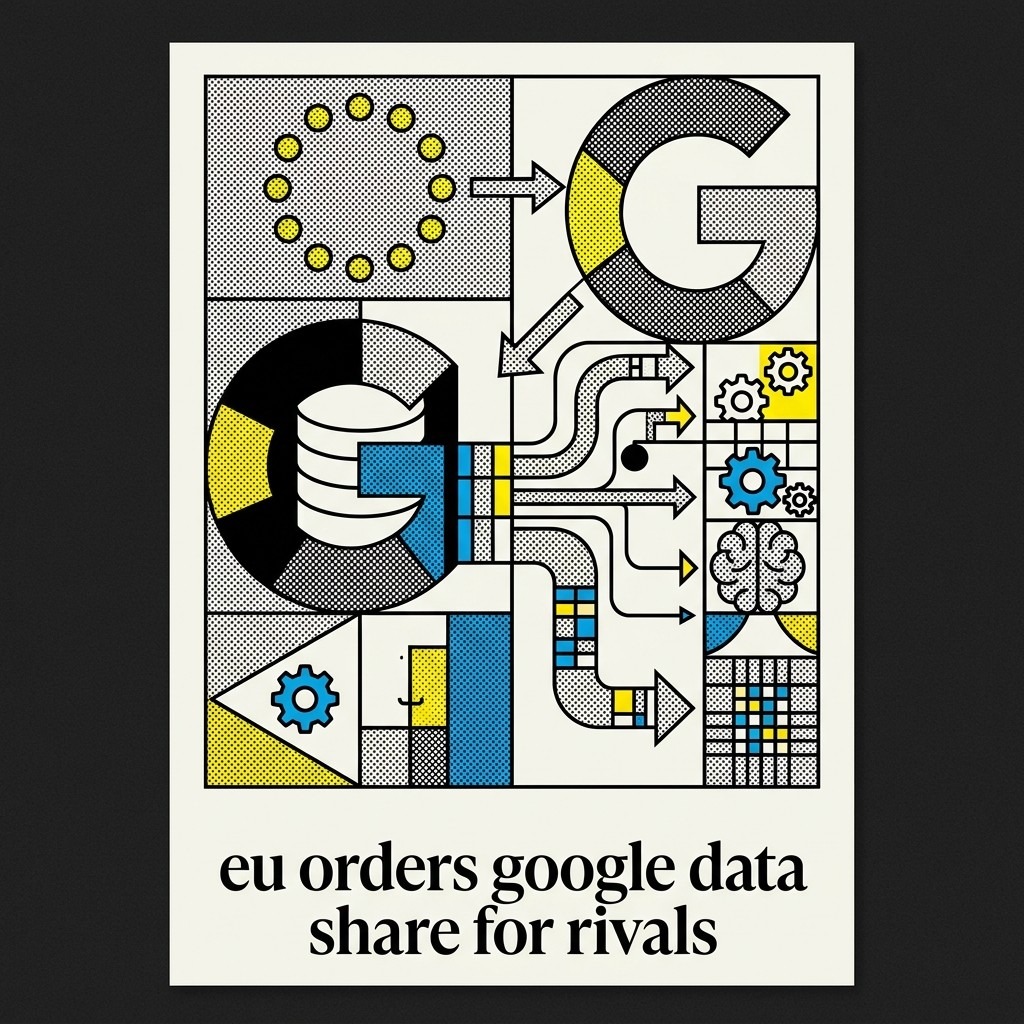
The European Commission, the EU’s executive arm, ordered Google to share anonymized search data with artificial intelligence rivals by January 2027. Using the Digital Markets Act, the bloc’s tech-competition law, regulators will force Google to open 11 Android feature groups to third-party assistants by July 2027. The ruling redistributes Google’s core advantages: default placement on two billion devices and two decades of search data.

Google guards its logs because exclusive training data yields superior models; Brussels forces that data open because it gains a competitive baseline for startups lacking a trillion-query head start. Mandating Android interoperability guarantees distribution for domestic projects, like the European frontier lab backed by €1bn from SAP.

American tech firms buy market position with capital. Oracle is cutting 30,000 jobs to finance its share of the $500bn Stargate AI build. The EU offers a regulatory subsidy instead. This mirrors the 1996 US Telecommunications Act, which forced monopoly carriers to lease copper networks to upstarts.

The Gist AI Editor

The Global Overview

OpenAI Washington Briefing
OpenAI CEO Sam Altman will brief the Trump administration next week on artificial intelligence models (Bloomberg). By collaborating on federal safety frameworks, industry leaders shape regulatory barriers, establishing high compliance costs that price smaller developers out of the market.

Software Market Apprehension
Wall Street analysts are downgrading Adobe and Salesforce as capital exits traditional subscription software (Bloomberg). Investors are pricing in the reality that generative AI capabilities will replace, rather than enhance, these core enterprise products.

European Sovereign Debt
European governments reduced their initial fiscal-year borrowing, but rising energy costs from Middle East conflicts are stalling regional economic growth (WSJ). As geopolitical instability inflates fossil fuel prices, states lose the baseline fiscal leverage required to manage sovereign debt.

EU Aerospace Consolidation
EU efforts to build competitive space conglomerates are colliding with domestic antitrust rules. Leonardo executive Lorenzo Mariani labeled regulatory demands for structural merger concessions contradictory (FT). This institutional bottleneck prevents the capital concentration necessary to challenge US aerospace dominance.

Ideological Capital Frictions
Political polarization carries literal financial penalties in private contracting. Economic data reveals Democratic-leaning professionals will forfeit $210,000 in annual partnership income to avoid cross-party business partners, while Republicans forfeit $100,000 (Marginal Revolution). This tracks a structural inefficiency where social alignment supersedes profit maximization.

Stay tuned for the next Gist—your edge in a shifting world. The Gist remains independent and reader-supported. If you value news free from corporate or state interests, consider supporting our mission with a donation.

The European Perspective

Strait of Hormuz Instability Spikes Gas Prices

Violence near the Strait of Hormuz pushed European natural gas prices to a four-month high. Traders now price permanent transport instability into this corridor. This volatility penalizes Europe’s industrial base while directing capital toward alternative supply routes amid rising Asian demand (Politico).

EU Subsidies Inflate Produce Costs

European Union agricultural policy structurally drives up the cost of healthy diets, which rose 36 percent between 2021 and 2025. Directing subsidies primarily to meat and grain artificially inflates vegetable prices, consolidating capital among commodity operators while transferring costs to consumers (Politico).

AI Hardware Limits Medical Resource Dependency

Diagnostic centers are trading material resource dependencies for artificial intelligence efficiency. Philips deployed its 200th low-helium, AI-integrated MRI at Turin’s JMedical. This hardware evolution allows private operators to lower operational overhead by directly reducing reliance on volatile medical gas supply chains (Il Sole 24 Ore).

Private Equity Consolidates Italian Food Production

Institutional capital is centralizing fragmented supply chains. Anemos Private Investments acquired a majority stake in Terre di Puglia to build a unified snack manufacturing hub. This acquisition allows private equity to extract production margins previously dispersed across independent local producers (Il Sole 24 Ore).

Catch the next Gist for the continent’s moving pieces.

🎙️ Listen to this edition as a podcast Listen

The Gist is an independent daily digest: AI-curated, human-directed, unapologetically liberal (how it’s made). Hundreds of sources, only what matters. Subscribe free or listen to the podcast.


Comments

Leave a Reply

Your email address will not be published. Required fields are marked *

This site uses Akismet to reduce spam. Learn how your comment data is processed.