East Asia Fertility Rates Plummet Amid Focus on Education

Morning Intelligence • Tuesday, July 28, 2026

The Gist View

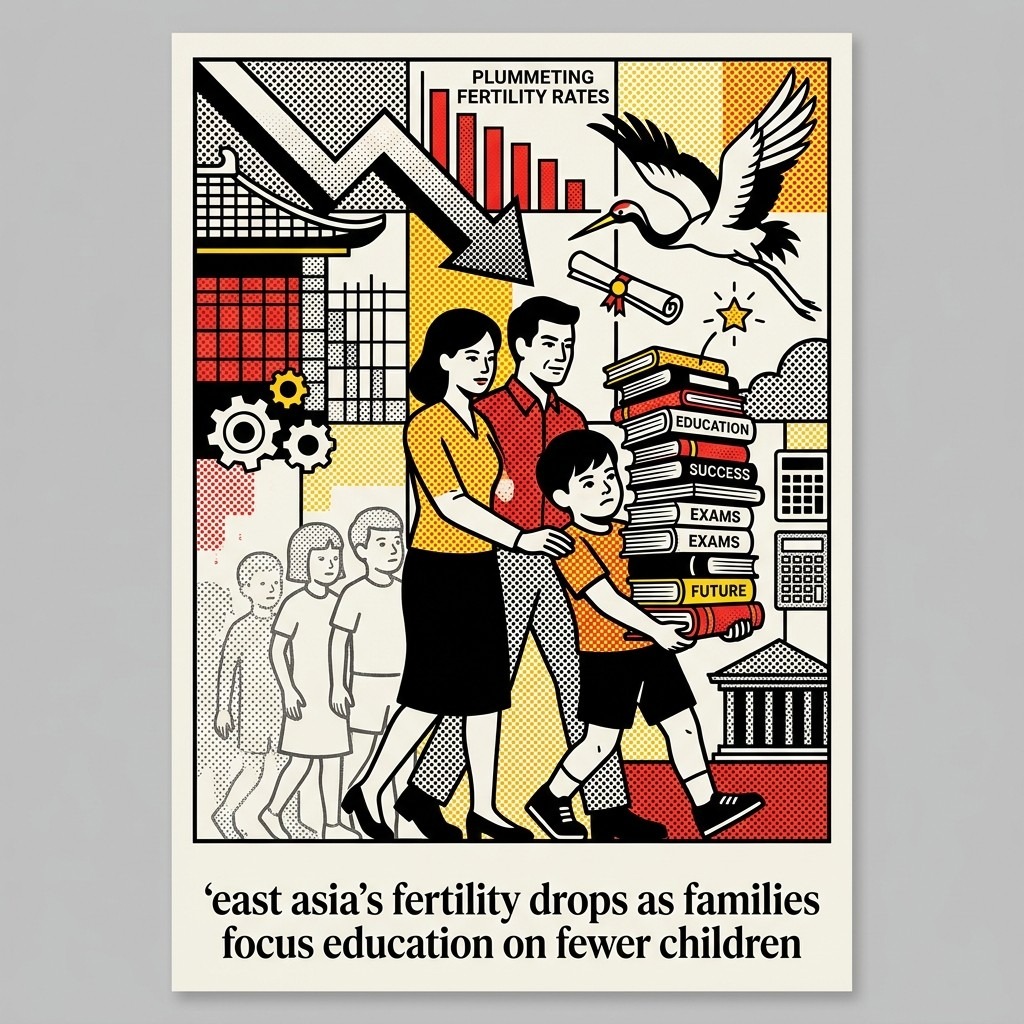
East Asia’s total fertility rates have collapsed to levels without historical precedent, defying massive state subsidies. The plunge is not a rejection of traditional values, but their exact consequence in a knowledge economy. When the drive for family status collides with hyper-credentialism, cultural incentives override government policy, turning children into immense capital sinks.

The historical examination system once rewarded families for having multiple sons to increase their odds of securing elite positions. Today, that structure is a single-ranking academic tournament. Parents maximize status by concentrating vast financial resources on one or two intensively educated children. While greater female workforce participation independently depresses birth rates globally, East Asian families suppress their aggregate fertility because spreading resources guarantees failure.

“The traditional emphasis on educational status—once a pro-natal force when success required having many sons to win imperial exams—now acts as a powerful anti-natal force,” notes the economics blog Marginal Revolution.

The Gist AI Editor

The Global Overview

East Asian Fertility and Hyper-Credentialism
Total fertility rates in East Asia have fallen to levels without historical precedent (Marginal Revolution). This stems directly from traditional values adapting to a modern knowledge economy. The historical examination system that rewarded having many sons has been replaced by a single-ranking educational tournament. This modern tournament rewards concentrating vast resources on one or two intensively educated children, turning them into immense capital sinks and structurally suppressing aggregate fertility. Cultural shifts toward individual autonomy and female workforce participation also play significant independent roles in driving birth rates down, but hyper-credentialism ensures even massive state subsidies cannot reverse this demographic decline.

Nvidia Backs Safe Superintelligence
Nvidia has agreed to a $5 billion investment in Safe Superintelligence, an AI startup led by OpenAI co-founder Ilya Sutskever (FT). The funding will allow the startup to increase its available computing power 10-fold over the next 12 months using Nvidia’s Vera Rubin chips. While we recently noted the market beginning to discipline Big Tech’s AI spending, Nvidia’s $5 billion investment in Safe Superintelligence shows that circular financing between chipmakers and their own clients remains a potent distortion.

Japan Finances Middle East Pipelines
Tokyo is expanding financial support to Japanese companies investing in overseas pipeline projects, particularly in the Middle East. The initiative is designed to strengthen alternative oil and gas transportation routes in the Gulf region to bypass the Strait of Hormuz, directly mitigating Japan’s structural dependencies and energy supply chain vulnerabilities against maritime disruption.

Join us in the next edition of The Gist for further analysis of the systems shaping our global order. The Gist remains independent and reader-supported. If you value news free from corporate or state interests, consider supporting our mission with a donation.

The European Perspective

France and Spain Wildfires Overwhelm Emergency Services

As 300,000 flee wildfires in France and Spain (Deutsche Welle), national emergency service failures expose a severe state capacity deficit. The bloc is deploying rescEU, the European Union’s reserve of civil protection capacities and disaster response equipment. However, centralized pooling merely aggregates local shortfalls; Brussels acknowledges that even adding dozens of planes remains insufficient (Politico). While historic climate extremes would overwhelm any rapid-response infrastructure, this physical volatility now structurally threatens the financial models of cultural events, which must absorb heavy hidden adaptation and insurance costs (Le Monde).

EU Shields Russian-Owned Alumina Plant

EU officials are withholding sanctions against Ireland’s Aughinish Alumina factory, owned by Russian metals giant Rusal. Despite accusations that the facility supplies Russian weapons manufacturing, officials warn targeting it would sever essential materials for EU aluminium smelters serving the defense and automotive sectors, proving supply chain dependencies override geopolitical policy.

Germany Proposes Preventive Detention

Following a fatal attack at Berlin’s CSD (Christopher Street Day, European LGBTQ+ pride celebrations), Minister Alexander Dobrindt of the CSU (the Christian Social Union, a conservative political party in Germany) is demanding preventive detention powers. Leveraging LKA (Landeskriminalamt, a German state criminal police office) footage showing the suspect at 20:58, just an hour before one died and 29 were injured, the state seeks expanded legal authority to compensate for its operational surveillance failures (ZDF).

Catch the next Gist for the continent’s moving pieces.

🎙️ Listen to this edition as a podcast Listen

The Gist is an independent daily digest: AI-curated, human-directed, unapologetically liberal (how it’s made). Hundreds of sources, only what matters. Subscribe free or listen to the podcast.


Comments

Leave a Reply

Your email address will not be published. Required fields are marked *

This site uses Akismet to reduce spam. Learn how your comment data is processed.