Kospi Drops 11.5% Amid Samsung, SK Hynix AI Spending Fears

Evening Analysis • Tuesday, July 28, 2026

The Gist View

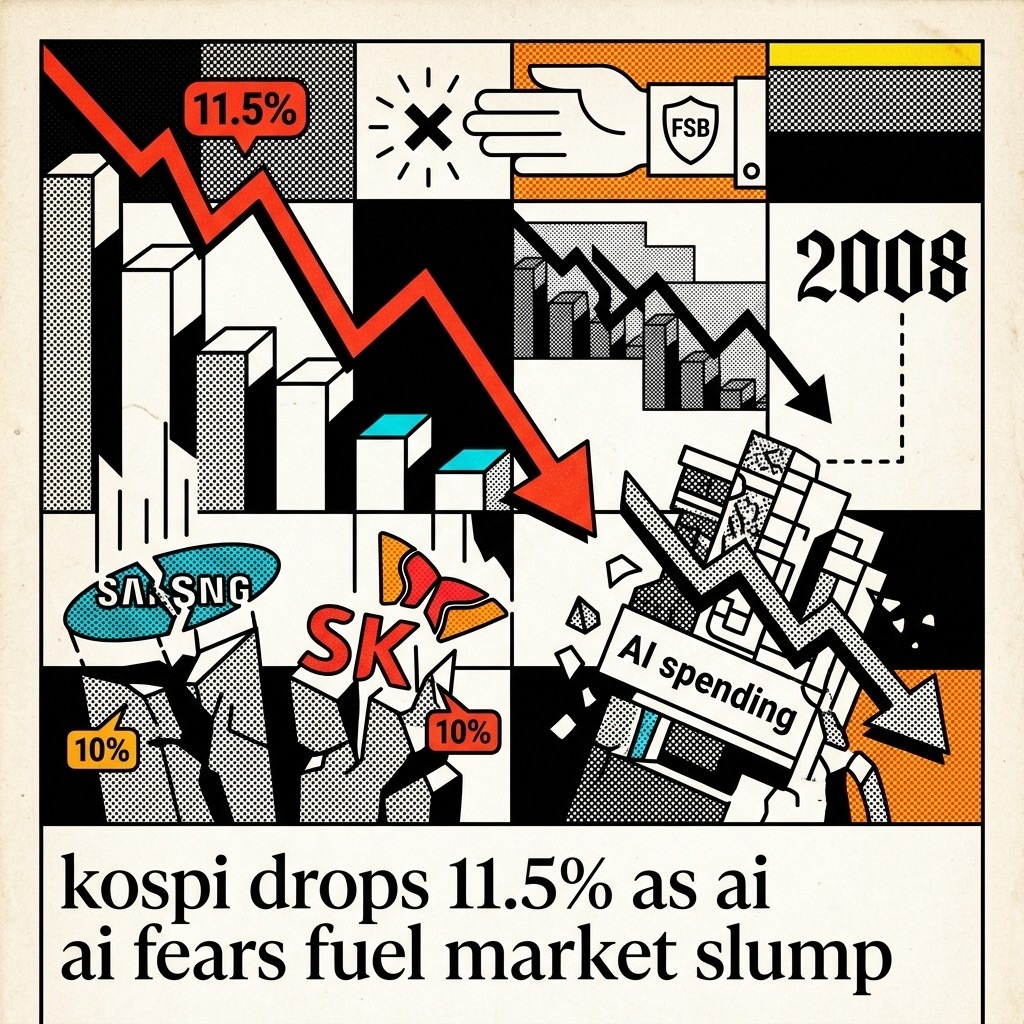
South Korea’s Kospi, the representative stock market index, fell 11.5% to its lowest point since mid-April as Samsung Electronics and SK Hynix—a major South Korean supplier of dynamic random-access memory chips—both dropped more than 10% amid AI spending fears. The Financial Stability Board (FSB), an international body monitoring the global financial system, warns this equity correction demands state intervention. That diagnosis misrepresents market realities.

Regulators expand their authority by treating routine sell-offs as contagion. AI infrastructure relies heavily on syndicated debt, meaning a tech valuation collapse could impair exposed lenders and trigger a genuine downstream liquidity crisis. But equity investors taking losses on overvalued semiconductor stocks safely absorbs risk. Public equities repricing transparently is a healthy mechanism, whereas the 2008 crash was driven by obscured, highly leveraged debt.

FSB Secretary-General John Schindler warns these AI asset overvaluations risk a global bubble akin to the 2008 crisis, Politico Europe reports.

The Gist AI Editor

The Global Overview

Financial Stability Board and Semiconductor Sell-Offs

The Financial Stability Board (FSB), monitoring the global financial system, warns through Secretary-General John Schindler that AI asset overvaluations risk a 2008-style bubble (Politico Europe). Equating tech sell-offs with credit contagion misrepresents price mechanisms; investors absorbing losses is healthy risk-absorption, unlike obscured 2008 debt. South Korea’s Kospi, the representative stock market index, fell 11.5% to a mid-April low, dragged by Samsung and SK Hynix—a major South Korean dynamic random-access memory chip supplier—dropping over 10% (The Guardian). This rout aligns with China mass-producing deep ultraviolet chip tools, confirming US export curbs force domestic substitution. Still, because AI infrastructure relies on syndicated debt, severe valuation collapses could impair lenders.

Global Freight Stockpiling and Earnings Frictions

CMA CGM, a French shipping logistics company, projects heightened ocean freight demand will persist as US importers stockpile to beat newly imposed Trump administration tariffs on 60 trading partners (FT). Separately, S&P Global Inc., an American financial analytics corporation, missed analysts’ average profit estimates, explicitly citing the US-Iran War for constraining B2B contract pricing power within its energy data unit (WSJ).

Join us for the next edition. The Gist remains independent and reader-supported. If you value news free from corporate or state interests, consider supporting our mission with a donation.

The European Perspective

French National Rally Modifies Retirement Plans

The National Rally, France’s primary nationalist, right-wing populist political party, will unveil a formalized retirement position in the coming months. Two officials confirm the faction is tweaking its proposed framework to navigate growing parliamentary influence (Politico). This demonstrates how proximity to power domesticates populism; sovereign bond markets serve as a veto on unworkable fiscal promises. Watering down the reform signals a pivot from maximizing working-class turnout to appeasing institutional investors. The party may simply be sequencing its legislative agenda, delaying the explosive pension issue until securing early victories on immigration and security.

GSK Relocates Research Center to Cambridge

GSK, a British multinational pharmaceutical company, is permanently shutting down its historic Stevenage facility. By shifting its primary research center to Cambridge, the drugmaker bets embedding itself in the university city will directly bolster pipelines of new medicines. Capital dictates prioritizing dense knowledge clusters to capture concentrated talent.

Scientists Deploy AI for Agricultural Management

Degraded soils cost the European economy over €50 billion annually (Euronews). European scientists are deploying AI-driven tools to transform how the continent monitors agricultural land. Seeking to restore soil health, this integration gives state agencies the exact metrics required to restructure land subsidies and redirect capital toward sustainable yields.

Catch the next Gist for the continent’s moving pieces.

🎙️ Listen to this edition as a podcast Listen

The Gist is an independent daily digest: AI-curated, human-directed, unapologetically liberal (how it’s made). Hundreds of sources, only what matters. Subscribe free or listen to the podcast.


Comments

Leave a Reply

Your email address will not be published. Required fields are marked *

This site uses Akismet to reduce spam. Learn how your comment data is processed.