Microsoft Cloud Revenue Soars 32% to $39.3B with AI Boost

Evening Analysis • Thursday, July 30, 2026

The Gist View

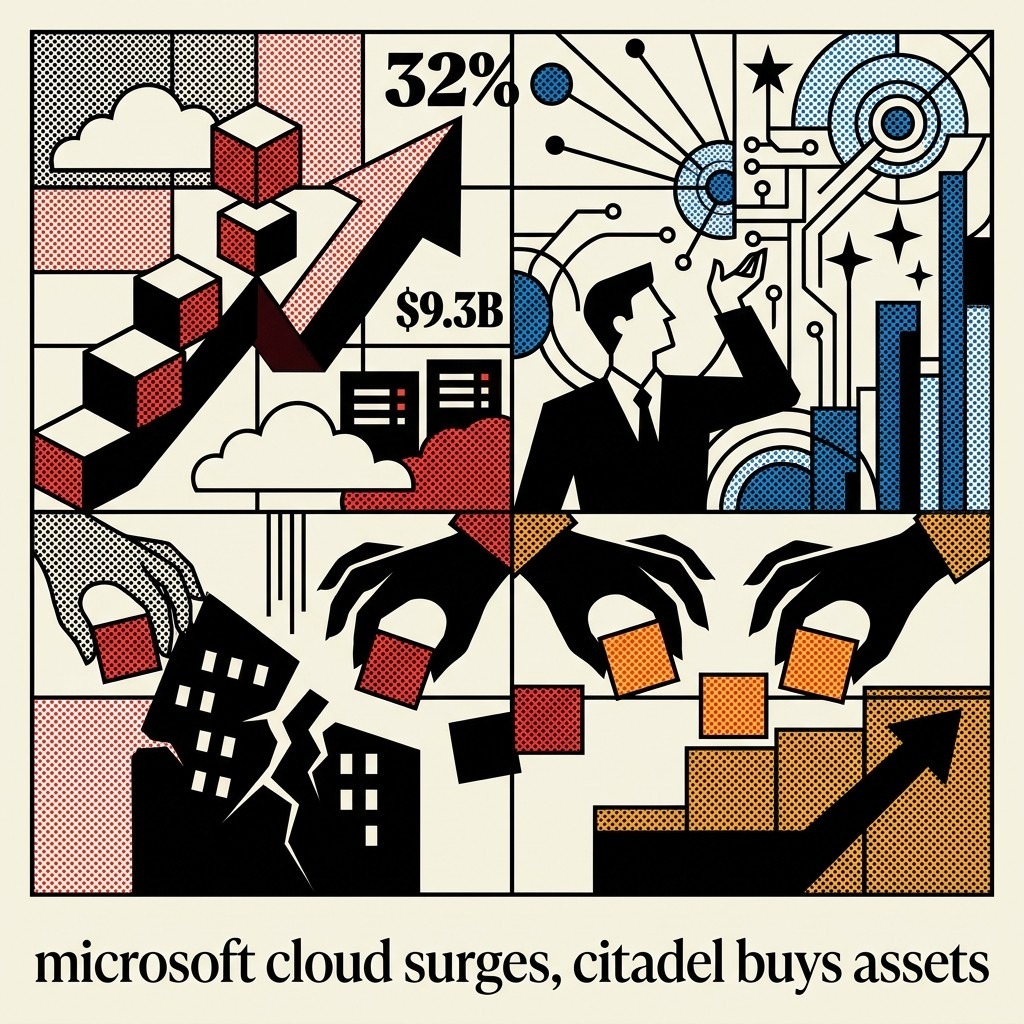
Microsoft, a massive cloud provider operating global data centers, posted $39.3 billion in fourth-quarter intelligent cloud revenue. This 32 percent jump shows AI’s immediate winners are not frontier model developers, but incumbents with captive enterprise distribution. The boom is fracturing into two realities: hyperscalers converting infrastructure into immediate cash flow, and speculative funds facing rapid liquidation.

Situational Awareness, an investment firm run by former OpenAI researcher Leopold Aschenbrenner, absorbed steep losses during a sudden sell-off. The ensuing overnight panic allowed Citadel, Ken Griffin’s $71 billion hedge fund, to buy a large portion of Aschenbrenner’s $16 billion public equity holdings. Citadel executes this rushed transaction because it secures premium assets at a distress discount. Even Microsoft faces constraints; its $41 billion in quarterly capital expenditures for AI infrastructure could compress margins if corporate software adoption slows.

During the 2000 dot-com crash, speculative pure-play funds evaporated overnight while network incumbents absorbed their stranded assets to survive the purge, the Wall Street Journal notes.

The Gist AI Editor

The Global Overview

AI Market Stratification: Microsoft’s Cloud Surge and Situational Awareness Collapse

The AI market actively punishes speculative bets while rewarding incumbents integrating AI into existing workflows. Microsoft’s intelligent cloud Q4 revenue hit $39.3 billion, rising 32% year-over-year (FT). Immediate winners are not developers of frontier models, but a hyperscaler—a massive cloud provider operating global data centers—possessing captive distribution. Meanwhile, Leopold Aschenbrenner’s Situational Awareness faced steep losses in an AI sell-off (FT), prompting Ken Griffin’s $71 billion Citadel to absorb its $16 billion equity holdings (WSJ). Massive capital demands and regulations like the FRIA—a mandatory evaluation under the EU AI Act ensuring AI respects human rights—build compliance barriers only multinationals can absorb. Still, Microsoft’s $41 billion quarterly capital expenditures risk margin compression if corporate adoption slows.

Central Bank Responses to Currency and Inflation Risks

Japan’s yen hit a two-month high amid intervention warnings against imported inflation (WSJ). The Bank of England held rates steady, warning the ongoing US-Iran conflict could push UK inflation to a 4.5% peak in 2027’s second quarter (FT). Confirming our prior warning that energy constraints would ripple globally, external shocks continually dictate domestic stability—a dynamic tracked by the ifo Institute, a Munich-based economic research institution providing closely watched forecasts on the German economy.

Stay tuned for the next Gist—your edge in a shifting world. The Gist remains independent and reader-supported. If you value news free from corporate or state interests, consider supporting our mission with a donation.

The European Perspective

Global AI Governance and the EU AI Act

The European Union is exporting its regulations globally, imposing compliance costs on foreign hyperscalers—massive cloud service providers operating global data centers—that erect barriers to entry and protect established incumbents. Nearly 47% of companies proactively citing the EU AI Act in disclosures are headquartered outside the bloc (Euronews). The United States is the largest source of non-EU firms engaging with the regulation before it fully takes effect in August 2026 (Thomson Reuters Foundation). By leveraging its massive consumer market, the EU successfully dictates tech governance without fostering a domestic AI innovation ecosystem of its own. Deployers of high-risk systems must now pass Fundamental Rights Impact Assessments (FRIAs)—mandatory evaluations to ensure AI systems do not violate human rights—before market entry. While costly, this prevents a race to the bottom in AI safety, securing baseline fundamental rights protections that individual nations struggle to enforce unilaterally.

German Export Growth Defies Contraction

Germany’s gross domestic product unexpectedly grew by 0.2% in the second quarter of 2026, defying market expectations of a 0.1% contraction (ifo). The growth was primarily driven by stronger exports offsetting subdued household consumption. This prompted the ifo Institute—a Munich-based economic research institution—to confirm the national economy remains on track for recovery, proving industrial foreign demand can still sustain output despite internal economic friction.

UK Healthcare Capacity and Assisted Dying

UK Prime Minister Andy Burnham threw a planned September parliamentary vote on legalizing assisted dying into doubt, stating legislation cannot proceed until social and palliative care are structurally fixed (Politico). Burnham effectively leverages the legislative timeline to force systemic capacity upgrades in state-funded medical support before altering end-of-life legal frameworks.

Catch the next Gist for further structural developments shaping global markets.

🎙️ Listen to this edition as a podcast Listen

The Gist is an independent daily digest: AI-curated, human-directed, unapologetically liberal (how it’s made). Hundreds of sources, only what matters. Subscribe free or listen to the podcast.


Comments

Leave a Reply

Your email address will not be published. Required fields are marked *

This site uses Akismet to reduce spam. Learn how your comment data is processed.