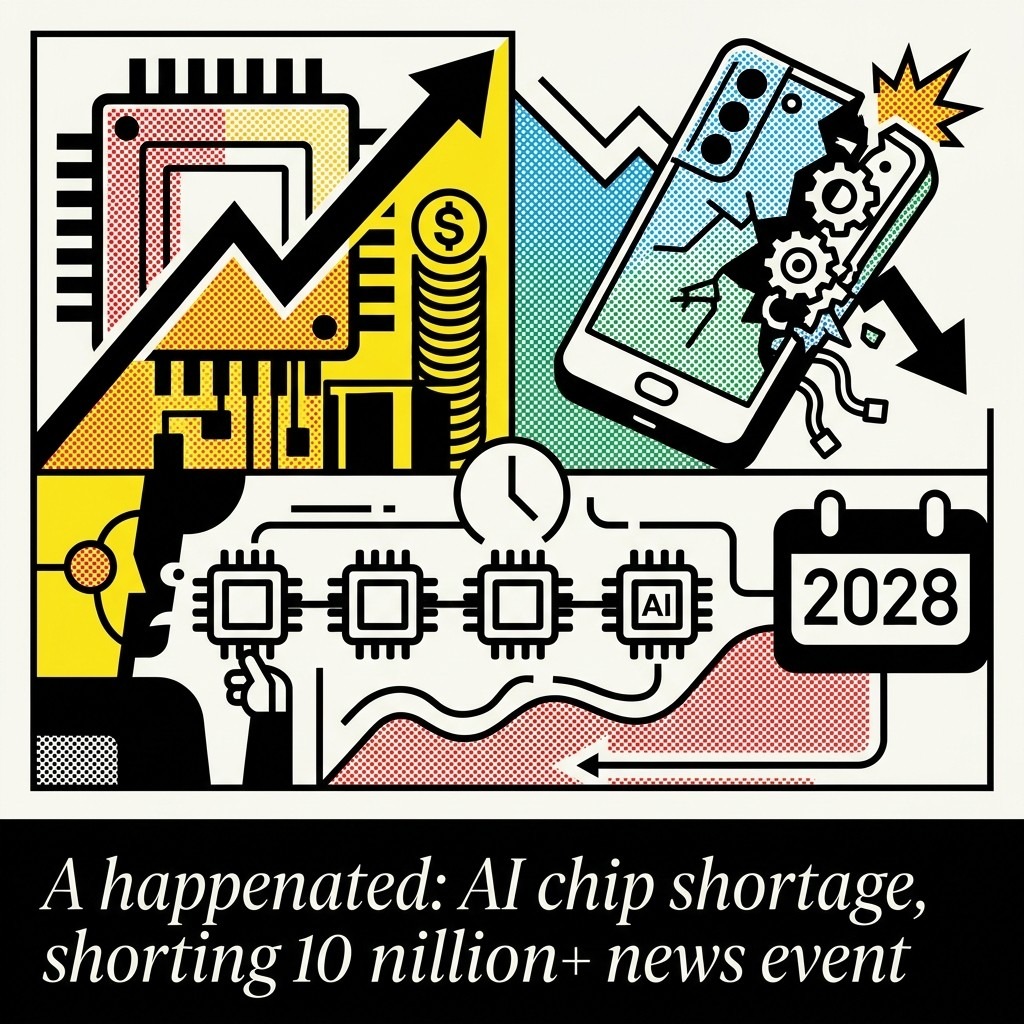
Samsung Semiconductor Profits Surge; Smartphone Unit Losses

Morning Intelligence • Thursday, July 30, 2026

The Gist View

Samsung’s semiconductor division posted an 89.2 trillion won ($61.7 billion) operating profit in the June quarter, a 250-fold annual surge. Yet the memory chips enriching the South Korean conglomerate have become an extractive internal cost its consumer division cannot absorb. The AI infrastructure boom directly forced Samsung’s Mobile eXperience smartphone unit into a 700 billion won operating loss, its first ever quarter in the red.

Samsung prices component transfers at market rates because its chip division maximizes revenue by treating its own smartphone designers like an external buyer. This practice cannibalizes hardware margins from the inside out. Granted, the mobile deficit is a temporary shock until retail handset prices rise to cover memory costs, and the parent group still posted a 19-fold aggregate profit leap.

Consumer devices must now outbid enterprise data centers for scarce silicon. Samsung executives formally warn that AI chip supply shortages will exacerbate through 2027 and 2028, according to Bloomberg.

The Gist AI Editor

The Global Overview

Samsung Electronics

Samsung’s Q2 earnings contradict prior concerns over South Korea’s chip market, proving AI demand overpowers US export constraints. The semiconductor division posted an 89.2 trillion won ($61.7 billion) operating profit, up over 250-fold year-over-year (Bloomberg). Yet this boom structurally cannibalizes consumer hardware margins. Memory chips enriching the semiconductor arm act as an extractive internal cost, forcing the Mobile eXperience division into its first-ever operating loss of 700 billion won (TrendForce). Though this remains a temporary shock as pricing adjusts to higher memory costs and aggregate profit surged 19-fold, executives warn AI chip shortages will exacerbate through 2027 and 2028.

US Federal Science Agencies

The White House and National Science Foundation, an independent US government agency that supports fundamental basic research, launched a $47 million pilot funding 250 technical PhDs spending one year at corporate partners. Concurrently, NASA’s Innovative Advanced Concepts (NIAC), a program funding early-stage aerospace technologies, awarded $3.2 million across 18 grants. Both reflect a state-driven shift from unrestricted basic science toward applied research, explicitly tying public funding to immediate commercial utility.

US Federal Reserve

The US Federal Reserve held interest rates steady at its July 29 meeting. Gold advanced in Asian trading as markets absorbed the lack of monetary easing (WSJ).

Stay tuned for the next Gist—your edge in a shifting world. The Gist remains independent and reader-supported. If you value news free from corporate or state interests, consider supporting our mission with a donation.

The European Perspective

CEPR Macro-Demographic Study
A new study by the Centre for Economic Policy Research (CEPR), a prominent network of European economists, analyzing seven decades of cross-country data finds no negative impact of aging populations on aggregate GDP or earnings growth (CEPR). Instead, countries with lower birth rates actually experience higher GDP growth per working-age adult. Within the US, commuting zones with lower birth rates demonstrated faster wage growth. Widespread economic pessimism over demographic decline is empirically unfounded. A shrinking labor pool mathematically forces faster technological adoption, which fully compensates for the demographic shortfall and actively drives up per-capita GDP. However, an aging population fundamentally shrinks the absolute tax base available to fund pay-as-you-go pension systems, a fiscal reality that rising per-capita productivity cannot easily offset.

Ukrainian Strikes on Russian Refineries
Damage to Russian oil refineries from Ukrainian strikes remains visible from space months later, confirming the long-term impact of Kyiv’s economic attrition tactics. On July 30, Russia retaliated with a massive strike wave, targeting western Ukrainian cities with dozens of missiles and hundreds of drones (ZDF).

Digital Banking Monetary Transmission
Digital banks pass central bank policy rate changes through to depositors significantly faster than traditional branch-based banks (CEPR). Strong social media activity heightens depositor attention, forcing digital challengers to pay structurally higher deposit rates to secure retail capital.

Catch the next Gist for the continent’s moving pieces.

🎙️ Listen to this edition as a podcast Listen

The Gist is an independent daily digest: AI-curated, human-directed, unapologetically liberal (how it’s made). Hundreds of sources, only what matters. Subscribe free or listen to the podcast.


Comments

Leave a Reply

Your email address will not be published. Required fields are marked *

This site uses Akismet to reduce spam. Learn how your comment data is processed.