Middle East Conflict Spurs Price Hikes by India’s Top Firms

Morning Intelligence • Saturday, August 01, 2026

The Gist View

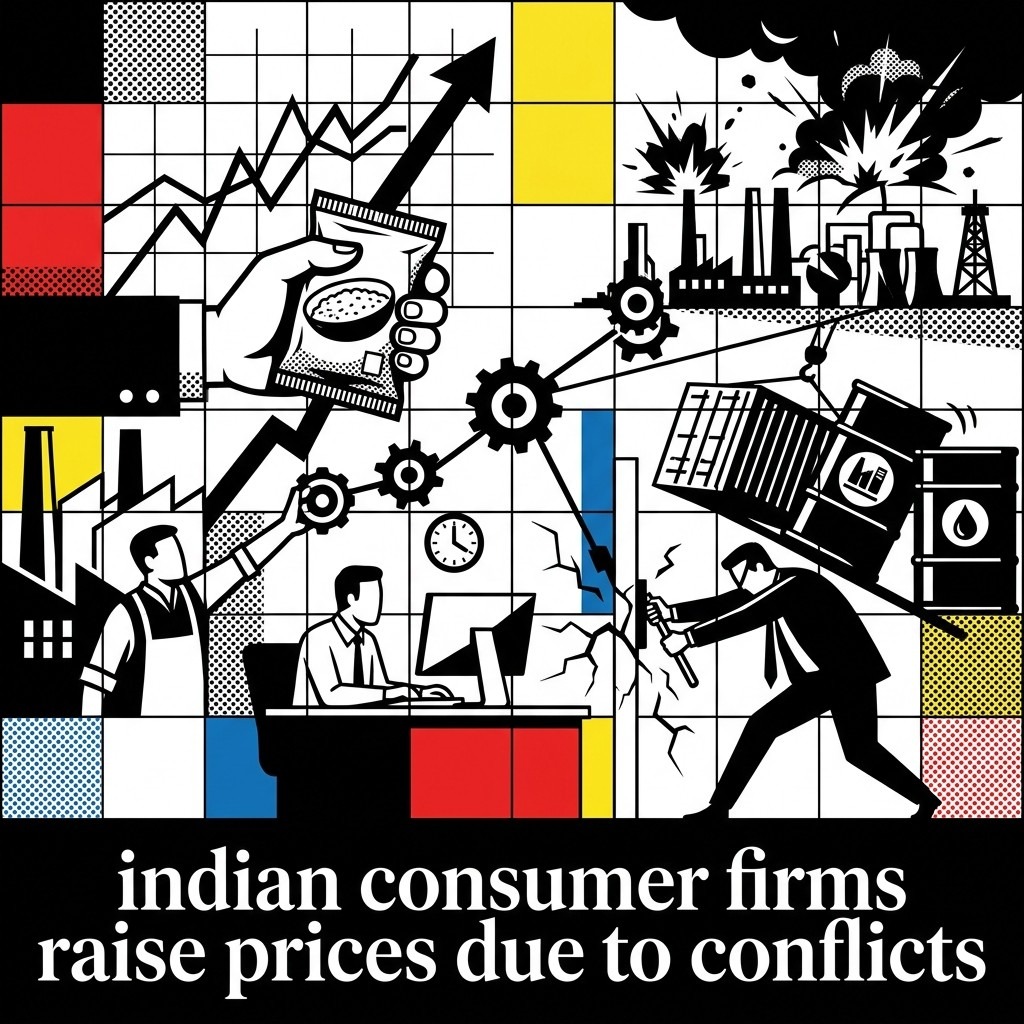
India’s largest consumer companies are planning a second consecutive quarter of price hikes on goods from toothpaste to tires ahead of the festival season. They blame the prolonged Middle East conflict for driving up commodity costs, transferring the price of geopolitical instability directly onto emerging-market consumers. This exposes a harsh limit: central banks cannot cure inflation driven by supply shocks without inflicting severe demand destruction on domestic economies.

US Treasury yields—the return on investment on US government debt obligations, which serve as a benchmark for global borrowing costs—ended the month higher following a market sell-off. While these yields primarily reflect robust domestic data and fiscal deficit issuance, revived energy fears compound the squeeze. Consumer firms raise prices because they must protect margins, forcing everyday buyers to absorb the shock.

Driven by these rising commodity costs, companies warn that inflation will remain elevated, reinforcing the WSJ’s assessment that interest rates are powerless to clear shipping lanes or extract crude oil.

The Gist AI Editor

The Global Overview

Global Inflation and Geopolitical Friction

Indian consumer companies are planning a second consecutive quarter of price hikes ahead of the festival season, explicitly citing the Middle East conflict driving up commodity costs (Bloomberg). Simultaneously, US Treasury yields—the return on investment on government debt serving as a benchmark for global borrowing costs—ended the month higher on revived energy-inflation fears (WSJ). Central banks cannot cure geopolitical supply shocks without inflicting severe domestic demand destruction. This commodity pressure transfers the cost of instability directly onto emerging-market consumers. Admittedly, US Treasury yields are primarily responding to robust domestic data and fiscal deficit issuance, not merely energy shocks.

Agentic AI in Retail Banking

Lloyds Bank is evaluating the systemic risk of consumers utilizing agentic AI—systems capable of autonomously executing multi-step tasks on behalf of users (FT). This integration threatens retail lending stability; automated yield shopping could rapidly shift deposits, eroding the consumer inertia banks rely on to secure cheap capital.

Commercial Space Property Rights

Advocates are pushing for established lunar land rights to unlock space exploration’s economic potential (WSJ). The absence of a legal framework for extraterrestrial property remains the primary institutional bottleneck preventing private capital allocation toward long-term orbital infrastructure and resource extraction.

Stay tuned for the next edition of The Gist to maintain your edge in a shifting world. The Gist remains independent and reader-supported. If you value news free from corporate or state interests, consider supporting our mission with a donation.

The European Perspective

Italy Suspends Schengen Over Ceuta Border Crisis

The diplomatic fallout from the Ceuta border crisis confirms our assessment that the sheer scale of the crossings would overwhelm standard security responses, now escalating to Italy’s suspension of the Schengen treaty (TIME). Italian Prime Minister Giorgia Meloni announced a temporary suspension of Italy’s Schengen open-border arrangement with Spain—halting the European Union’s passport-free travel zone that abolishes internal border controls—to defend borders against human trafficking. Nearly 50,000 migrants crossed from Morocco into Ceuta, a Spanish autonomous city in North Africa representing one of the European Union’s only land borders with Morocco, over a 24-hour period. Spain quickly returned over 48,000 via the Tarajal crossing and deployed military forces to reinforce security in the territory of 85,000 residents (Xinhua). Morocco’s ability to trigger the suspension of Europe’s core internal mobility treaty by simply relaxing its own border controls demonstrates how vulnerable the EU remains to demographic weaponization (The Washington Post). Suspending Schengen is a legally established emergency brake within EU treaties, intended to preserve the system’s long-term viability by temporarily halting cascading security failures (Chatham House).

Bev Craig Secures Greater Manchester Mayoralty

Labour candidate Bev Craig won the Greater Manchester mayoral by-election with 309,525 votes, securing a second-round victory under the supplemental vote system (Politico). Craig succeeds Andy Burnham, who resigned as mayor in June 2026 to claim leadership of the Labour Party and assume office as UK Prime Minister on July 20, 2026.

ECB Escalates Nature Risk Monitoring

European Central Bank executive board member Frank Elderson announced the ECB—the central institution of the Economic and Monetary Union—is escalating its monitoring of bank exposures to the destruction of nature-related ecosystem services (The Guardian). Elderson warned that the rapid decline of natural assets poses a dramatically growing risk to the global economy and core financial stability. Both developments reflect a structural shift where central banks are being forced to price in real-world physical supply destruction—whether from geopolitical conflict or ecological collapse—that traditional monetary demand-management cannot fix.

Catch the next Gist for the continent’s moving pieces.

🎙️ Listen to this edition as a podcast Listen

The Gist is an independent daily digest: AI-curated, human-directed, unapologetically liberal (how it’s made). Hundreds of sources, only what matters. Subscribe free or listen to the podcast.