CXMT’s IPO Skyrockets 466% to $487B Amid US Chip Ban

Evening Analysis • Sunday, August 02, 2026

The Gist View

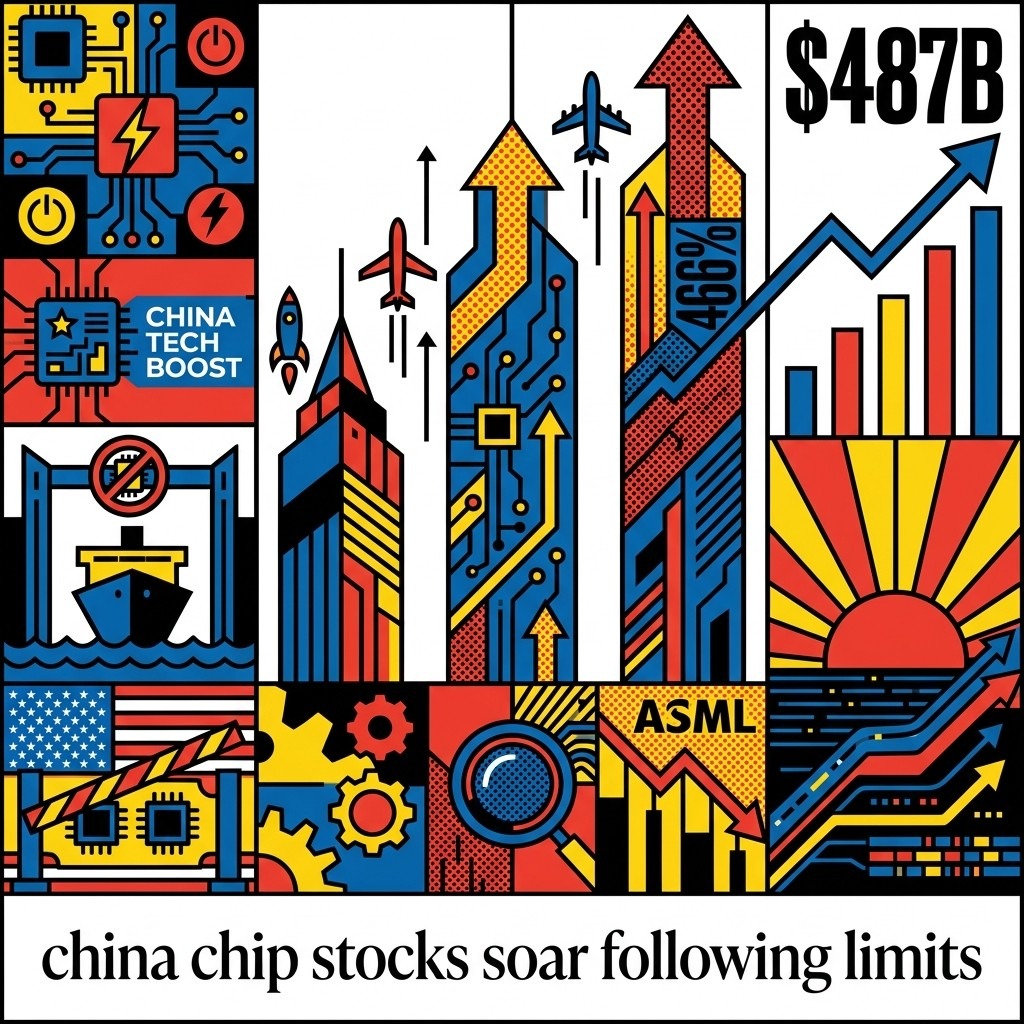
ChangXin Memory Technologies (CXMT), China’s top producer of dynamic random-access memory (DRAM)—the standard chip used in servers—surged 466% in its Shanghai IPO to a $487 billion valuation. Washington’s chip embargo perversely acts as a state-enforced subsidy. By locking Western firms out, US export controls guarantee captive demand, de-risking the capital Beijing’s startups need to forge a parallel ecosystem.

This explains how state-owned Shanghai Aishengna Electronic Technology Group can mass-produce domestic deep-ultraviolet (DUV) lithography machines, the complex optical technology used to print circuit patterns. Chinese chipmakers buy this hardware because they gain immunity from Western sanctions. The rollout cost Dutch lithography firm ASML 13% of its market capitalization in two sessions. ASML retains its monopoly on extreme ultraviolet machines for sub-5nm AI chips, keeping China a generation behind, but the legacy market is fractured.

As Reuters notes, Washington’s 1999 export limits on satellite components similarly drove foreign aerospace sectors to design out American parts entirely.

The Gist AI Editor

The Global Overview

ChangXin Memory Technologies

We previously noted China’s gradual progress toward semiconductor self-sufficiency; the astonishing $487 billion IPO valuation of CXMT and mass production of domestic deep-ultraviolet (DUV) lithography tools—optical technology used to print intricate circuit patterns onto semiconductor wafers—confirms US export controls acted as a massive state subsidy for a parallel Chinese tech ecosystem. CXMT, China’s leading producer of dynamic random-access memory (DRAM)—standard computer memory chips—surged 466% in its Shanghai IPO (Reuters). State-owned Shanghai Aishengna began mass-producing DUV machines, causing Dutch firm ASML to drop 13% in market capitalization over two trading sessions (FT). By locking Western firms out, Washington de-risked the capital investments needed for Chinese state-backed startups to achieve DUV manufacturing, though ASML’s extreme ultraviolet monopoly remains unbroken and essential for sub-5nm AI chips.

Morgan Stanley

Morgan Stanley logged $74 billion in net new wealth assets in the second quarter of 2026 (FT). This influx is heavily driven by newly minted millionaires cashing in on IPOs and private equity offerings from companies like SpaceX.

Washington Dulles International Airport

A proposed $20 billion overhaul will replace aging concourses and mobile lounges, anchoring United Airlines’ long-term hub strategy (Bloomberg). Promoted by President Donald Trump, the modernization project is largely funded through user passenger fees.

Join us for the next edition of The Gist to track these structural shifts. The Gist remains independent and reader-supported. If you value news free from corporate or state interests, consider supporting our mission with a donation.

The European Perspective

Migrant Surge in Ceuta

In late July 2026, 60,000 migrants crossed from Morocco into Ceuta, leaving 67 dead (Le Monde). Morocco’s tactical relaxation of border controls uses migration to extract diplomatic concessions. Outsourcing European border enforcement gives third-party autocracies a low-cost mechanism to pressure Brussels. While Moroccan authorities are genuinely overwhelmed, and European nations have a sovereign obligation to secure borders, systemic risks persist. Johann Wadephul of the Christian Democratic Union (CDU, Germany’s major center-right conservative political party) called the breach an “absolute stress test” for the Schengen Area, a zone of 29 European countries that have abolished internal border controls (ZDF).

African Biopiracy and European Markets

A Giant African Harvester Ant queen sells for €200 ($230) on European hobbyist markets (DW). Exploiting this pricing, a Chinese national received a one-year prison sentence in Kenya for exporting thousands of ants, showing how European retail capital directly incentivizes illegal ecological extraction.

German Climate Skepticism Surges

Despite a 98% active scientific consensus and a heatwave causing 10,000 excess deaths, climate-change skeptics in Germany have materially increased (DW). This divergence between empirical data and public sentiment complicates structural state investment in climate adaptation.

Catch the next Gist for further global developments.

🎙️ Listen to this edition as a podcast Listen

The Gist is an independent daily digest: AI-curated, human-directed, unapologetically liberal (how it’s made). Hundreds of sources, only what matters. Subscribe free or listen to the podcast.


Comments

Leave a Reply

Your email address will not be published. Required fields are marked *

This site uses Akismet to reduce spam. Learn how your comment data is processed.