Mexico Tops Taiwan with $46.9bn US Server Exports in 2026

Morning Intelligence • Sunday, August 02, 2026

The Gist View

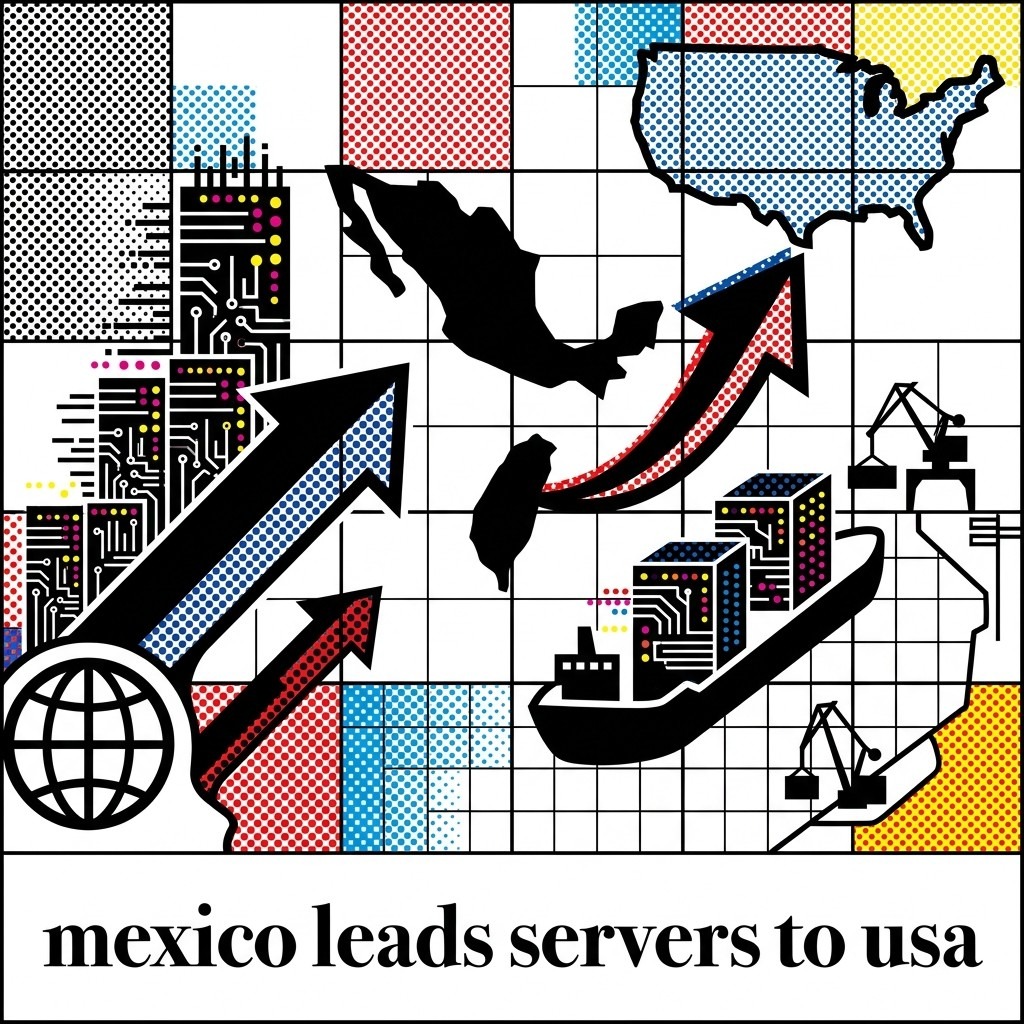
Mexico shipped $46.9bn in enterprise servers to the US in 2026, briefly overtaking Taiwan in May to become America’s top supplier. Washington’s attempt to isolate domestic tech behind tariff walls has not decoupled the industry from Asia; it has merely rerouted it. Taiwanese manufacturers assemble hardware in Mexico because they gain tariff-free access to US tech giants through the United States-Mexico-Canada Agreement, a free trade pact succeeding NAFTA.

Since 2020, Taiwanese companies have invested over $1.6bn in Mexican facilities to bypass US import penalties. While geographic proximity genuinely reduces trans-Pacific shipping risks and secures North American assembly jobs, this export surge is not a homegrown Latin American tech boom. Asian manufacturers are actively outmaneuvering state protectionism to maintain their grip on American buyers.

This geographic arbitrage reshapes the local economy at scale. Computer servers and related hardware now account for 20% of the $317bn in goods Mexico exported between January and May, according to the Financial Times.

The Gist AI Editor

The Global Overview

Mexico overtakes Taiwan as top US AI server supplier

Washington’s tariffs relocated assembly lines rather than cutting Asian reliance. Mexico became the second-largest US server provider in 2026 with $46.9 billion, trailing Taiwan’s $53.5 billion but briefly overtaking it in May (Marginal Revolution). Taiwanese manufacturers exploit the United States-Mexico-Canada Agreement (USMCA, a free trade pact succeeding NAFTA) to bypass US barriers, investing $1.6 billion there since 2020 (FT). Servers are 20% of Mexico’s $317 billion Jan-May exports. While USMCA reduces shipping risks, redirected capital proves market demand outmaneuvers protectionism.

Apple caps security bug submissions amid AI slop

Apple added a June 2026 submission cap and 30-day cool-off to limit AI-generated security reports (FT). Italian startup Bynario found over 50 macOS vulnerabilities in three weeks using ChatGPT, but the quota blocked them. Like the ongoing China Semiconductor Export Boom proving AI demand overrides US constraints, automated discovery outpaces corporate administrative capacity.

Trump suspends Iran strikes for rapid deal

US President Donald Trump suspended Iran strikes for a deal reopening the Strait of Hormuz (Bloomberg). Following Saudi Crown Prince Mohammed bin Salman’s intervention, Brent crude closed above $90 a barrel, as regional powers prioritize energy flows over military escalation.

Stay tuned for the next Gist. The Gist remains independent and reader-supported. If you value news free from corporate or state interests, consider supporting our mission with a donation.

The European Perspective

AfD Youth Mobilization in Schwerin

Clashes surrounding Generation Deutschland—the youth organization of the Alternative for Germany (AfD) party—stress-test democratic consensus before state elections. On August 1, 420 supporters marched in Schwerin against 460 counter-demonstrators (ZDF). This explicit focus is a strategy to bypass traditional media and normalize right-wing populism as a Gen Z counter-culture. Yet, counter-demonstrators initiated violence via illegal blockades, leaving Hamburg chairman Michael Schumann hospitalized with a head injury (WELT, Der Spiegel). These illiberal tactics prove equally damaging to democratic norms.

LSE Streamlines AIM Rules

The London Stock Exchange (LSE) is cutting regulatory costs on AIM—the Alternative Investment Market for growing companies (FT). This pivot attempts to arrest the junior market’s structural decline amid dropping listings, acknowledging a severe competitiveness loss across UK capital markets.

National Rally Courts French CEOs

Marine Le Pen deployed 30-year-old leader Jordan Bardella to court France’s top CEOs before 2027 (Politico). This normalizes the party among a corporate establishment that historically shunned its protectionism. This domestic realignment parallels the protracted debate over European Supply Chain Disruptions; as global trade fractures, the EU must rapidly weigh the economic efficiencies of specialization against the coercive risks of dependency (CEPR).

Catch the next Gist for the continent’s moving pieces.

🎙️ Listen to this edition as a podcast Listen

The Gist is an independent daily digest: AI-curated, human-directed, unapologetically liberal (how it’s made). Hundreds of sources, only what matters. Subscribe free or listen to the podcast.


Comments

Leave a Reply

Your email address will not be published. Required fields are marked *

This site uses Akismet to reduce spam. Learn how your comment data is processed.