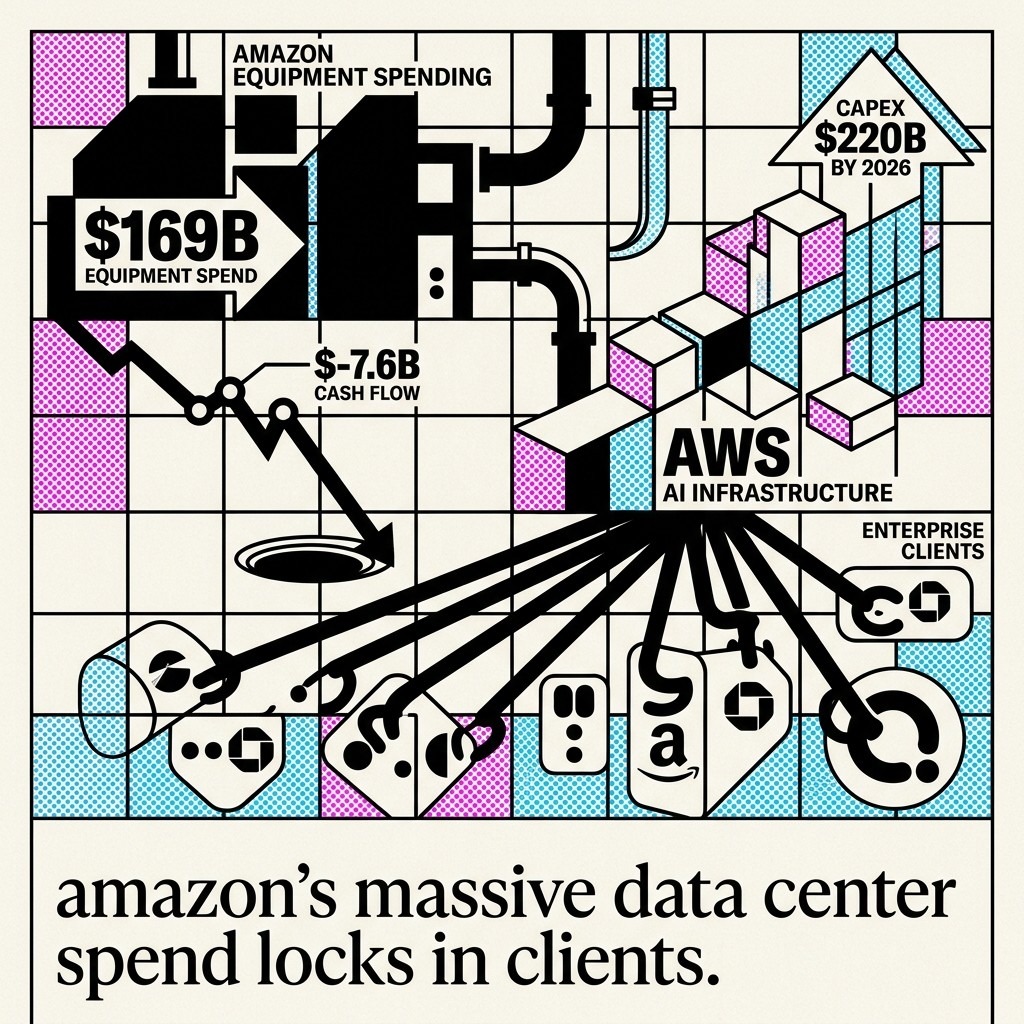
Amazon’s $169B Spend Causes $7.6B Cash Flow Shortfall

Evening Analysis • Monday, August 03, 2026

The Gist View

Amazon drove its free cash flow—cash generated after supporting operations and maintaining assets—into a $7.6 billion shortfall by spending $169 billion on equipment over 12 months. The company projects 2026 capital expenditures, or CapEx, will hit $220 billion to build artificial intelligence infrastructure for AWS, its cloud computing subsidiary. The AI race is no longer an algorithmic contest; it is a pure infrastructure scale game.

This budget physically prices out challengers, ensuring only entrenched hyperscalers—massive cloud providers capable of enterprise computing—possess the compute layer for the next digital epoch. Yet the spending is entirely reactive to concrete contracts, demonstrating an efficient market response rather than monopolistic overreach. By pre-selling capacity, Amazon shifts the risk of this massive outlay onto enterprise customers, locking them into the AWS ecosystem.

AWS CEO Matt Garman confirmed to Bloomberg that capacity is largely committed to enterprise buyers through the end of 2027 and into 2028.

The Gist AI Editor

The Global Overview

Amazon AWS $220B AI Capital Expenditure

Amazon’s free cash flow—cash generated after accounting for operations and capital assets—hit a $7.6 billion shortfall following $169 billion in equipment spending (Bloomberg). This utilizes projected 2026 capital expenditures (CapEx, funds for physical assets like servers) of $220 billion to physically price out challengers (GeekWire). Artificial intelligence is an infrastructure scale game restricted to hyperscalers: massive cloud providers capable of enterprise-scale computing. By pre-selling Amazon Web Services (AWS, its cloud computing subsidiary) capacity through 2028, Amazon shifts this massive outlay’s risk onto customers, ensuring ecosystem lock-in. Yet AWS CEO Matt Garman confirms this spending reacts strictly to concrete enterprise contracts, reflecting efficient market demand rather than monopolistic overreach (Investing.com).

SpaceX IPO Lock-up Overhang

Following an $86 billion IPO, 911.5 million SpaceX insider shares worth $100 billion unlock in August (FT). The staggered lock-up mechanism, designed to prevent an immediate selloff cliff, instead caused a protracted 12-month valuation uncertainty overhang for the stock.

NASA Commercial Lunar Relay

NASA delivered the 3.5-pound NavCube3-mini to Intuitive Machines for the Altus-1 commercial lunar relay satellite, establishing privately operated navigation and communications infrastructure for future Moon Base operations.

Join us for tomorrow’s Gist. The Gist remains independent and reader-supported. If you value news free from corporate or state interests, consider supporting our mission with a donation.

The European Perspective

East German Resistance to Pension Reform
Three East German state premiers oppose the federal abolition of ‘Rente mit 63’, which permits workers with 45 years of contributions to retire without financial penalties (ZDF). Facing upcoming elections in three states, regional politicians are defending doomed entitlements at the expense of younger taxpayers. East German workers frequently have longer, uninterrupted histories in physically demanding jobs, making a blunt increase to the retirement age disproportionately punitive for that demographic. However, preserving this benefit actively exacerbates the skilled-labor shortages that are already crippling the East German regional economy they are supposedly protecting.

Reform UK’s Operation Fortress
Reform UK leader Nigel Farage unveiled ‘Operation Fortress,’ a proposal to deploy the Royal Navy, RAF, and British Army to track and intercept migrant boats (Politico). The policy dictates detaining intercepted individuals and immediately returning them to France using military inflatable boats. The proposal aims to shift state capital and operational mandates entirely toward hard-security maritime enforcement.

UK University Consolidations and Science Funding
Two prominent British universities announced a merger to form the country’s first ‘super-university’ as higher education institutions face severe economic and inflationary pressures (Euronews). This consolidation coincides with warnings from regional leaders like Andy Burnham that waning state support for basic scientific research threatens Britain’s broader technology ambitions. This represents a macroeconomic shift, demonstrating how financial constraints are forcing structural contractions in British research and development.

Catch the next Gist for the continent’s moving pieces.

🎙️ Listen to this edition as a podcast Listen

The Gist is an independent daily digest: AI-curated, human-directed, unapologetically liberal (how it’s made). Hundreds of sources, only what matters. Subscribe free or listen to the podcast.


Comments

Leave a Reply

Your email address will not be published. Required fields are marked *

This site uses Akismet to reduce spam. Learn how your comment data is processed.