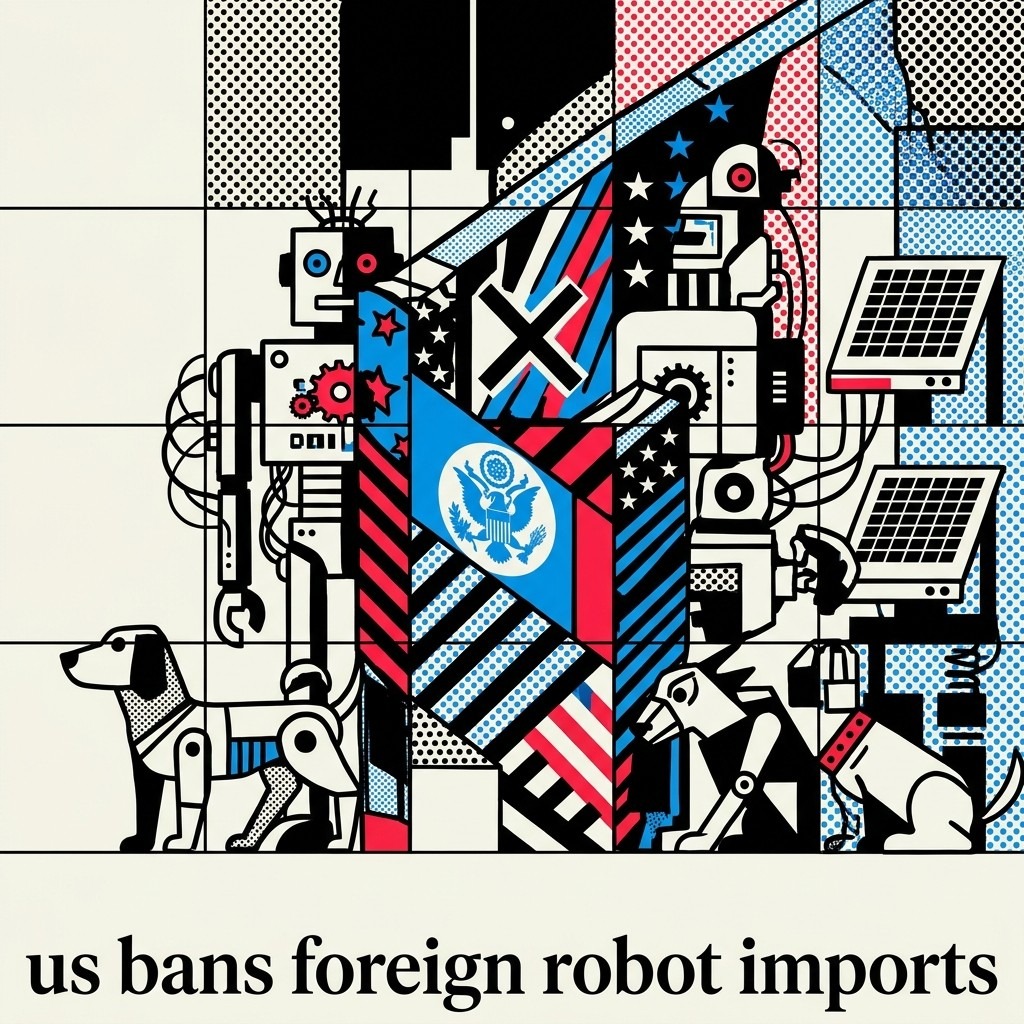
US Bans Imports of Chinese Robots and Solar Inverters

Morning Intelligence • Tuesday, August 04, 2026

The Gist View

The US government banned the import of three hardware categories today—foreign-made humanoid robots, robot dogs, and solar inverters—declaring them an “unacceptable” national security threat. This embargo pushes Washington’s artificial intelligence protectionism from the digital layer into physical infrastructure. By treating automation tools as sovereign assets, the administration extends its semiconductor decoupling strategy directly to the factory floor.

Chinese-manufactured networked robots do present a genuine data-exfiltration risk. Yet by involving the FTC—the federal agency enforcing antitrust and consumer protection laws—Washington formally binds a fragile domestic robotics sector into its industrial policy. The government restricts imports because it gains a sheltered incubator for American manufacturers. Local enterprises ultimately pay the price through deliberately inflated costs for industrial automation.

Choosing autarky over rapid technological adoption isolates US buyers from their most efficient suppliers. The restrictions explicitly target China, “which currently dominates the global manufacturing market for these hardware technologies,” reports MIT Technology Review.

The Gist AI Editor

The Global Overview

US Expands AI Protectionism to Robotics

The US banned foreign-made humanoid robots, robot dogs, and solar inverters over ‘unacceptable’ national security threats (MIT Technology Review). Enforced by the FTC—the US Federal Trade Commission, a federal agency enforcing antitrust and consumer protection laws—the restriction directly targets China’s manufacturing dominance (TechCrunch). While Chinese networked robots pose genuine data-exfiltration risks, this policy structurally inflates American industrial automation costs to shield a nascent domestic hardware sector. Extending its semiconductor decoupling strategy to the physical layer, Washington now treats robotics as sovereign infrastructure, proving embargoes operate as state-enforced mandates to build entirely separate, parallel supply chains.

NSE Closing Auction Triggers Rare Index Divergence

India’s National Stock Exchange introduced a Closing Auction Session on August 3 to determine final prices for derivatives-eligible stocks (Bloomberg). Low initial participation spiked the benchmark Nifty 50 index by 200 points in its final two minutes, creating a rare 91-basis-point divergence from the BSE Sensex at the close.

Global Markets Await US Labor Data

Gold remains range-bound as markets weigh Middle East volatility against shifting US monetary policy expectations (WSJ). Concurrently, Japanese Government Bonds tracked overnight US Treasurys gains as capital positions ahead of crucial US labor data.

Todd Blanche Rescinds Trump Compensation Fund

Acting US Attorney General Todd Blanche formally rescinded a $1.8 billion ‘anti-weaponization’ fund intended to compensate Donald Trump allies. The reversal functioned as an institutional transaction, securing Blanche the necessary confirmation backing from Republican Senators Thom Tillis and John Cornyn.

Join us tomorrow for the next edition of The Gist to track these ongoing systemic shifts. The Gist remains independent and reader-supported. If you value news free from corporate or state interests, consider supporting our mission with a donation.

The European Perspective

France and Germany replace Palantir
France and Germany are replacing Palantir—a US data analytics software company heavily used by western defense and intelligence agencies—to build a sovereign digital backbone (Politico Europe). France’s DGSI (internal security and counter-intelligence agency) and Germany’s BfV (domestic intelligence agency) are deploying ArgonOS, built by French firm ChapsVision. This state-directed subsidy for defense-tech sacrifices immediate interoperability, as NATO commanders warn no mature European alternatives exist for real-time battlefield data processing. Yet, eliminating US-controlled architecture removes European vulnerability to Washington’s foreign policy shifts.

Revolut CEO sued over superyacht commission
Brokerage Cecil Wright is suing Revolut CEO Nik Storonsky, alleging he bypassed the firm to avoid paying a €17.5 million commission on a €350 million superyacht.

Spanish equities attract tech-weary capital
Spanish stocks are drawing investors seeking refuge from global AI volatility. Analysts warn this isolation from AI-driven growth poses long-term economic risks. Concurrently, extreme heat exposes infrastructure limits: France is shutting nuclear reactors to preserve river levels, and Greek wildfires have claimed five lives (Euronews). Politically, Prime Minister Pedro Sánchez’s disputes over the Ceuta border surge confirm Morocco’s migration tactics predictably inflame European diplomatic friction.

Ukraine dismisses US ambassador
President Volodymyr Zelenskyy dismissed Olha Stefanishyna after nearly a year as US ambassador (ZDF), restructuring Kyiv’s primary channel for securing Western military aid.

Catch the next Gist for the continent’s moving pieces.

🎙️ Listen to this edition as a podcast Listen

The Gist is an independent daily digest: AI-curated, human-directed, unapologetically liberal (how it’s made). Hundreds of sources, only what matters. Subscribe free or listen to the podcast.


Comments

Leave a Reply

Your email address will not be published. Required fields are marked *

This site uses Akismet to reduce spam. Learn how your comment data is processed.