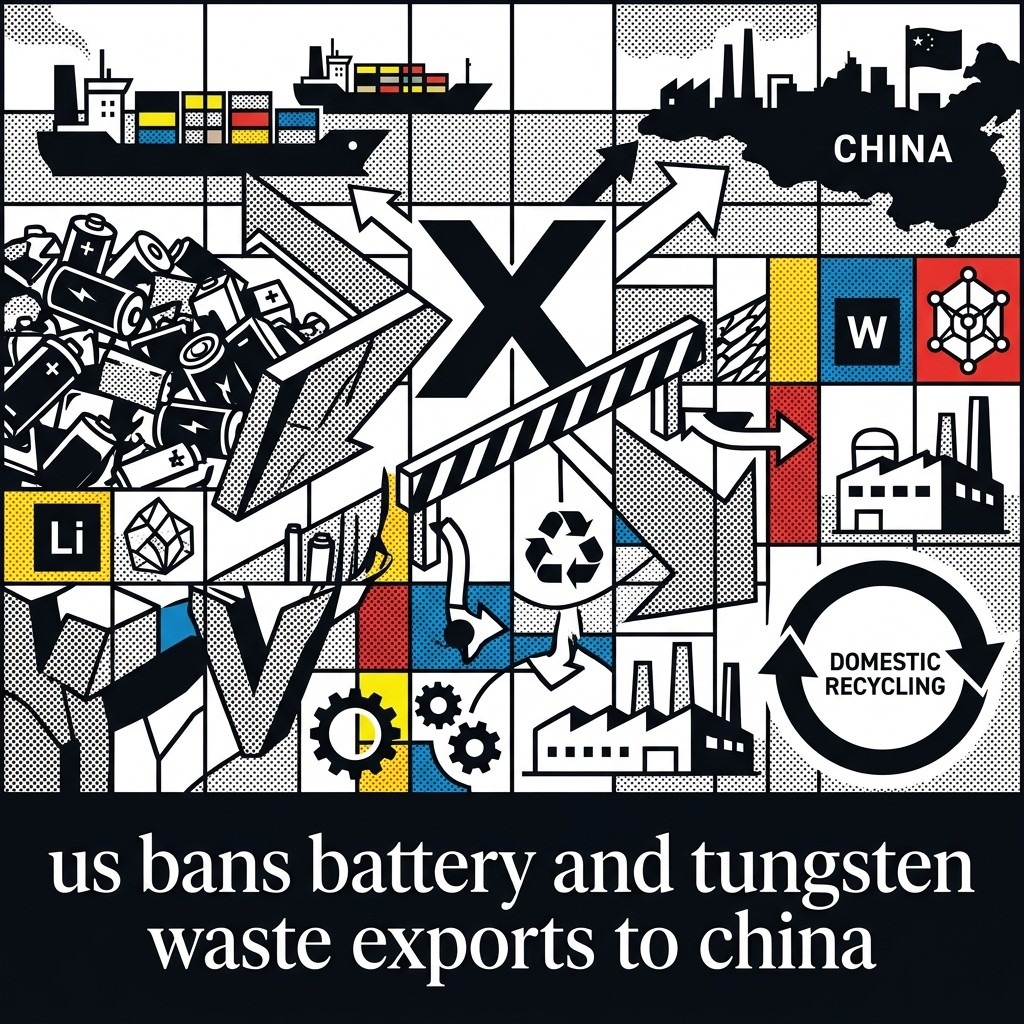
US Bans Lithium-Ion Battery, Tungsten Waste Exports to China

Evening Analysis • Thursday, August 06, 2026

The Gist View

The United States is cutting off China from American industrial refuse by banning exports of two critical materials: lithium-ion battery and tungsten waste. The restriction marks a deliberate pivot toward autarky. Washington accepts higher localized costs to untangle its defense and advanced technology sectors from foreign supply chains. Halting open-market sales forcefully incubates a domestic recycling industry.

This policy reclassifies scrap material as a strategic asset, shifting the geopolitical bottleneck from physical mining to recycling infrastructure. Beijing currently dominates global processing, meaning unrestricted waste exports would supply America’s primary rival with the raw materials for technological dominance. Washington restricts market access because it gains the captive supply necessary to sustain its own nascent processing plants.

The intervention revives the industrial logic of 1940, when Washington embargoed scrap iron to throttle Japan’s military expansion; today, the Wall Street Journal reports, the restrictions aim to secure the supply chains of future conflicts.

The Gist AI Editor

The Global Overview

White House Exempts Open-Weight AI Models

The White House exempts US-developed open-weight models—artificial intelligence models whose core parameters are made publicly available for others to use and modify—from pre-release security reviews (WSJ). Focusing federal cybersecurity scrutiny on closed proprietary models balances safety with innovation against geopolitical competitors. Simultaneously, Alphabet secured $115 billion in demand for a bond sale (Bloomberg). This finances hyperscalers—massive cloud computing providers, like Google Cloud, operating a global network of data centers—despite equity investor skepticism over Amazon AWS’s capital expenditure.

US Export Ban on Critical Metal Waste

By banning lithium-ion battery and tungsten waste exports, Washington is absorbing higher costs to separate strategic capabilities from foreign supply chains. The restriction secures raw materials for defense by forcefully incubating domestic processing capacity instead of allowing open-market sales (WSJ). This reclassifies industrial refuse as a strategic national asset, shifting the geopolitical constraint from physical mining to recycling infrastructure. While China dominates global processing—meaning unrestricted exports would supply America’s primary rival—this ban prioritizes autarky over globalized efficiency.

NASA High-Altitude Space Training

NASA astronaut Adam Fuhrmann is conducting flights aboard the WB-57, a specialized high-altitude research aircraft used by NASA for spaceflight training and atmospheric studies. These flights simulate pressurized environments, preparing crews to operate systems on the International Space Station and the Moon.

Stay tuned for the next Gist—your edge in a shifting world. The Gist remains independent and reader-supported. If you value news free from corporate or state interests, consider supporting our mission with a donation.

The European Perspective

Ukraine Develops Domestic Ballistic Missile Defense

On August 6, 2026, President Volodymyr Zelenskyy announced domestic manufacturers are developing an indigenous ballistic missile defense system (ZDF). This signals a structural pivot toward military autarky, reducing Kyiv’s vulnerability to volatile Western political cycles. Building domestic missile infrastructure requires immense capital allocation and supply chain integration, indicating Ukraine is industrializing its defense sector while under active bombardment. However, indigenous systems remain largely untested against advanced Russian hypersonic weapons, whereas proven Western systems like the Patriot are necessary for immediate tactical survival.

UK Eases Corporate Listing Rules

The FCA—the Financial Conduct Authority, which regulates the financial services industry in the United Kingdom—eased corporate listing rules to revitalize London’s capital markets. The reform is designed to attract initial public offerings and reverse a trend of companies choosing to list in New York instead. By reducing regulatory barriers, the UK is deliberately lowering corporate governance standards to aggregate capital and compete directly with American market liquidity.

Switzerland Rejects Italy in Fire Probe

The prosecutor’s office in Sion rejected the Italian government’s request to join as a civil party in the investigation into the deadly Crans-Montana fire (Il Sole 24 Ore). This exclusion denies Italy formal legal leverage, ensuring Swiss authorities retain exclusive jurisdiction over the investigation’s parameters and any resulting financial liabilities.

Catch the next Gist for the continent’s moving pieces.

🎙️ Listen to this edition as a podcast Listen

The Gist is an independent daily digest: AI-curated, human-directed, unapologetically liberal (how it’s made). Hundreds of sources, only what matters. Subscribe free or listen to the podcast.


Comments

Leave a Reply

Your email address will not be published. Required fields are marked *

This site uses Akismet to reduce spam. Learn how your comment data is processed.