Netanyahu Rejects Trump’s Gaza Plan Amid Coalition Fears

Evening Analysis • Sunday, August 09, 2026

The Gist View

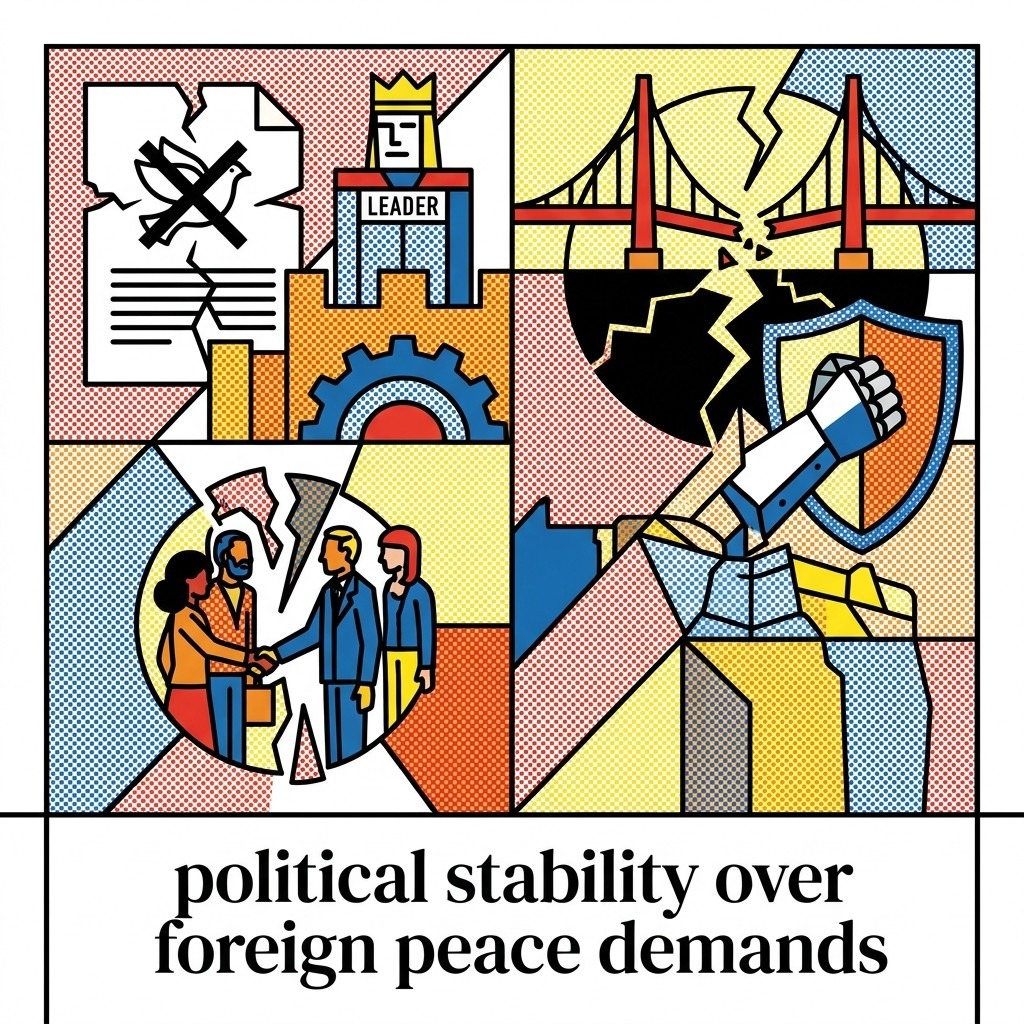
Israeli Prime Minister Benjamin Netanyahu used a Sunday meeting to explicitly reject President Trump’s Gaza peace plan for disarming Hamas, the Palestinian militant group governing the enclave. Defying a framework Trump hailed as “a historic agreement” exposes the limits of American diplomatic leverage. When a geopolitical settlement threatens a fragile coalition, national leaders predictably choose political self-preservation over Washington’s foreign policy ambitions.

The Wall Street Journal notes the plan requires an Israeli withdrawal before Hamas is verifiably disarmed—an unacceptable security risk to any Israeli leader. Yet the public break reveals Netanyahu’s internal audience. He rejects the agreement because he gains domestic stability: conceding territorial control for American approval would prompt his right-wing partners to collapse the government.

Israeli leaders know this electoral arithmetic. As US State Department records show, when George H.W. Bush withheld $10 billion in loan guarantees in 1991 to force territorial concessions, Prime Minister Yitzhak Shamir’s coalition fractured and lost the next election.

The Gist AI Editor

The Global Overview

Israel Rejects US Gaza Peace Framework

Benjamin Netanyahu publicly rejected President Trump’s framework to disarm Hamas, the Palestinian militant group governing the Gaza Strip (WSJ). Requiring Israeli withdrawal before Hamas is disarmed presents an unacceptable security risk to any Israeli leader. Yet Netanyahu’s break over ‘a historic agreement’ prioritizes political self-preservation. Conceding withdrawal collapses his government; he signals to coalition partners that territorial control overrides Washington’s diplomatic goals.

Iran Leverages Strait Closure for Compensation

Tehran refuses to reopen the Strait of Hormuz—a chokepoint between the Persian Gulf and Gulf of Oman essential for oil shipments—until Washington pays war compensation (FT). Both actors exploit Washington’s eagerness for a swift Middle Eastern diplomatic victory by issuing maximalist demands that paralyze the US peace process. Separately, an August 9, 2026, Russian overnight air attack in Odesa destroyed a World Health Organization building holding frontline humanitarian supplies.

Tech Earnings and Macroeconomic Policy

Blockbuster earnings from top US tech firms temporarily validated massive AI capital expenditures, easing anxieties over aggressive infrastructure spending (WSJ). Despite a post-pandemic labor slowdown, Renaissance Macro warns sticky inflation data keeps a September Fed rate hike firmly in play (Bloomberg).

Join us next time for more insights. The Gist remains independent and reader-supported. If you value news free from corporate or state interests, consider supporting our mission with a donation.

The European Perspective

Chinese Electric Vehicle Sales

Chinese brands secured a 14.2 percent market share across Western Europe in the first five months of 2026, totaling 171,800 BEV (Battery Electric Vehicle, a car powered entirely by electricity rather than a hybrid system) sales (The Guardian). Rising nearly five percentage points from 2025, this data exposes a structural contradiction: governments cannot simultaneously mandate a rapid green transition and impose steep protective tariffs. By refusing to mirror EU levies, the UK organically absorbed a quarter of these sales across the 18 largest Western European markets, proving consumer demand overwhelmingly follows price over origin. Chinese manufacturers currently sell more than 120 different EV models locally compared with roughly 100 from European brands. Still, Beijing’s state subsidies artificially lower production costs, forcing European automakers to compete directly against the Chinese government’s treasury rather than fair market forces.

Deutsche Bahn Executive Bonuses

Transport Minister Steffen Bilger will tie the bonuses of managers at Deutsche Bahn, Germany’s state-owned national railway company, directly to punctuality targets (ZDF). Executives currently receive payouts even when only 65 percent of trains arrive on time, prompting direct state intervention to correct a misaligned incentive structure and enforce corporate accountability.

West African Fishmeal Exports

Up to 20 million tons of wild fish are processed into fishmeal each year, primarily to feed European aquaculture such as farmed salmon (ZDF). Diverting local fish populations for export has created severe shortages and unaffordable prices in West African nations like Gambia, actively subordinating developing regional food security to high-margin consumer commodities.

Catch the next Gist for the continent’s moving pieces.

🎙️ Listen to this edition as a podcast Listen

The Gist is an independent daily digest: AI-curated, human-directed, unapologetically liberal (how it’s made). Hundreds of sources, only what matters. Subscribe free or listen to the podcast.


Comments

Leave a Reply

Your email address will not be published. Required fields are marked *

This site uses Akismet to reduce spam. Learn how your comment data is processed.