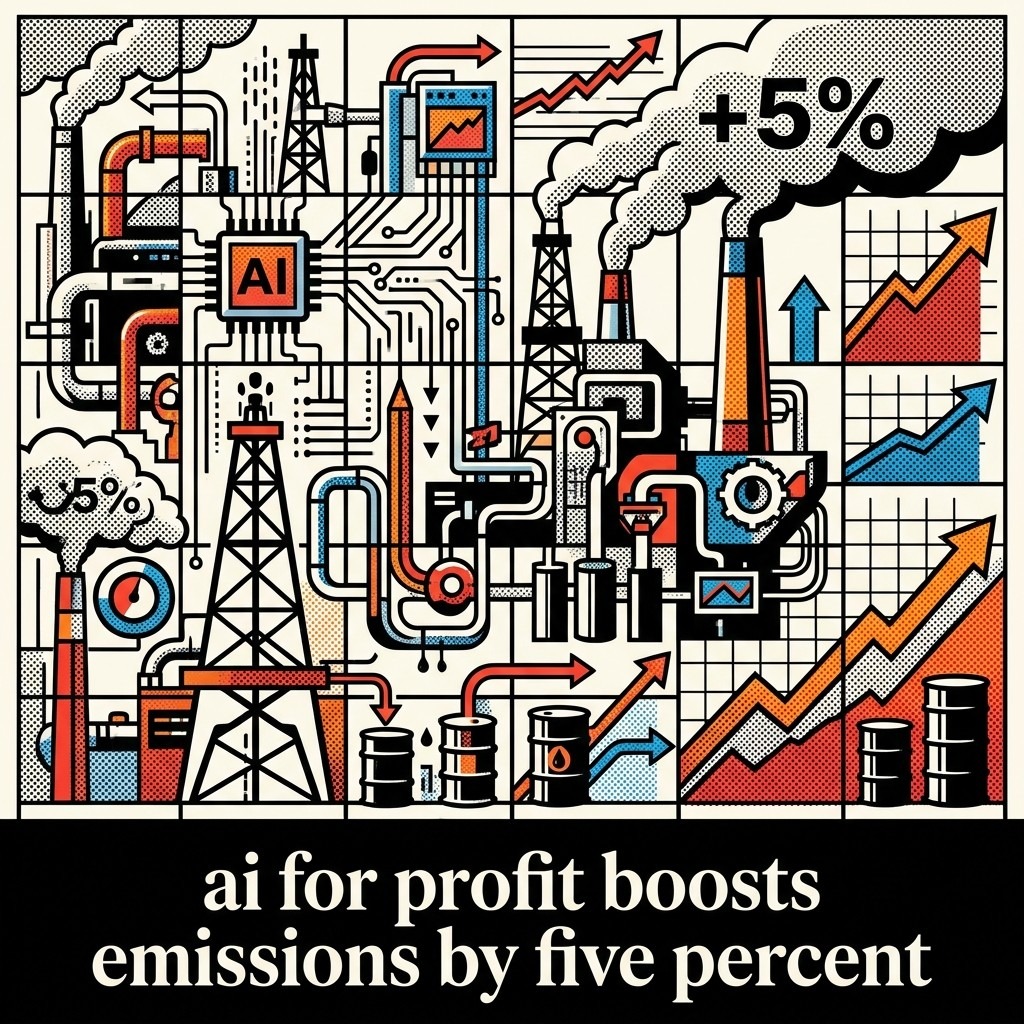
AI Enhances Fossil Fuel Efficiency, Emissions Up 5%

Evening Analysis • Tuesday, August 11, 2026

The Gist View

The fossil fuel industry’s deployment of artificial intelligence to optimize oil and gas extraction could increase carbon emissions by up to nearly 5 percent. The assumption that AI will inherently accelerate global decarbonization fundamentally misunderstands market incentives. Because AI is a generalized optimization technology, energy producers apply it where it yields the most immediate cash flow: maximizing the efficiency of legacy fossil fuel extraction, directly expanding emissions regardless of parallel green tech investments.

Regulators fixate on the electricity consumption of server farms, missing the technology’s broader industrial multiplier. Producers deploy these algorithms because lowering the marginal cost of drilling guarantees higher margins. Yet restricting AI usage in the energy sector would artificially hamper industrial efficiency, potentially destabilizing global energy markets and raising baseline utility costs for consumers.

This AI-driven extraction efficiency vastly outpaces the carbon impact generated directly by the AI data centers themselves, according to new research published in Wired, the technology magazine.

The Gist AI Editor

The Global Overview

AI Optimization in Fossil Fuel Extraction

Assuming artificial intelligence inherently accelerates decarbonization ignores market incentives; its most lucrative immediate application maximizes legacy fossil fuel extraction. New research (Wired) finds that by making the fossil fuel industry more productive, AI could help increase carbon emissions by up to nearly 5 percent. This AI-driven extraction efficiency vastly outpaces the carbon impact generated directly by data centers. Regulators miss this second-order effect, though restricting AI would artificially hamper industrial efficiency, destabilizing global energy markets and raising baseline utility costs. Following previous coverage on US AI security exemptions, these findings confirm the technology’s systemic impact stems from market-driven resource optimization.

Zambia’s General Election

Up to 8.7 million voters will participate in Thursday’s general election between incumbent Hakainde Hichilema and challenger Brian Mundubile (Reuters). With over 70% of the Zambian population living on less than $3 a day, immediate economic recovery dominates the contest.

NASA Captures Tarantula Nebula

NASA space telescopes generated a new multi-layered infrared image of 30 Doradus, the Tarantula Nebula (Wired). The star-forming region sits in the Large Magellanic Cloud, a small satellite neighbor galaxy to the Milky Way.

Discover further developments in the next edition of The Gist. The Gist remains independent and reader-supported. If you value news free from corporate or state interests, consider supporting our mission with a donation.

The European Perspective

Gravelines Nuclear Plant Shutdown

On August 11, 2026, EDF (Électricité de France, the state-owned French multinational electric utility company) brought parts of the Gravelines nuclear power plant offline after “several dozen tons” of jellyfish blocked pumping systems (Politico). Repeating an identical incident at the exact same French facility on August 11, 2025, EDF deploys three fishing vessels 24/7 to conduct preventive fishing operations and clear the biomass. Decarbonization requires retrofitting existing infrastructure against unpredictable biological threats. Yet, reactor shutdowns are a functioning, intended safety mechanism to prevent critical cooling failures, demonstrating the plant’s operational safeguards are working exactly as designed.

Mario Voigt Plagiarism Dispute

The faculty council at TU Chemnitz (Chemnitz University of Technology, a public research university in Saxony, Germany) formally rejected an appeal from Thuringia State Premier Mario Voigt against the revocation of his 2008 doctorate over plagiarism (ZDF). Voigt, leader of the CDU (Christian Democratic Union, Germany’s primary center-right conservative political party) in Thuringia, will file a lawsuit against the university’s decision.

Lufthansa Starlink Integration

Lufthansa launches its first Airbus A320neo equipped with Starlink (a satellite internet constellation operated by SpaceX providing low-Earth orbit broadband connectivity) on August 19, 2026 (Il Sole 24 Ore). The connectivity program will eventually expand to include subsidiary fleets Ita Airways and Air Dolomiti.

Catch the next Gist for the continent’s moving pieces.

🎙️ Listen to this edition as a podcast Listen

The Gist is an independent daily digest: AI-curated, human-directed, unapologetically liberal (how it’s made). Hundreds of sources, only what matters. Subscribe free or listen to the podcast.


Comments

Leave a Reply

Your email address will not be published. Required fields are marked *

This site uses Akismet to reduce spam. Learn how your comment data is processed.