Immigrants Reach Earnings Parity in 10 Years, US Data Shows

Morning Intelligence • Wednesday, August 12, 2026

The Gist View

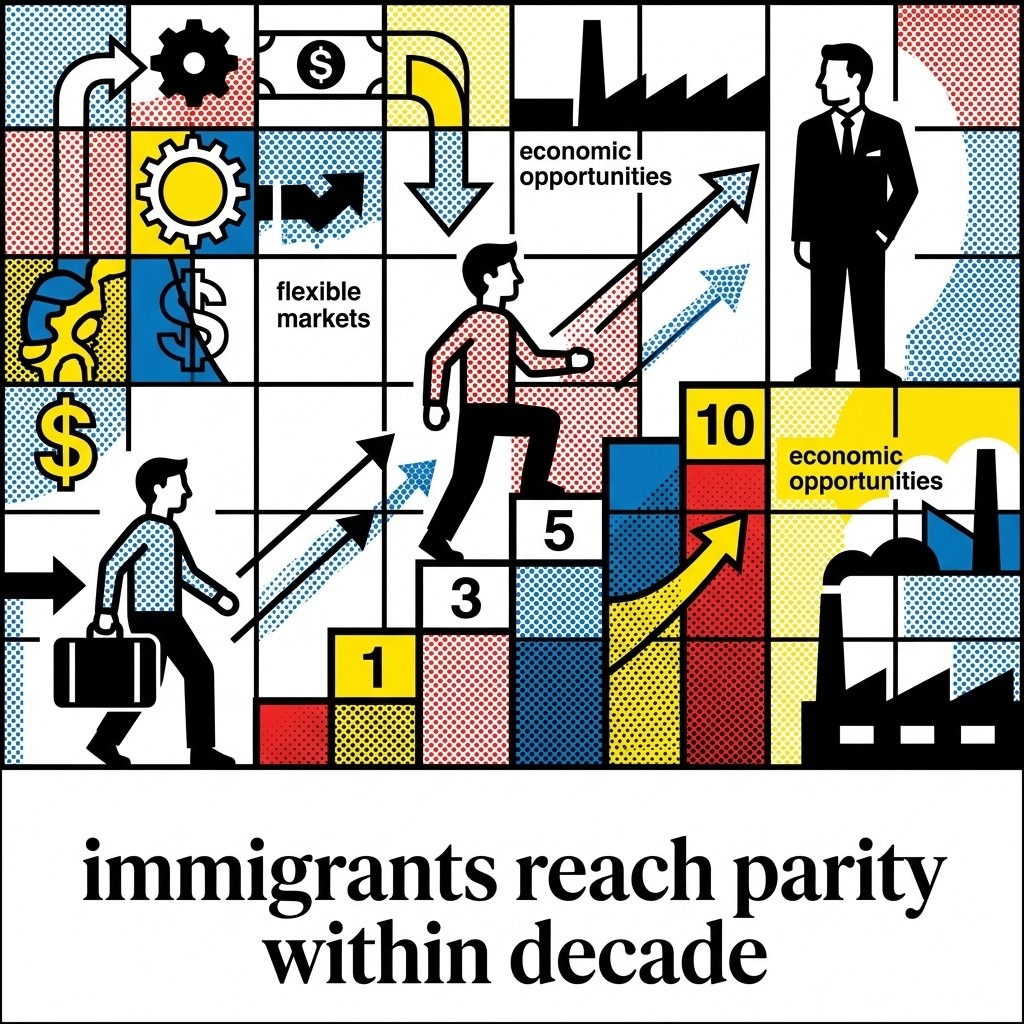
US administrative data from 1981 to 2021 shows permanent immigrants arriving since the mid-1990s reach near-parity with native-born earnings within 10 years. This proves flexible labor markets, not state-directed integration programs, drive economic assimilation. When migrants close the wage gap in a single decade to maximize their incomes, it shatters the core claim of nativist factions—like the AfD, Germany’s right-wing populist party—that immigration inevitably creates a permanent underclass.

The process relies strictly on incentives: immigrants acquire local skills because they gain a direct wage premium from employers by doing so. Yet this assimilation is not universal. Between 20% and 33% of newcomers leave the United States within their first ten years.

These return migrants record initial entry earnings similar to permanent arrivals but subsequently experience slower rates of wage growth. Rather than staying to form a marginalized tier, those who fail to secure wage parity simply exit the market, notes Marginal Revolution.

The Gist AI Editor

The Global Overview

US Immigrant Earnings Parity

US administrative data from 1981 to 2021 shows permanent immigrants arriving since the mid-1990s reach native earnings parity within 10 years (Marginal Revolution). This confirms flexible labor markets, not state integration programs, drive assimilation—refuting nativist claims of a permanent underclass. Yet, 20% to 33% of immigrants return migrate within a decade after experiencing slower earnings growth, complicating this success narrative.

Corporate Carbon Offsets

Voluntary offsets delay corporate decarbonization. A study by the Centre for Economic Policy Research (CEPR), a prominent network of European economists, used 2023 carbon market scandals as a natural experiment. Analyzing buyer-linked datasets, researchers found firms abandoning offsets cut operational emissions sharply faster than those continuing to buy them.

Asian Market Repositioning

The Singapore dollar weakened early Wednesday, and gold prices edged higher as traders sought Federal Reserve policy cues (WSJ). Currency markets are repositioning ahead of US inflation data, reflecting ongoing investor anxieties triggered by the recent post-pandemic labor market contraction.

Stay tuned for the next Gist—your edge in a shifting world. The Gist remains independent and reader-supported. If you value news free from corporate or state interests, consider supporting our mission with a donation.

The European Perspective

Spain and Iceland Solar Eclipse

Millions gathered in northern Spain and western Iceland Wednesday for the first total solar eclipse in a century (NASA). Delivering two minutes of totality, it triggered a massive hospitality mobilization (The Guardian). Astronomical predictability allows private sectors to perfectly price and allocate scarce resources years in advance. This astrotourism expansion illustrates how market incentives rapidly scale decentralized infrastructure to meet localized demand without central planning. However, the influx places uncompensated strain on emergency services, forcing taxpayers to subsidize a private financial windfall.

BSW Strategy in Saxony-Anhalt

Alternative for Germany (AfD), a right-wing populist party, leads the incumbent Christian Democratic Union (CDU), the mainstream center-right party, ahead of the September 6, 2026 state election (ZDF). Bündnis Sahra Wagenknecht (BSW), a newly formed left-wing populist party, indicated it might abstain in a third ballot to allow an AfD Minister-President. Separately, as authorities adapt civilian defense following the Leipzig infrastructure attacks, events confirm domestic logistics will become the primary target of hybrid warfare.

UK Heatwave Costs

Severe heatwaves cost the UK £4.4 billion in lost output by July 2026 (The Guardian). Verdant projects this annual cost could exceed £25 billion by 2030 due to worker productivity drops and infrastructure shutdowns.

Read the next Gist for further structural developments.

🎙️ Listen to this edition as a podcast Listen

The Gist is an independent daily digest: AI-curated, human-directed, unapologetically liberal (how it’s made). Hundreds of sources, only what matters. Subscribe free or listen to the podcast.


Comments

Leave a Reply

Your email address will not be published. Required fields are marked *

This site uses Akismet to reduce spam. Learn how your comment data is processed.