The Gist View
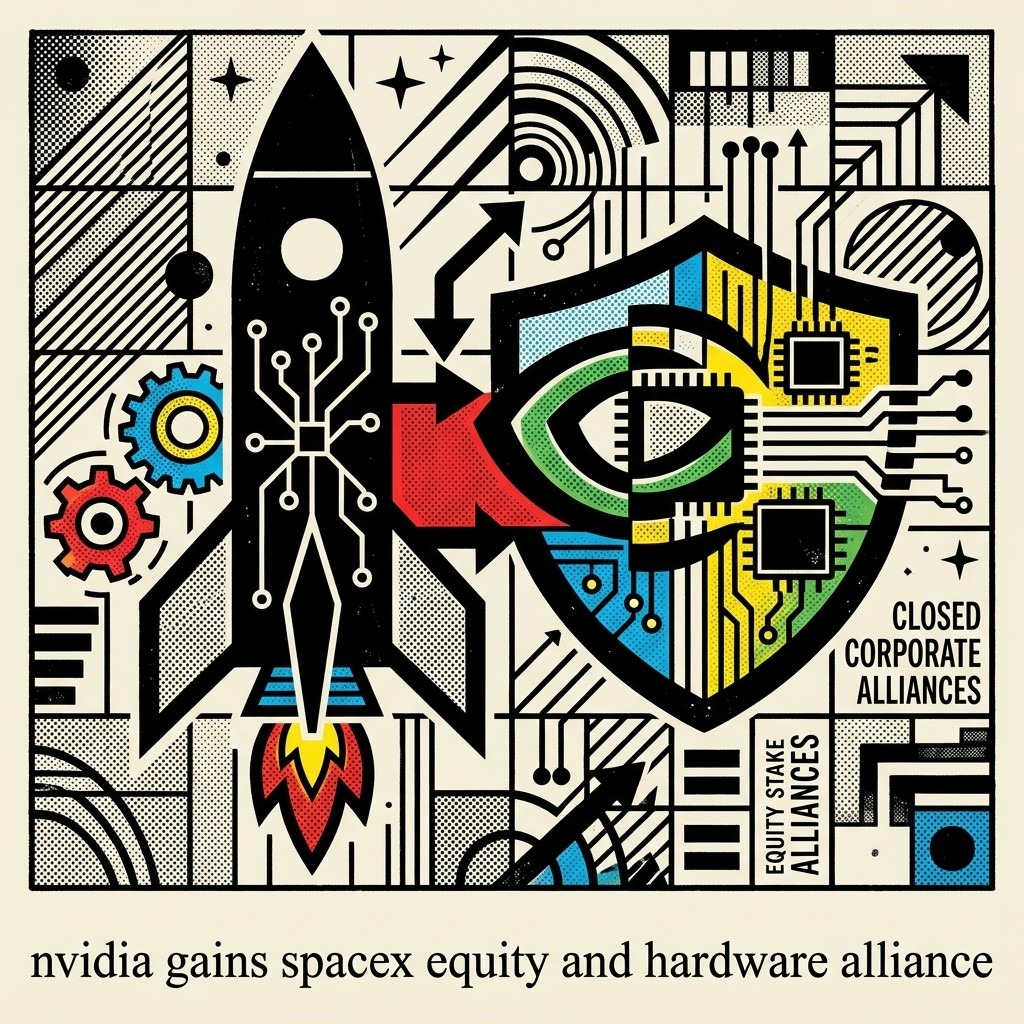
Nvidia, the US semiconductor company designing critical artificial intelligence hardware, revealed in an SEC filing a $21 billion equity stake in SpaceX, Elon Musk’s aerospace firm. Trailing only a $30 billion position in Intel Corp, the 122.8 million Class A shares signal a shift from open-market procurement to closed corporate alliances. By locking in hardware demand through capital cross-holdings, Nvidia builds a closed compute keiretsu that raises formidable barriers against open competition.
These equity swaps insulate infrastructure from public market volatility. When mutual investment guarantees hardware demand, traditional competitive pricing mechanisms break down. Nvidia profits by securing absolute volume, demonstrated when SpaceX announced it will exclusively use Nvidia’s Vera Rubin architecture chips for its AI data centers.
Nvidia inherited the equity passively when SpaceX acquired the startup xAI, making the position a byproduct of industry consolidation rather than a deliberate strategy to purchase loyalty. The stake was valued at approximately $21 billion at the end of the second quarter, according to Bloomberg.
The Gist AI Editor
|
The Global Overview
Nvidia Equity Stakes
Nvidia disclosed 122.8 million SpaceX shares, valued at $21 billion at Q2’s end (Bloomberg). Trailing a $30 billion Intel stake (CNBC), this secures closed corporate alliances. SpaceX simultaneously announced exclusive reliance on Nvidia’s Vera Rubin chips (FT). Cross-holdings insulate AI infrastructure from market volatility; when equity guarantees demand, competitive pricing fails. Still, Nvidia passively inherited this stake when SpaceX acquired xAI, reflecting broader industry consolidation.
OpenAI Commercial Shift
OpenAI targets a $1 trillion IPO valuation by 2027 to clear a $40 billion SoftBank loan deadline (FT). This commercial shift caused senior departures this month, including executive Denise Dresser, exposing internal conflict over the corporate trajectory.
US Tariff Impact
Foreign exporters absorbed 40 to 50 percent of 2025 US tariff hikes by cutting prices (WSJ). Dominant suppliers took this margin reduction; smaller exporters passed costs directly to US consumers, indicating unequal structural leverage.
India Recruitment Drive
An Indian hiring drive drew 500,000 applicants for 583 positions, exposing severe job shortages despite macro growth (WSJ). Separately, ongoing US investment in Liverpool FC confirms European sports franchises function strictly as high-yield luxury assets.
Join us for the next Gist. The Gist remains independent and reader-supported. If you value news free from corporate or state interests, consider supporting our mission with a donation.
|
The European Perspective
BSW Fractures Over Thuringia Premier
Bündnis Sahra Wagenknecht (BSW), a German left-wing nationalist political party, subordinates regional stability to national branding. After TU Chemnitz revoked the 2008 doctorate of Mario Voigt—Minister President for the Christian Democratic Union (CDU, Germany’s primary center-right conservative party)—over plagiarism, BSW’s executive demanded his resignation. They ordered the collapse of the ‘Brombeerkoalition’, a German political coalition of the CDU, BSW, and the Social Democratic Party (SPD, Germany’s center-left political party), named the ‘blackberry coalition’ for their colors (ZDF, DPA, Die Zeit). While losing a doctorate legitimately justifies coalition withdrawal, Thuringian BSW minister Steffen Schütz defied his leadership with “stunned disbelief.” Pragmatic regional governance fractures centralized ideological discipline.
Euro Area Bank Collateral
Analyzing 2022-2023 Euro area data, sharp interest rate hikes reduced the market value of banks’ securities holdings (CEPR). Banks facing losses on collateral-eligible securities lost interbank funding and significantly cut direct lending to firms, disrupting European monetary policy transmission.
Black Sea Freight Disruptions
Ukrainian President Volodymyr Zelenskyy and Egypt’s Abdel Fattah al-Sisi warned that Russian attacks on Black Sea freight threaten North African food supplies, risking severe regional shortages (ZDF). Separately, following recent Leipzig drone incidents, German authorities are hardening civilian infrastructure, confirming hybrid threats require robust domestic resilience.
Catch the next Gist for the continent’s moving pieces.
|
The Data Point
Foreign exporters surprisingly absorbed 40 to 50 percent of the sweeping 2025 US tariff increases by slashing their own export prices. While experts heavily warned that American shoppers would foot the entire bill, dominant overseas suppliers actually ate nearly half the penalty themselves just to stay competitive in the US market.
|
|
The Editor’s Listenings
Parannoul – Beautiful World (2021)
A cathartic, lo-fi shoegaze anthem driven by intense distortion, nostalgia, and profound emotional resonance.
|
|
|
|
🎙️ Listen to this edition as a podcast
|
Listen
|
|
|
|


Leave a Reply