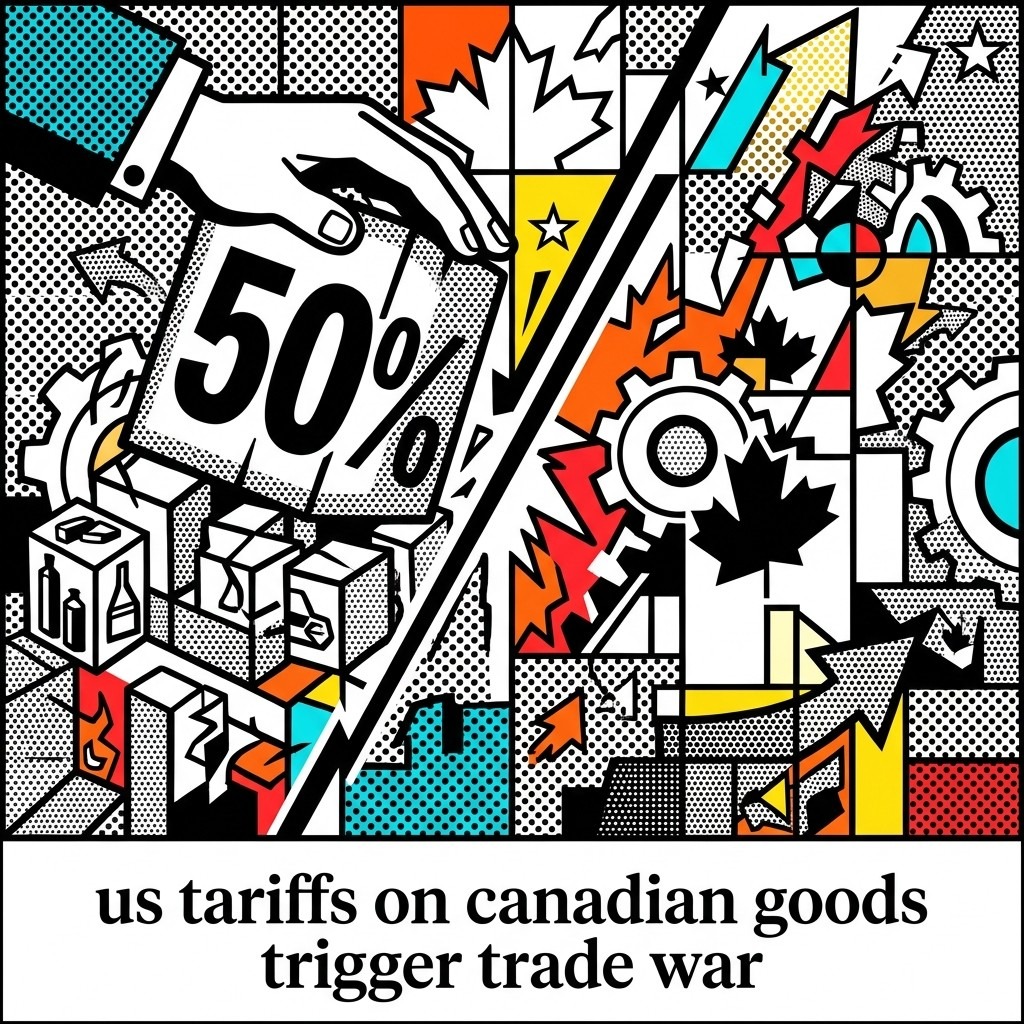
US Imposes 50% Tariffs on $20B Canadian Goods

Evening Analysis • Sunday, August 23, 2026

The Gist View

At midnight on Friday, the United States imposed 50% tariffs on roughly $20 billion of Canadian goods after bilateral trade talks collapsed. This breakdown over arbitrary executive demands proves that discretionary managed trade inevitably devolves into mutually destructive consumer taxes. When tariffs are deployed as capricious political weapons rather than economic safeguards, domestic populations bear the brunt of the resulting volatility.

The negotiations cratered not over core trade economics, but due to US executive overreach into Canadian domestic policy and internal factional disputes in Washington. Canada’s persistent protection of politically sensitive supply-managed sectors, like dairy, fundamentally distorts free markets and invites aggressive US countermeasures to force parity. Yet Canadian Prime Minister Mark Carney suspended negotiations and promised matching “dollar for dollar” retaliatory tariffs because his government gains domestic political survival by refusing to bow to foreign coercion.

US Trade Representative Jamieson Greer claimed Ottawa walked back commitments at the eleventh hour, but Carney cited “unfair, uneconomic” last-minute US demands to explain the collapse, Global News reports.

The Gist AI Editor

The Global Overview

US-Canada Trade Agreement Collapse

The collapse of US-Canada trade talks proves discretionary tariffs function as blunt consumer taxes. At midnight Friday, the US imposed 50% tariffs on $20 billion of Canadian goods. Prime Minister Mark Carney suspended negotiations, promising dollar-for-dollar retaliation (The Guardian). US Trade Representative Jamieson Greer cited broken commitments; Carney blamed uneconomic US demands (Global News). Talks cratered over US executive overreach and internal Washington factional disputes, though Canada’s protection of supply-managed dairy sectors undeniably distorts markets. It adds self-inflicted barriers to supply chains already stressed by ongoing Eastern European sabotage.

Alibaba’s AI Infrastructure Placement

Alibaba announced a $10.2 billion share placement in Hong Kong to fund AI infrastructure (FT). This record follow-on follows a 75% year-over-year drop in quarterly net profit driven by heavy capital expenditures. Systemic AI competitiveness now demands punishing short-term corporate balance sheets to secure permanent physical computing leverage.

Kevin Warsh at Jackson Hole

Kevin Warsh, the current Chair of the US Federal Reserve, addresses Jackson Hole—an annual economic policy symposium in Wyoming—on August 27 (Bloomberg). With US 10-year Treasury yields at 4.73%, capital markets demand clarity on inflation and rate hikes following recent Treasury interventions.

Stay tuned for the next issue. The Gist remains independent and reader-supported. If you value news free from corporate or state interests, consider supporting our mission with a donation.

The European Perspective

Ukrainian Electoral Dispute

Mykhailo Fedorov, Ukraine’s recently dismissed defense and digital minister, publicly demanded a legal mechanism to hold elections, arguing democracy “cannot be held hostage.” This internal push from a popular reformist, rather than from external Western allies, signals growing domestic friction over centralized wartime governance and challenges the consensus that indefinite martial law is necessary. President Volodymyr Zelensky explicitly rejected these demands on August 23, warning they would be a “tsunami” that would split the country. While Zelensky’s five-year mandate officially concluded in May 2024, organizing a secure, representative vote is functionally impossible while millions of Ukrainians are refugees and frontline soldiers remain under continuous Russian artillery fire (The Guardian, Kyiv Independent, CBS News).

Italian Highway Fuel Pricing

Diesel fuel prices on Italy’s highway network surged past 2.20 euros per liter during the late-August counter-exodus travel weekend. This spike reveals sharp disparities between highway service stations and local roads amid high seasonal demand, demonstrating how infrastructure operators leverage captive domestic migration flows to extract premium pricing (Il Sole 24 Ore). Concurrently, Belgian and German emergency teams are maintaining deliberate flood barriers to contain protracted peat fires, testing a novel climate adaptation tactic.

Aachen World Equestrian Championships

German showjumpers missed out on individual medals at the World Championships in Aachen, as Swiss rider Steve Guerdat won the individual world title in the final event (ZDF).

Catch the next Gist for the continent’s moving pieces.

🎙️ Listen to this edition as a podcast Listen

The Gist is an independent daily digest: AI-curated, human-directed, unapologetically liberal (how it’s made). Hundreds of sources, only what matters. Subscribe free or listen to the podcast.


Comments

Leave a Reply

Your email address will not be published. Required fields are marked *

This site uses Akismet to reduce spam. Learn how your comment data is processed.