SpaceX to Invest $100B for AI Network via 1M Satellites

Morning Intelligence • Wednesday, August 26, 2026

The Gist View

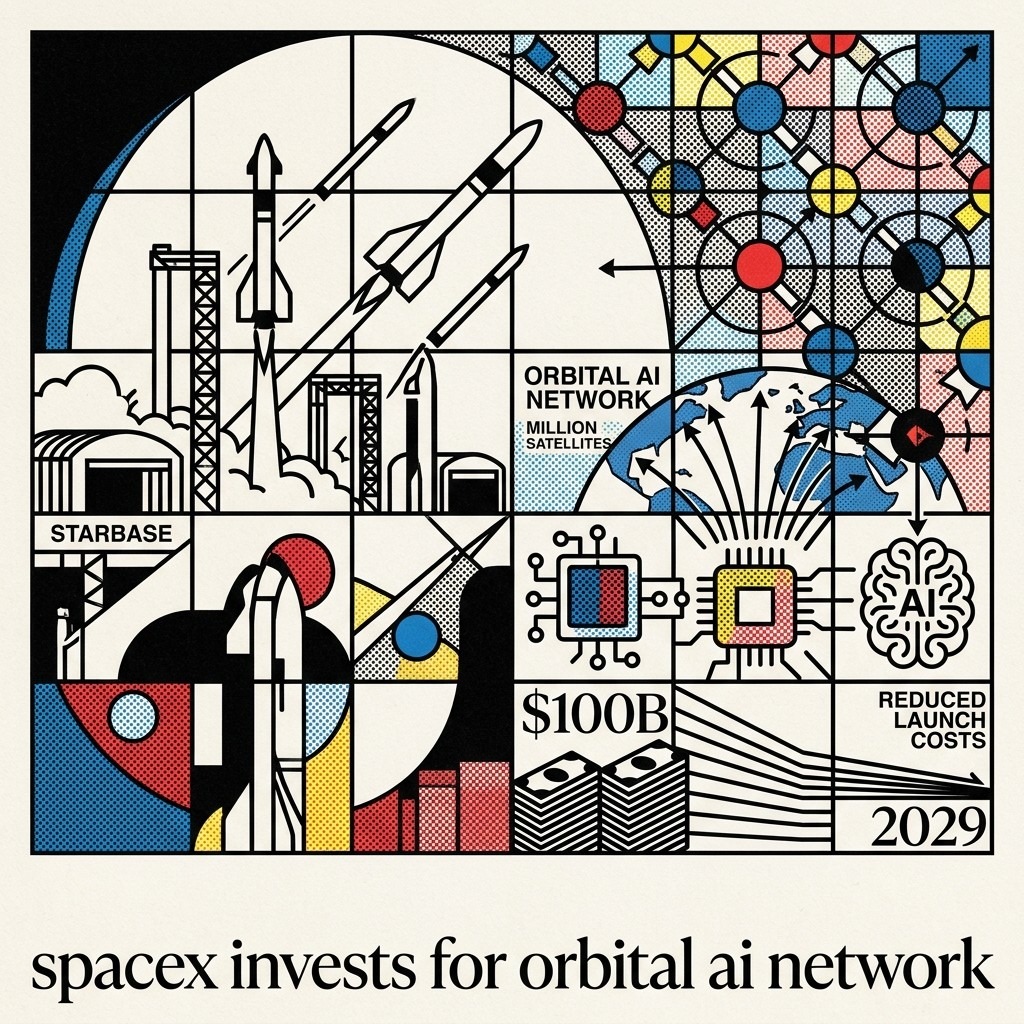
SpaceX, Elon Musk’s dominant commercial spaceflight company, is committing $100 billion to build Starbase Louisiana on 125,000 acres to launch artificial intelligence infrastructure into orbit. Space is no longer a mere vantage point; it is becoming the primary physical layer for the next era of technological power. The bottleneck for AI is shifting from terrestrial power grids to orbital payload capacity.

The company has filed to launch up to a million satellites for Starmind, an orbital data center network equipped with GPUs from Nvidia, the US semiconductor giant whose chips are the industry standard. SpaceX is betting that falling launch costs will soon undercut terrestrial land, power, and cooling expenses. While exposing delicate silicon to a high-radiation vacuum introduces hardware failure rates that terrestrial centers never face, bypassing Earth’s physical limits justifies the massive capital risk.

The Starbase complex targets thousands of Starship launches annually by 2029 to deploy the network, reports the Financial Times.

The Gist AI Editor

The Global Overview

SpaceX Plans Orbital Data Centers

SpaceX announced a $100 billion investment in ‘Starbase Louisiana’ across 125,000 acres, targeting thousands of launches by 2029 to deploy a million-satellite network named Starmind (FT). Nvidia will supply the GPUs. SpaceX is betting that satellite launch and maintenance costs will soon undercut terrestrial expenses for land, grid power, and cooling. Concurrently, the Trump administration is advancing the ‘Golden Dome’ space defense initiative, estimated by the Congressional Budget Office to cost up to $1.2 trillion, with Northrop Grumman expecting a decent share of the contracts (Bloomberg). Both moves show a structural shift where governments and tech monopolies alike move critical computation and defense infrastructure into orbit to bypass terrestrial constraints on land, power, and regulation. Yet, launching delicate AI chips into a high-radiation vacuum with zero gravity introduces unprecedented hardware failure rates and maintenance costs that terrestrial centers never face.

XPeng Pivots to Humanoid Robotics

Chinese electric vehicle manufacturer XPeng raised $900 million at a $6.2 billion valuation for its standalone humanoid robotics subsidiary (WSJ). Co-President Brian Gu stated the company expects humanoid robot gross margins to eventually eclipse its core automotive business. This funding signals a broader pivot of capital from saturated electric vehicle markets into general-purpose physical AI.

Iran and Oman Negotiate Maritime Corridor

As Washington continues its ‘Operation Economic Outcast’ sanctions against Tehran, new reports that Iran and Oman are discussing a temporary maritime corridor in the Strait of Hormuz confirm our view that maximalist blockades quickly spur alternative trade workarounds.

Join us for the next edition to track exactly where global capital moves next. The Gist remains independent and reader-supported. If you value news free from corporate or state interests, consider supporting our mission with a donation.

The European Perspective

Reform UK Targets Data Regulation

Reform UK leader Nigel Farage and MP Robert Jenrick propose scrapping the UK’s version of the General Data Protection Regulation (GDPR), Europe’s stringent data privacy and security framework (Politico). Calling it “suffocating EU red tape,” they advocate a New Zealand-style regime to boost tech innovation. Europe’s model of preemptive tech regulation faces a domestic political reckoning, as populists correctly identify the GDPR as a structural tax on small businesses. While sold as a check on Big Tech, high compliance costs paradoxically entrench incumbents who can afford lawyers, starving startups. However, abandoning it would restrict data flows with the EU, severely crippling British service exports.

Franco-German Industrial Dispute

France and Germany are colliding over EU industrial policy (Politico). Paris demands aggressive “Made in Europe” regulations to protect domestic manufacturing. Berlin is formally pushing back, warning that such measures risk provoking trade wars that would damage export-driven economies.

German Coalition Negotiates Systemic Reforms

Finance Minister Lars Klingbeil committed to passing a major overhaul of German pension and social security systems by the end of 2026 (ZDF). These structural reforms are being negotiated within a fragile grand coalition between Chancellor Friedrich Merz’s Christian Democratic Union (CDU), Germany’s center-right conservative party, and Klingbeil’s Social Democratic Party of Germany (SPD), the center-left governing partner. Simultaneously, following the state-backed sabotage attempt at Leipzig airport, Merz faces intense pressure to plug gaps in Germany’s security architecture, exposing the exact vulnerabilities in critical infrastructure we highlighted yesterday.

Catch the next Gist for the continent’s moving pieces.

🎙️ Listen to this edition as a podcast Listen

The Gist is an independent daily digest: AI-curated, human-directed, unapologetically liberal (how it’s made). Hundreds of sources, only what matters. Subscribe free or listen to the podcast.


Comments

Leave a Reply

Your email address will not be published. Required fields are marked *

This site uses Akismet to reduce spam. Learn how your comment data is processed.