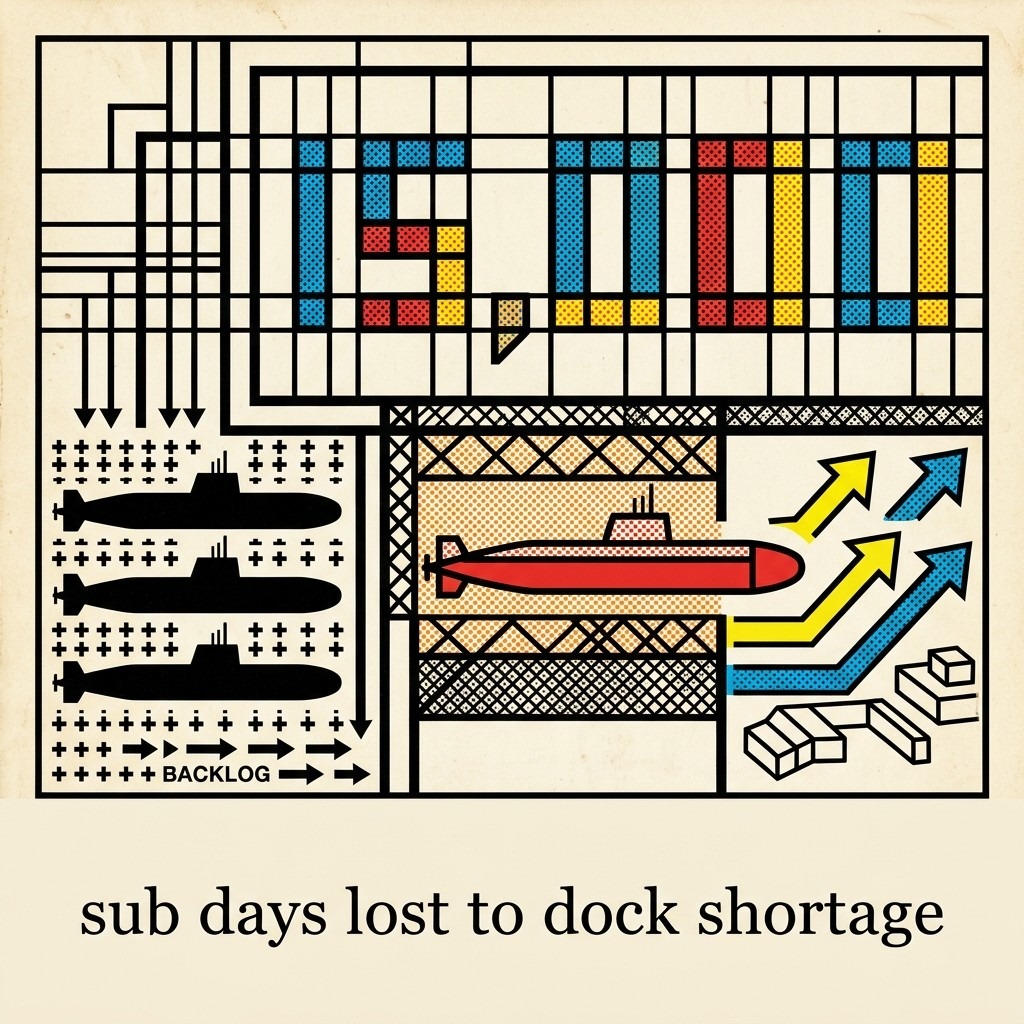
US Navy Lost 15,000 Sub Days Due to Dry-Dock Shortage

Evening Analysis • Thursday, August 27, 2026

The Gist View

The US Navy forfeited 15,000 operational days across its attack submarine fleet since 2016 simply because it lacks the physical dry-docks to maintain them. American power projection relies more heavily on mundane repair logistics than on advanced weaponry. Because expanding coastal yards requires immense capital and environmental clearances, the military rationally prioritizes procuring new submarines over funding the concrete infrastructure to fix them.

This bureaucratic preference quietly hollows out American maritime projection. When the Pentagon rewards commissioning vessels but neglects the depots required to service them, the effective fleet shrinks. Rival powers measure deterrence not by total hull counts, but by deployable assets in the water.

The backlog is a delayed invoice from post-Cold War consolidation, when Washington closed four public naval shipyards between 1991 and 1996 to capture immediate savings, notes the Government Accountability Office, an independent agency that investigates federal spending.

The Gist AI Editor

The Global Overview

US Navy Attack Submarines

Thursday’s report from the US Government Accountability Office (GAO)—an independent agency investigating federal spending—revealed the US Navy lost 15,000 operational days for its attack submarines since 2016 (GAO, Bloomberg, The Economic Times). Maintenance delays of up to four years cost approximately $3.4 billion over the past decade. A critical dry-dock space shortage for 44 Los Angeles-class and Virginia-class submarines drives this backlog. This proves geopolitical deterrence is constrained less by defense budgets than by a decayed physical industrial base and regulatory bottlenecks.

Arkin Group and Niels Troost

US corporate intelligence firm Arkin Group dropped its legal claim against Dutch oil trader Niels Troost (FT). Arkin stated it was deceived by client Gaurav Srivastava, who falsely posed as a spy for the Central Intelligence Agency (CIA), the primary US civilian intelligence service.

Nepal-China Glacier Flood

A flash flood along the Nepal-China border on August 26, 2026, killed at least 353 people, leaving over 1,300 missing (WSJ). Preliminary investigations suggest the event triggered when a massive glacier chunk broke off, temporarily dammed a river, and burst.

US Treasury Yields

Investors are now marking up their expectations for long-run economic growth in the US (FT). This slightly complicates our prior thesis that the Treasury’s aggressive bond buybacks were purely a liquidity manipulation tactic.

Join us for the next edition of The Gist to stay ahead of systemic global shifts. The Gist remains independent and reader-supported. If you value news free from corporate or state interests, consider supporting our mission with a donation.

The European Perspective

ESA Awards €158.9 Million Contract to PLD Space

On August 27, 2026, ESA (the European Space Agency, an intergovernmental organization dedicated to space exploration) signed a €158.9 million contract with Alicante-based PLD Space (Euronews). The deal, funded primarily by Spain with German contributions, backs the MIURA 5 rocket to deliver payloads of up to 540 kg to a sun-synchronous orbit (ESA). Europe’s capital allocation exposes a reactive industrial policy: while US operators scale orbital infrastructure, Europe spends public funds merely to secure basic launch access. This contract functions less as a catalyst for technological innovation and more as a sovereign insurance policy against relying entirely on American commercial launch providers. Nurturing a domestic provider with guaranteed state contracts is exactly how the US successfully incubated SpaceX before it became commercially viable.

Poland Declines NATO Nuclear Deployments

On Thursday, Poland’s Deputy Defense Minister Paweł Zalewski explicitly ruled out hosting allied nuclear weapons on its territory (Politico). Warsaw clarified it still intends to participate in the broader nuclear deterrence strategy of NATO (the North Atlantic Treaty Organization, a political and military alliance of European and North American countries) despite growing worries of a Russian incursion. By rejecting physical deployments while maintaining strategic integration, Poland secures regional defense guarantees while avoiding the infrastructure costs and direct target status associated with housing foreign nuclear stockpiles.

UK Labour Party Conference Access Costs Surge

The cost to attend the business day at the UK Labour Party conference has surged 83% in two years, reaching £5,500 (Politico). Lobbyists express concern they could be priced out of direct engagement with the new Prime Minister’s inner circle. This capital shift demonstrates how political access monetizes following government transitions. The ruling party leverages its newly concentrated authority to extract higher premiums from private sector actors seeking direct proximity to structural policy decisions.

Catch the next Gist for the continent’s moving pieces.

🎙️ Listen to this edition as a podcast Listen

The Gist is an independent daily digest: AI-curated, human-directed, unapologetically liberal (how it’s made). Hundreds of sources, only what matters. Subscribe free or listen to the podcast.


Comments

Leave a Reply

Your email address will not be published. Required fields are marked *

This site uses Akismet to reduce spam. Learn how your comment data is processed.