US Secures 35% Stake in Venezuelan Oil Concession

Evening Analysis • Wednesday, September 02, 2026

The Gist View

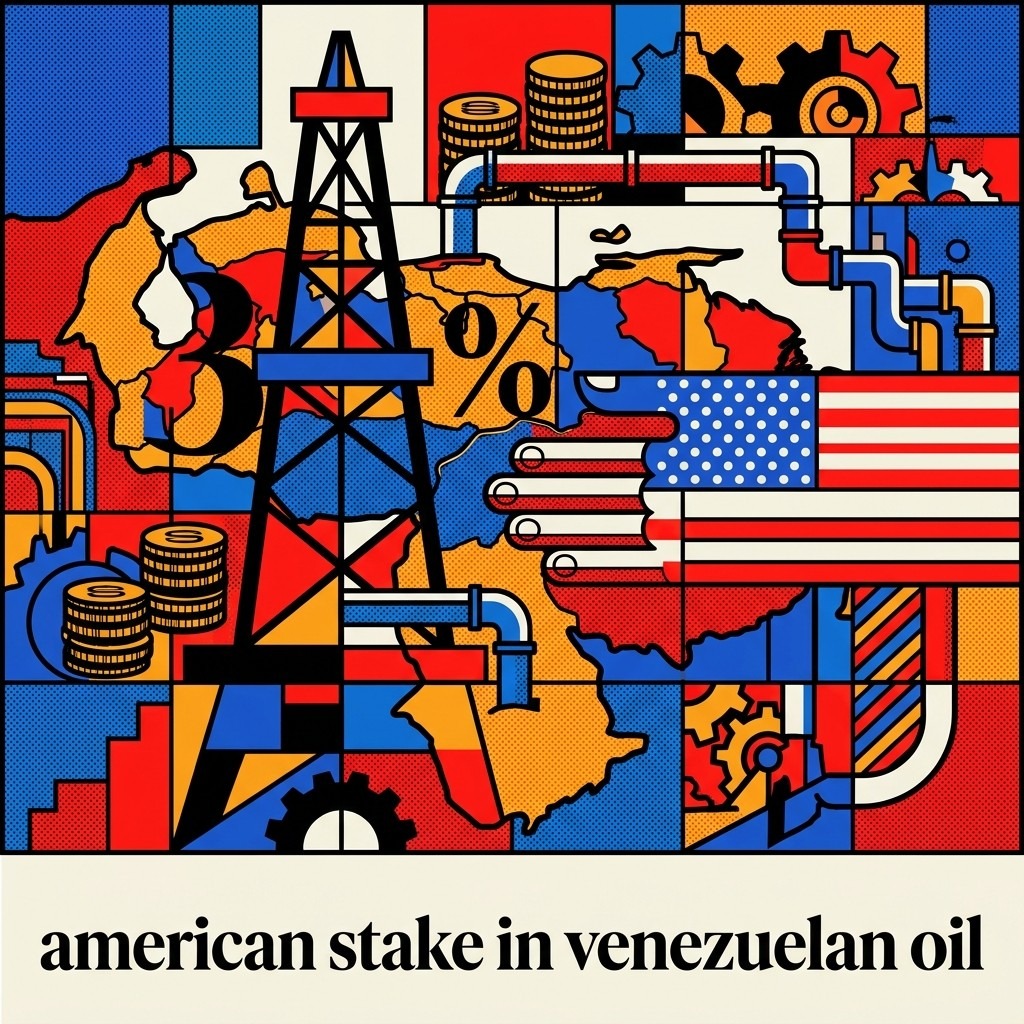
The United States government just took a direct 35% equity stake in a 100-year Venezuelan oil concession, bypassing its historical reliance on private supermajors. By routing this acquisition through the US Office of Strategic Capital—a government entity designed to scale private capital for national security—Washington permanently abandons the free-market proxy model.

Washington embraces state capitalism because it gains hemispheric resource dominance without the political risk of military intervention. The primary extraction operator, North American Blue Energy Partners, remains a private entity, allowing the deal to stabilize global supply without direct taxpayer subsidies. Yet the underlying mechanism has shifted: the American government no longer just regulates the energy market, it directly owns the production.

When Britain bought a controlling stake in the Anglo-Persian Oil Company in 1914, Winston Churchill argued to Parliament (Hansard) that naval survival required the state to act as a primary shareholder. A century later, Washington has adopted the same logic.

The Gist AI Editor

The Global Overview

US Acquires Direct Stake in Venezuelan Oil Concession

On August 28, 2026, the US and Venezuela finalized a 100-year agreement covering 17 oil fields and 65 billion barrels of reserves (Bloomberg). The US Office of Strategic Capital—a government entity designed to attract and scale private capital for national security technologies—took a 35% equity stake in the venture holding a 55% output share (Asia Times). Targeting 1.5 million barrels per day and $100 billion in private investment, the arrangement structurally mitigates Washington’s Middle East exposure. This confirms our view that escalating geopolitical risk in the Strait of Hormuz forces a rapid realignment of American energy strategy.

Uber Reallocates Capital to Autonomous Infrastructure

On September 2, 2026, Uber CEO Dara Khosrowshahi announced the dismissal of approximately 3,300 employees, cutting 10% of the global workforce (FT). These operational savings directly fund a pledged $10 billion investment in robotaxi partnerships to launch autonomous services in 15 cities this year (WSJ). This marks a strategic capital reallocation toward future transportation networks, not immediate automation of existing jobs.

Aurora Cannabis Rejects Hostile Takeover Bid

Aurora Cannabis urged shareholders on September 2 to reject an unsolicited $272 million hostile takeover bid from Curaleaf Holdings (WSJ). Management stated the offer is structurally inadequate and fundamentally undervalues its core medical and recreational divisions.

Stay tuned for the next Gist—your edge in a shifting world. The Gist remains independent and reader-supported. If you value news free from corporate or state interests, consider supporting our mission with a donation.

The European Perspective

Ukrainian Drones Escalate Aviation Risk Premiums

By deploying drone swarms to force airlines from Russian airspace, Ukraine privatizes no-fly zone enforcement, outsourcing Moscow’s economic isolation to insurers. On September 1, 2026, President Volodymyr Zelensky declared the airspace unsafe. Ukraine notified ICAO—the UN agency coordinating international air navigation—of Operation M&M’s, a plan launching 1,000 AI-guided drones daily toward Moscow. Consequently, Sheremetyevo airport saw 21 cancellations and 235 delays on September 2 (Flightradar24). This bypasses sanctions via automatic risk-premium hikes, making airspace economically unviable, though major non-Western carriers continue these routes for fuel savings (The Guardian).

Coordinated Sabotage Targets German Grid

On September 1, 2026, police found 20 homemade rockets at Brandenburg’s Turnow-Preilack substation. A subsequent attack on a Bergheim facility managed by Amprion—a German electricity transmission operator—forced five coal units from RWE, a major German energy company, offline, cutting 4.2 gigawatts of capacity (ZDF).

UK Labour Details Growth Strategy

UK Chancellor John Healey delivers his first economic address on September 7, 2026, outlining the Labour government’s strategy for accelerating domestic growth (Politico).

National Rally Courts Foreign Capital

National Rally president Jordan Bardella launched a September 2026 media blitz, addressing the Reform UK congress and Italy’s Ambrosetti Forum (Politico). The outreach aims to reassure investors regarding the economic viability of Marine Le Pen’s populist policy platform.

Catch the next Gist for the continent’s moving pieces.

🎙️ Listen to this edition as a podcast Listen

The Gist is an independent daily digest: AI-curated, human-directed, unapologetically liberal (how it’s made). Hundreds of sources, only what matters. Subscribe free or listen to the podcast.


Comments

Leave a Reply

Your email address will not be published. Required fields are marked *

This site uses Akismet to reduce spam. Learn how your comment data is processed.