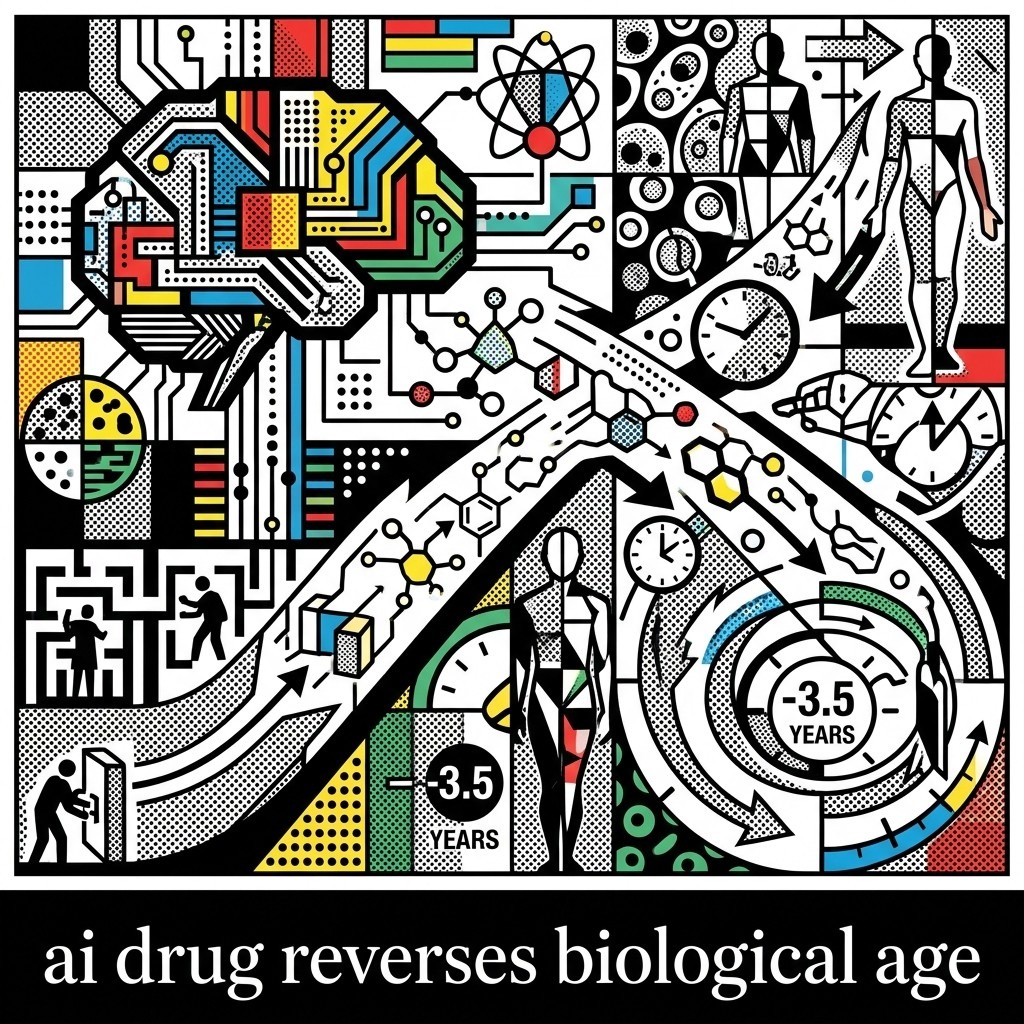
Insilico’s AI Drug Rentosertib Cuts Biological Age by 3.5 Years

Morning Intelligence • Tuesday, September 08, 2026

The Gist View

On September 7, 2026, Insilico Medicine, a Hong Kong clinical-stage biotech, reported its AI-designed drug rentosertib reduced biological age by up to 3.5 years in a 42-patient trial. The true significance lies in algorithms bypassing laboratory bottlenecks entirely. Effective state capacity now means adapting to technological momentum rather than attempting to bureaucratically command innovation.

This signal was a secondary observation in a trial targeting the TNIK protein for lung disease, not a longevity study on healthy individuals. But drug development expenses are driven by late-stage failure. Pharmaceutical incumbents license these computational models because they profit by killing doomed molecules before they reach human subjects.

Simulating efficacy in silicon reshapes the global medical supply chain. Nearly 90 percent of clinical candidates fail in testing, driving the average price of bringing one new therapy to market to $2.6 billion, according to the Tufts Center for the Study of Drug Development.

The Gist AI Editor

The Global Overview

Insilico Medicine Reverses Aging Markers
On September 7, 2026, Insilico Medicine, a Hong Kong biotech using generative AI for drug discovery, published a 42-patient Phase IIa trial reanalysis. Patients taking the AI-designed drug rentosertib showed a biological age reduction of 2.7 to 3.5 years (Nature Biotechnology). By computing both the target and the molecule, generative AI is becoming a structural deflationary force in pharma, collapsing traditional discovery timelines (Bloomberg).

US Trade Volatility Depresses Imports
The Centre for Economic Policy Research (CEPR), a network of European economists, found that confusion over 2025 US tariff policy caused import declines equaling the actual hikes. Arbitrary policy shifts act as a secondary barrier to trade, effectively doubling the economic friction of the tariffs themselves as capital hesitates amid uncertainty.

Apollo Faces Borrowing Premium
Portfolio entities of Apollo Global Management, a major American private equity and alternative asset firm, face borrowing costs one percentage point higher than peers (FT). Capital markets directly price in Apollo’s reputation for aggressive, hardline creditor treatment during debt restructurings, increasing the cost of capital for its acquired assets.

China Tourism Rebounds Cautiously
China’s tourism sector has rebounded into a trillion-dollar domestic driver, drawing tens of millions of foreign visitors annually (WSJ). Yet per-capita spending remains constrained, with travelers displaying tightfisted consumption amid global economic uncertainty. Stay tuned for the next Gist—your edge in a shifting world. The Gist remains independent and reader-supported. If you value news free from corporate or state interests, consider supporting our mission with a donation.

The European Perspective

Kaja Kallas Scraps Defense Advisory Group

EU foreign policy chief Kaja Kallas cancelled a defense advisory group on September 6, 2026, hours before its presentation (Politico Europe). Scrapped following pressure from Germany and Italy, the reversal exposes an institutional turf war over whether the European Commission or member states control the military industrial base. Technocratic task forces cannot substitute for hard political consensus. Admittedly, the group risked adding bureaucratic friction alongside Defense Commissioner Andrius Kubilius. With Washington previously signaling that its defense umbrella may become a fee-for-service arrangement, this failed launch confirms our view that internal political fragmentation remains the continent’s primary security vulnerability.

Draghi Competitiveness Report Stalls

The defense advisory cancellation and Draghi competitiveness report stagnation demonstrate that European integration consistently stalls when proposals demand member states surrender national sovereignty over regulatory frameworks and defense. As Mario Draghi’s blueprint approaches its second anniversary on September 9, 2026, only 60 of its 383 recommendations (15.7%) are fully implemented (Politico). Digital and telecommunications implementation sits at just 6.4%, leaving regional tech markets highly fragmented.

Ukrainian Prosecutor General Resigns

Prosecutor General Ruslan Kravchenko resigned on September 8, 2026, over a €360,000 overpayment for nuclear insurance contracts (ZDF). Embezzled state-owned Energoatom funds were allegedly routed through Cypriot networks tied to Russian capital.

Catch the next Gist for the continent’s moving pieces.

🎙️ Listen to this edition as a podcast Listen

The Gist is an independent daily digest: AI-curated, human-directed, unapologetically liberal (how it’s made). Hundreds of sources, only what matters. Subscribe free or listen to the podcast.


Comments

Leave a Reply

Your email address will not be published. Required fields are marked *

This site uses Akismet to reduce spam. Learn how your comment data is processed.