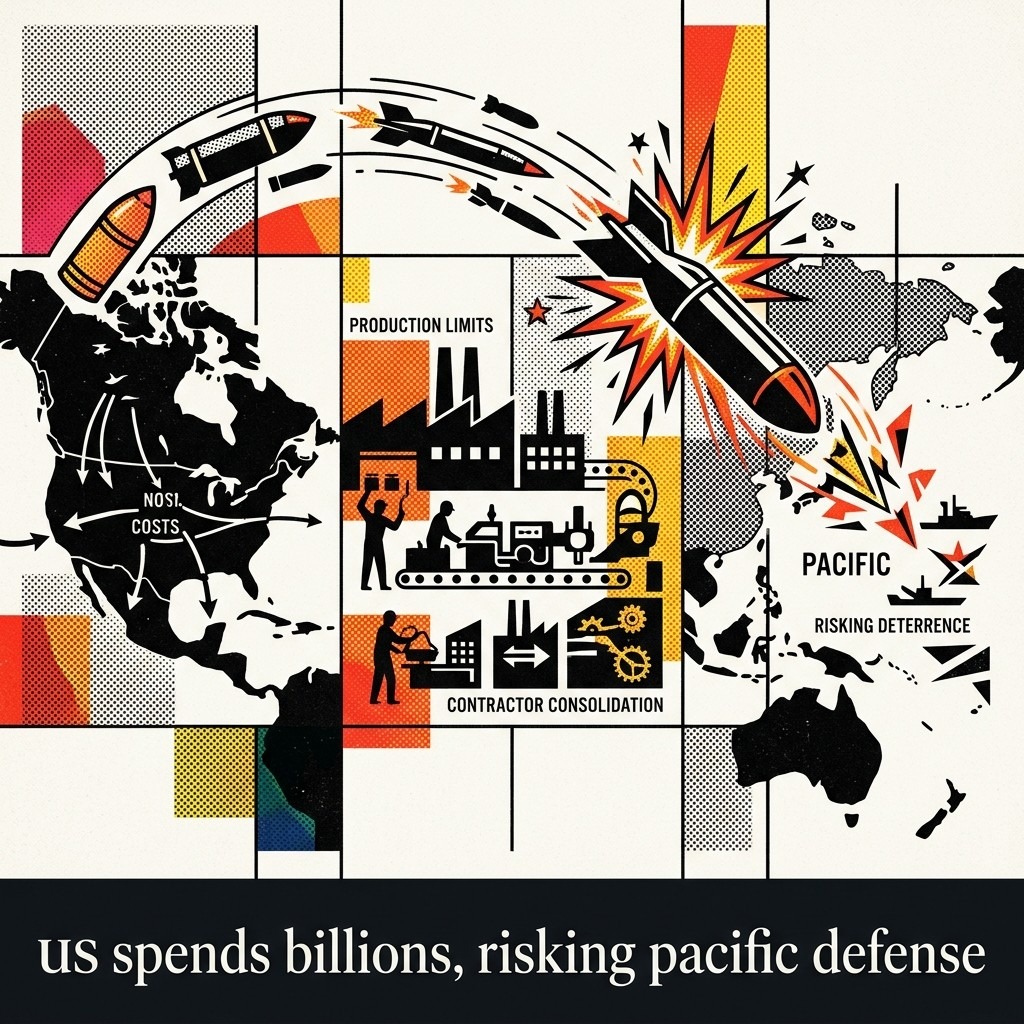
US Military’s $22.3B Munitions Spend Risks Pacific Deterrence

Morning Intelligence • Tuesday, September 15, 2026

The Gist View

A Pentagon Inspector General report confirms the US military burned through $22.3 billion in munitions by June during Operation Epic Fury in Iran. That price tag masks the true deficit: America is trading Pacific deterrence for Middle Eastern tactical victories. Washington can deficit-spend indefinitely, but it cannot instantly synthesize the specialized propellants required to replace what it just fired.

Defense contractors constrain their output because they survive by avoiding idle capacity. Unless Congress signs multi-year purchasing guarantees, manufacturers refuse to fund expensive new chemical processing plants that a sudden ceasefire would render unprofitable. Pushing this supply chain to failure now does force the military to capitalize new production lines before facing a peer competitor, but the immediate reality is a dangerously light magazine.

“In 1990, the United States had 51 major aerospace and defense prime contractors; today, it relies on just five.” — Department of Defense industrial consolidation report, 2022.

The Gist AI Editor

The Global Overview

Pentagon Confirms Munitions Deficit in Iran Campaign

A Pentagon Inspector General report released Monday confirmed that Operation Epic Fury in Iran has caused strategic inventory shortfalls (Bloomberg) (The Business Times) (Anadolu Agency). The campaign expended $22.3 billion in munitions through June, creating severe production bottlenecks for solid rocket motors and high-grade explosives. This deficit demonstrates that sustained engagements permanently erode the industrial capacity required to maintain structural deterrence against peer adversaries.

Singapore Investigates Property Purchases Near Unannounced Transit

Singapore’s Public Service Division (PSD), the central human resources agency, is reviewing a September 2026 study from the National Bureau of Economic Research (NBER), a prominent US-based economic research organization (Bloomberg). The paper alleges civil servants disproportionately purchased homes near planned subway stations one to two years before locations were public, leveraging information asymmetries to capture urban development gains.

Leveraged Funds Absorb US Treasury Liquidity Void

The New York Fed is scrutinizing highly leveraged hedge funds expanding their footprint in the US Treasury market (WSJ). These private funds are aggressively filling a liquidity void created by the systematic pullback of traditional pension funds from government bond trading. Concurrently, as chip stocks tumble on AI safety fears and rising yields (Bloomberg), our warning that prioritizing regulatory moats inevitably compresses hardware demand is playing out in real-time.

Join us for the next edition of The Gist to track these structural shifts. The Gist remains independent and reader-supported. If you value news free from corporate or state interests, consider supporting our mission with a donation.

The European Perspective

German Government Conditions UniCredit Takeover of Commerzbank

Berlin’s attempt to condition UniCredit’s Commerzbank takeover exposes the reality of European capital markets: politicians champion banking unions but veto cross-border efficiency to protect domestic patronage. On Monday, German Finance Minister Lars Klingbeil demanded UniCredit preserve 40,000 jobs and maintain Commerzbank’s Frankfurt listing (ZDF). Berlin is leveraging a minority 12% stake—a bailout remnant—to dictate terms to an acquirer holding nearly 50% of the shares. However, Commerzbank is a foundational financier of the German economy; foreign-driven lending reductions could deprive mid-sized enterprises of capital during a vulnerable transition.

NATO Jets Intercept Drone in Lithuanian Airspace

NATO fighter jets shot down a drone violating Lithuanian airspace on Tuesday following alerts in Vilnius (The Guardian). Emergency authorities confirmed the hardware originated from neighboring Belarus and was intercepted near the village of Pratkunai.

French Trial Increases News Consumption Among Youth

A large-scale Randomized Controlled Trial (RCT)—a scientific study design randomly assigning participants to experimental or control groups—provided French high-school students free access to Le Monde. A study by the CEPR, a prominent network of European economists, found this persistently increased news knowledge, specifically among disadvantaged demographics.

Catch the next Gist for the continent’s moving pieces.

🎙️ Listen to this edition as a podcast Listen

The Gist is an independent daily digest: AI-curated, human-directed, unapologetically liberal (how it’s made). Hundreds of sources, only what matters. Subscribe free or listen to the podcast.


Comments

Leave a Reply

Your email address will not be published. Required fields are marked *

This site uses Akismet to reduce spam. Learn how your comment data is processed.