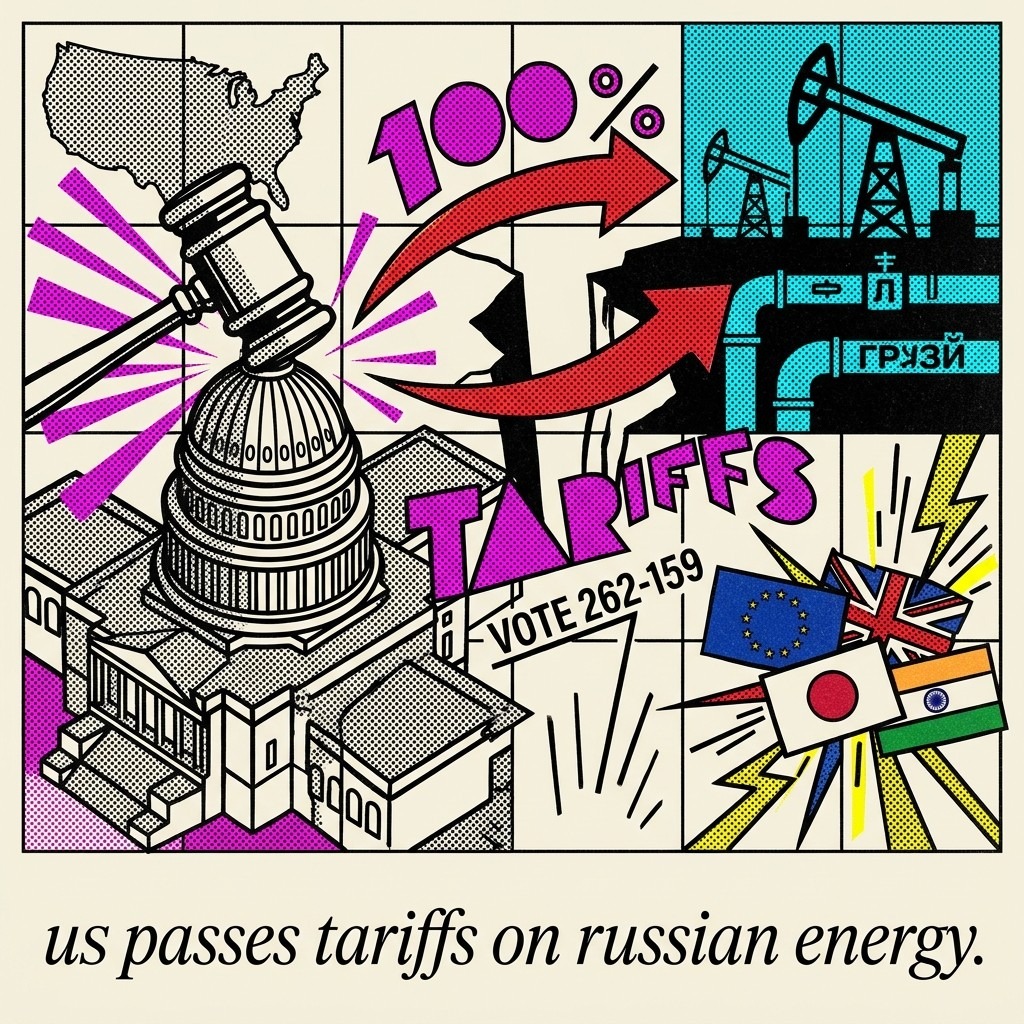
US House Approves 100% Tariffs on Russian Energy Buyers

Morning Intelligence • Thursday, September 17, 2026

The Gist View

On September 16, 2026, the US House granted the executive branch authority to impose up to 100% tariffs on nations purchasing Russian energy, passing the measure 262-159. By weaponizing import taxes to enforce geopolitical containment, Congress turns a foreign policy dispute into a blunt instrument for global trade wars. The 152 Democrats who rejected the bill did not vote to shield Moscow; they opposed it because unchecked tariff powers threaten allied economic integration.

Without secondary penalties, existing embargos fail. Buyers like India willingly absorb diplomatic friction to purchase discounted crude because they gain cheap fuel for growth, leaving Russia’s military funded. Yet by deploying blanket tariffs, Washington forces foreign capitals into a severe dilemma. Punishing a strategic partner’s exports over its energy imports prioritizes immediate coercion at the direct expense of international commerce.

The legislation succeeded primarily because the majority faction eagerly expanded presidential trade authority, clearing the chamber with 203 Republican votes to just seven dissenting (Washington Post).

The Gist AI Editor

The Global Overview

US House Approves Tariffs on Russian Energy Buyers

On September 16, 2026, the US House passed the Lindsey O. Graham Sanctioning Russia and Iran Act in a 262-159 vote, sending the legislation to President Donald Trump (Reuters). The bill grants the executive branch unilateral authority to impose secondary tariffs of up to 100% on countries, such as India and China, that continue purchasing Russian crude oil and natural gas. Republicans backed the measure 203-7, while 152 Democrats opposed the expansion of executive trade power.

Tata Sons Navigates Mandatory IPO

The Reserve Bank of India (RBI), the central regulatory body for the Indian banking system, rejected an exemption request from Tata Sons, the principal holding company of the $200 billion Tata Group (Bloomberg). The RBI mandates the conglomerate to list on stock exchanges by September 2025. The board is now meeting to manage this public float—which could command a valuation of up to ₹11.5 trillion—and debate retaining outgoing Chairman Natarajan Chandrasekaran.

Fed Hikes Rates Amid Supply Frictions

The US Federal Reserve raised its benchmark interest rate to a target range of 3.75% to 4.00%, marking its first increase since 2023 in response to stubbornly high core inflation (WSJ). This triggered cross-border capital adjustments, strengthening the Singapore dollar during early Asian trade. Simultaneously, global logistics constraints worsen; Iran’s attempts to circumvent the Hormuz blockade are actively fracturing its overland logistics, leaving hundreds of freight truckers trapped at land borders and threatening further domestic economic paralysis (WSJ).

Stay tuned for the next edition of The Gist for further global developments. The Gist remains independent and reader-supported. If you value news free from corporate or state interests, consider supporting our mission with a donation.

The European Perspective

Scaleup Europe Fund Launch

The European Commission finalized the €5 billion Scaleup Europe Fund, appointing EQT—a Swedish global investment organization and private equity firm—to back late-stage technology companies. Concurrently, a Centre for Economic Policy Research (CEPR)—a network of European economists—analysis demonstrates that US-backed Swedish startups sustain deeper early operating losses but secure far more follow-on funding than locally funded peers (CEPR). Europe’s scale-up gap is a structural deficit of risk tolerance. Sustaining deep early operating losses is a core feature of successful scaling under the US model, a reality European institutions systematically avoid. Yet, a €5 billion centralized fund managed by EQT provides the exact institutional anchor needed to crowd-in risk-averse European capital.

German Welfare Fraud Action Plan

Ministers Bärbel Bas and Alexander Dobrindt presented a cross-party plan to eliminate systemic welfare fraud by the end of 2026 (ZDF). The initiative explicitly targets organized rings using “Schrottimmobilien” (slum real estate) to extract benefits, reallocating state enforcement from individuals onto structural exploitation networks.

Italian Femicide Law Proposal

Following Istat data revealing 3 million Italian women suffered abuse before age 16, a controversial political proposal has surfaced seeking to abolish the specific crime of femicide (Il Sole 24 Ore).

UK Political Funding Probe

The investigation into UK political funding escalated as two Reform UK aides resigned after a sting exposed alleged efforts to conceal a £32,500 foreign polling donation (Politico).

Catch the next Gist for the continent’s moving pieces.

🎙️ Listen to this edition as a podcast Listen

The Gist is an independent daily digest: AI-curated, human-directed, unapologetically liberal (how it’s made). Hundreds of sources, only what matters. Subscribe free or listen to the podcast.


Comments

Leave a Reply

Your email address will not be published. Required fields are marked *

This site uses Akismet to reduce spam. Learn how your comment data is processed.