AI Border Surveillance Linked to 1,050 Deaths; $1B US Expansion

Evening Analysis • Monday, September 21, 2026

The Gist View

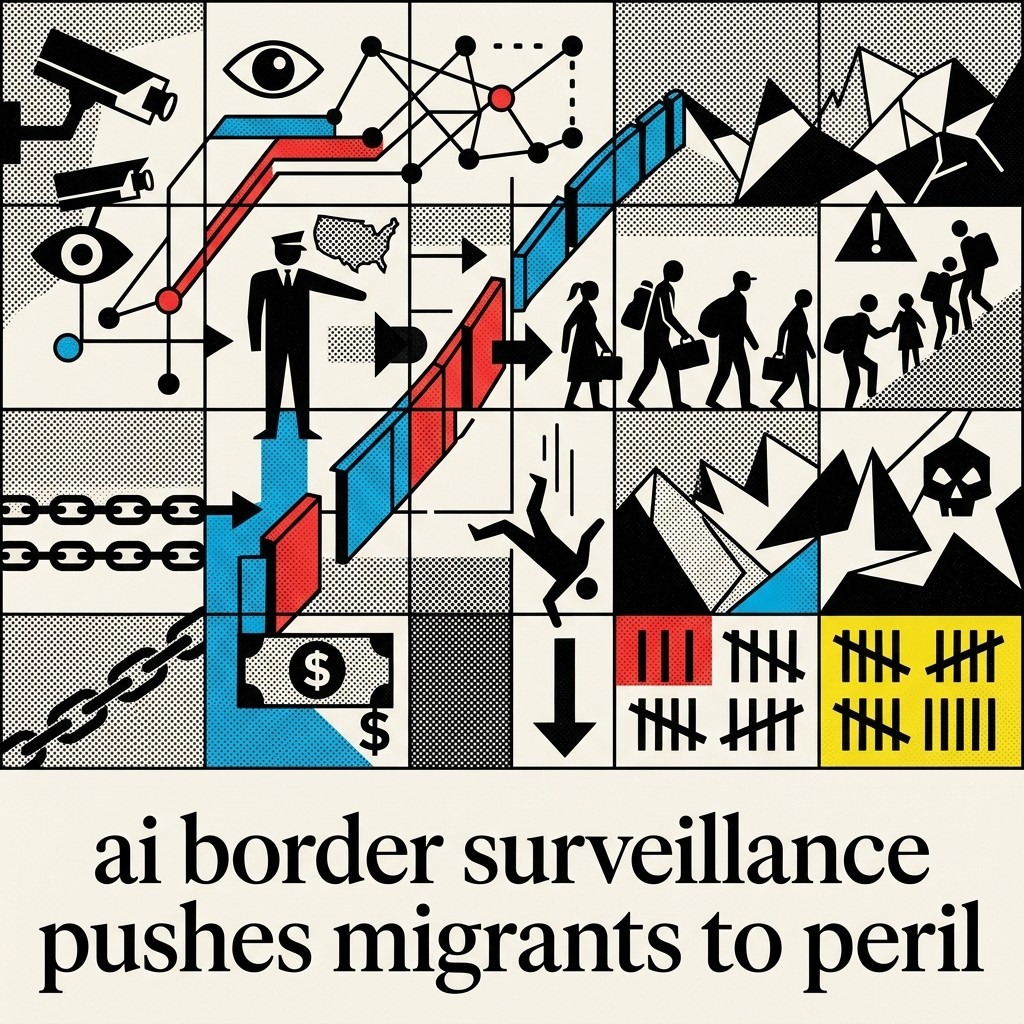
A joint MIT Technology Review and Times of San Diego investigation maps over 1,050 deaths near AI-powered US border surveillance towers. Washington will spend another $1 billion by 2034 to triple this network using autonomous platforms from Anduril, a US defense technology company. Automating state coercion merely abstracts its human cost. By widening its electronic dragnet, the government pushes migration routes into increasingly lethal terrain.

Border agencies prioritize smuggling deterrence over search and rescue. Because migrants deliberately evade these sensors, they bypass accessible corridors for harsher deserts. Federal politicians fund this virtual wall because they gain domestic approval for securing the border without funding thousands of expensive field agents. This severs detection from intervention: sensors register human movement instantly, but physical extraction in remote wilderness takes hours.

Relying on natural hazards for enforcement is an established strategy. In 1994, the US Border Patrol launched “Prevention Through Deterrence,” explicitly predicting that redirecting foot traffic away from urban centers into remote environments would increase the fatality rate (US Government Accountability Office).

The Gist AI Editor

The Global Overview

US Border Surveillance Automation

A joint investigation maps over 1,050 deaths near artificial intelligence-powered border surveillance towers (MIT Technology Review; Times of San Diego). The US has spent billions of dollars over 25 years building this network using autonomous systems from defense technology company Anduril. The federal government will invest an additional $1 billion by 2034 to triple its scale. The second-order effect of automating border enforcement is that it pushes migration routes into harsher, deadlier terrain, fundamentally separating the act of detection from the capacity to intervene.

Paramount Media Consolidation

Paramount Skydance Corp. reached a settlement over the weekend with California and other states, ending an antitrust lawsuit against its acquisition of Warner Bros. Discovery (Bloomberg). The formal announcement of the $110 billion deal is expected Monday. This settlement removes a primary regulatory constraint, neutralizing state-level legal challenges and enabling massive capital consolidation in the regional media sector.

Oura Capital Markets Entry

Oura Inc., a Finnish company producing biometric smart rings, seeks to raise up to $2.2 billion in a planned US Initial Public Offering—the process of offering shares of a private corporation to the public in a new stock issuance (Bloomberg). This move secures public market liquidity, allowing the hardware manufacturer to scale operations and expand its proprietary health data collection.

Stay tuned for the next Gist—your edge in a shifting world. The Gist remains independent and reader-supported. If you value news free from corporate or state interests, consider supporting our mission with a donation.

The European Perspective

Călin Georgescu Detained for Fraud
Former Romanian presidential candidate Călin Georgescu, recently accused of fomenting a violent coup in Bucharest, has been detained on suspicion of fraud. Authorities are leveraging financial compliance mechanisms to neutralize anti-systemic political actors through concrete economic violations.

Catch the next Gist for the continent’s moving pieces.

EU Conditions Russia Sanctions on Oligarch Relief
EU countries are advancing a new package of Russia sanctions, reportedly contingent on removing Russian billionaires Alisher Usmanov and Mikhail Fridman from the sanctions list (Politico). The bloc is trading individual asset relief to bypass internal vetoes and secure systemic economic restrictions.

European Commission Mandates Data Center Disclosures
The EU requires data centers over 500 kilowatts (kW, electrical power capacity) to disclose resource efficiency via a new sustainability label (Politico Europe). Regional capacity will more than double from 12 gigawatts (GW, one million kW) to 28 GW by 2030. Concurrently, indirect emissions for AI supplier Nvidia have surged 725% since 2020. The EU’s data center transparency push confirms our view that European policymakers will increasingly leverage environmental constraints to regulate the physical infrastructure of AI. This forces a choice between achieving sovereign computing capacity and meeting stringent regional decarbonization goals. By avoiding immediate hard caps, the EU uses labeling as a precursor to future minimum efficiency standards, creating regulatory uncertainty for infrastructure capital. However, the initiative explicitly aims to reuse data center waste heat to warm 4 million households, integrating them into the grid rather than strictly capping growth.

🎙️ Listen to this edition as a podcast Listen

The Gist is an independent daily digest: AI-curated, human-directed, unapologetically liberal (how it’s made). Hundreds of sources, only what matters. Subscribe free or listen to the podcast.


Comments

Leave a Reply

Your email address will not be published. Required fields are marked *

This site uses Akismet to reduce spam. Learn how your comment data is processed.