Andreessen Horowitz Introduces $42M Academy for Youth

Evening Analysis • Tuesday, September 22, 2026

The Gist View

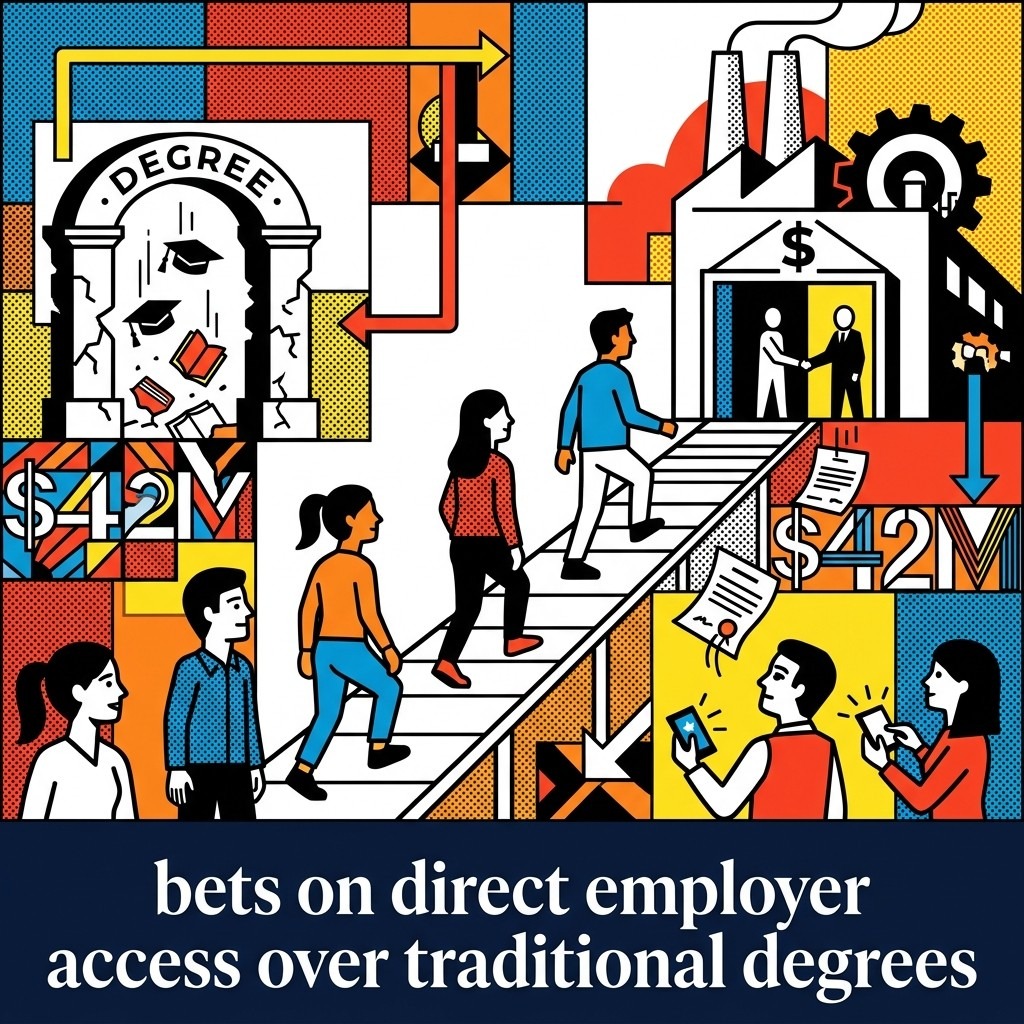
Andreessen Horowitz (a16z), a major Silicon Valley venture capital firm, is launching the Horowitz Andreessen Academy, a $42 million unaccredited college alternative for talent aged 16 to 22. By abandoning state accreditation, the firm shifts the signaling burden onto its elite corporate backers. Universities rely on a generalized credential to prove competence; this model bets that direct employer access will instantly outcompete legacy academic gatekeepers.

The traditional higher-education model inflates because administrators gain guaranteed tuition revenue by prolonging study timelines. Stripping away that bureaucracy forces teenagers to become immediate builders rather than passive credential-seekers. To be sure, a standard degree survives broader downturns, whereas a hyper-specific tech fellowship leaves graduates exposed if the artificial intelligence bubble deflates.

Legacy institutions ignore this shift at their peril. When Peter Thiel launched his fellowship in 2011 to pay founders to drop out of university, academia dismissed it as an eccentric anomaly; private capital is now aggressively institutionalizing that exit.

The Gist AI Editor

The Global Overview

Andreessen Horowitz Launches Unaccredited Tech Academy

Venture capital firm Andreessen Horowitz (a16z) is launching the Horowitz Andreessen Academy, a $42 million unaccredited two-year college alternative in San Francisco for students aged 16 to 22 (WSJ). Led by Udemy co-founder Gagan Biyani, the academy is backed by Anthropic, Meta, and OpenAI (GlobeNewswire). The tuition-free fellowship begins in Fall 2027 with 50 students, basing admissions on direct proof of work rather than standardized test scores (TechCrunch). By bypassing academic accreditation, a16z aligns education directly with market output, pushing students to develop immediately applicable skills rather than acquire passive credentials.

Trump-Xi Summit Excludes Business Delegations

The upcoming diplomatic summit between US President Trump and Chinese President Xi Jinping is unlikely to feature a Chinese corporate delegation (WSJ). This absence highlights historically low expectations for significant bilateral business agreements. By excluding executives, both governments prioritize geopolitical boundaries over cross-border capital integration, structurally reducing the immediate leverage of multinational corporations in shaping trade policy.

US President Threatens Iran at UN

President Trump used his United Nations address to threaten to “annihilate” Iran while laying out his foreign-policy vision (WSJ). The stark rhetoric follows escalating proxy warfare and drone attacks across the Middle East. President Trump’s threat at the UN to ‘annihilate’ Iran confirms our ongoing assessment that the protracted regional standoff is shifting from localized proxy skirmishes toward overt risks of direct military confrontation.

Stay tuned for the next Gist—your edge in a shifting world. The Gist remains independent and reader-supported. If you value news free from corporate or state interests, consider supporting our mission with a donation.

The European Perspective

A7 Fintech and EU Delistings Expose Sanctions Failure

A7, a Kremlin-backed fintech set up to bypass Western financial sanctions, used counterfeit invoices to funnel $6.9 billion globally (FT). Established in late 2024 by Ilan Shor and Promsvyazbank, a Russian state-owned bank tied to defense, A7 structured itself as a shadow clearinghouse. By abstracting SWIFT access through obscure front companies, Russia rendered entity-level sanctions meaningless against state-sponsored spoofing. Between late 2024 and August 2025, Standard Chartered, a British multinational bank, received $1.1 billion in Hong Kong, while Citigroup and DBS processed hundreds of millions more. While global banks process trillions daily and no private compliance apparatus can perfectly filter out transactions from hostile state actors utilizing industrial-scale document forgery, relying on them to enforce geopolitical blockades remains fatally flawed. Concurrently, the EU lifted sanctions on billionaires Alisher Usmanov and Mikhail Fridman to secure a three-year restriction extension on 3,000 others (ZDF). France drove Usmanov’s delisting for a secret Azerbaijan prisoner deal. Both events illustrate the structural collapse of the West’s financial siege against Russia, whether through state-sponsored forgery networks exploiting private banks or member states trading individual exemptions for diplomatic leverage.

France Resists EU Foreign Aid Reductions

French European Affairs Minister Benjamin Haddad warned against drastic development spending cuts in upcoming seven-year budget negotiations (Politico). Member states are debating finding required savings in the €200 billion Global Europe Fund rather than reducing domestic European programs.

Catch the next Gist for the continent’s moving pieces.

🎙️ Listen to this edition as a podcast Listen

The Gist is an independent daily digest: AI-curated, human-directed, unapologetically liberal (how it’s made). Hundreds of sources, only what matters. Subscribe free or listen to the podcast.


Comments

Leave a Reply

Your email address will not be published. Required fields are marked *

This site uses Akismet to reduce spam. Learn how your comment data is processed.