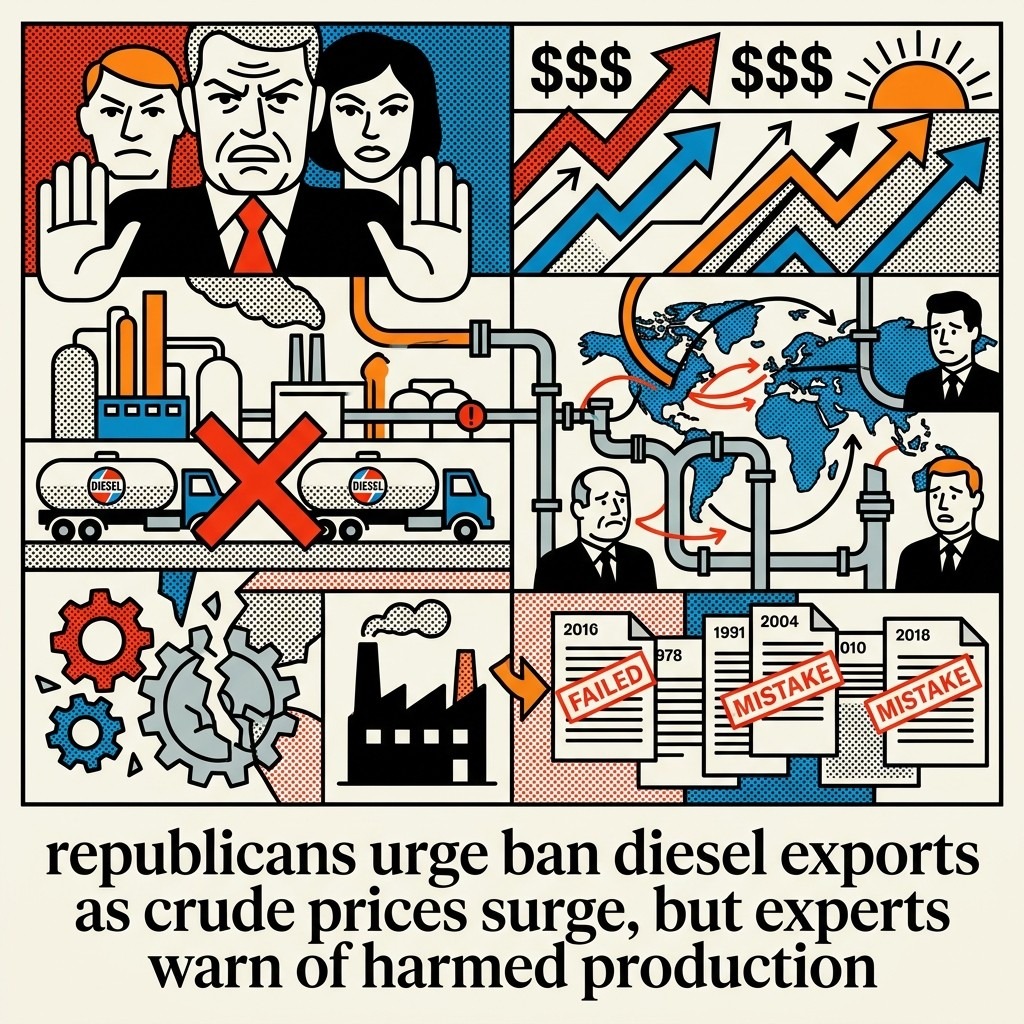
Republicans Push Trump to Ban Diesel Exports Amid Price Surge

Morning Intelligence • Tuesday, September 22, 2026

The Gist View

Republican lawmakers are pressing US President Donald Trump to ban diesel exports as Brent crude—the primary global price benchmark for Atlantic basin crude oils—surges past $100-a-barrel amid the US-Iran conflict. While domestic agricultural supply chains face a genuine threat of collapse under current prices, deploying state coercion to artificially trap fuel is a guaranteed policy failure.

Export restrictions cannot magically manufacture fuel; they merely strand existing inventory. American refiners will inevitably slash production because they lose the ability to clear excess product in foreign markets. By wiping out the profit margins necessary to fund a wartime surge in refining, this intervention disincentivizes the very producers required to stabilize the grid.

Hoarding domestic energy supplies at the expense of allied nations repeats a documented error. When Washington imposed strict price and export controls during the 1973 oil crisis, the policy deterred domestic drilling, transforming a temporary import shortage into years of rationing (Wall Street Journal).

The Gist AI Editor

The Global Overview

US Lawmakers Demand Diesel Export Ban

With Brent crude—the primary global price benchmark for Atlantic basin crude oils—hovering above $100-a-barrel amid Middle Eastern volatility, Republican lawmakers demand US President Donald Trump ban US diesel exports to ‘stop the bleeding’ (WSJ). Triggered by the US-Iran conflict, this push to trap energy supplies domestically is economic self-harm that disincentivizes refining and guarantees broader supply chain failures (FT).

22 Nations Call for Autonomous AI Controls

Separately, 22 countries signed a call demanding artificial intelligence remain strictly ‘under human control.’ Analysts reject proposals banning RSI—Recursive Self-Improvement, a theoretical threshold where an AI model autonomously writes code to improve its own architecture (Marginalrevolution). Confirming our argument that populist AI regulation is practically unworkable, enforcing bans on open-source code across borders requires draconian state surveillance. Both the diesel export ban and these AI controls share the flawed political premise that domestic borders can effectively contain inherently globalized resources, whether physical commodity flows or open-source digital code.

Global Leaders Convene for UN Summit

On September 22, Ukrainian President Wolodymyr Selenskyj meets Trump on the sidelines of UNGA, the main deliberative body of the UN. UK Prime Minister Andy Burnham attends with a strict focus on domestic optics, attempting to avoid his predecessor’s ‘globe-trotting’ criticisms (Politico). Amid the summit, former US diplomat Andy Rothman notes that China and the US are actively seeking to maintain stability in bilateral ties (Bloomberg).

Stay tuned for the next Gist—your edge in a shifting world. The Gist remains independent and reader-supported. If you value news free from corporate or state interests, consider supporting our mission with a donation.

The European Perspective

European Union Drafts AI Product Liability Rules

European Union lawmakers are drafting strict new product liability rules aimed specifically at preventing AI disasters (Politico). The proposed regulations seek to shift the legal and financial burden directly onto the developers of autonomous AI systems. Because border-based enforcement remains technically impossible, this structurally forces capital to exit European tech markets.

EU and Philippines Reach Bilateral Trade Agreement

On September 22, 2026, the European Union and the Philippines reached a substantial agreement on a free trade deal (Politico). While Washington defaults to export bans and tariffs under geopolitical stress, Brussels is rightly securing its economic sovereignty through aggressive bilateral trade expansion in the Indo-Pacific. This agreement anchors the EU’s commercial pivot toward ASEAN—the Association of Southeast Asian Nations, a political and economic union in Southeast Asia—to diversify supply chains away from Chinese dominance. Securing raw materials and tech components through binding, mutually beneficial trade pacts creates far more robust supply chains than relying on unilateral industrial subsidies or export controls. However, the EU’s enforcement of rigid labor and environmental standards on developing trade partners often acts as a backdoor tariff, limiting the actual economic gains of these agreements.

Left-Wing Coalition Talks in Eastern Germany

Following historic electoral losses for the conservative CDU on September 22, 2026, regional parties initiated exploratory talks (ZDF). As the populist surge continues to fracture Germany’s traditional conservative structures, the SPD and Greens are now being forced into unprecedented ‘Rot-Rot-Grün’ exploratory talks with Die Linke moving forward simultaneously in both Mecklenburg-Vorpommern and Berlin.

Catch the next Gist for the continent’s moving pieces.

🎙️ Listen to this edition as a podcast Listen

The Gist is an independent daily digest: AI-curated, human-directed, unapologetically liberal (how it’s made). Hundreds of sources, only what matters. Subscribe free or listen to the podcast.


Comments

Leave a Reply

Your email address will not be published. Required fields are marked *

This site uses Akismet to reduce spam. Learn how your comment data is processed.