UBS Ordered to Maintain 90% CET1 for Financial Stability

Evening Analysis • Wednesday, September 23, 2026

The Gist View

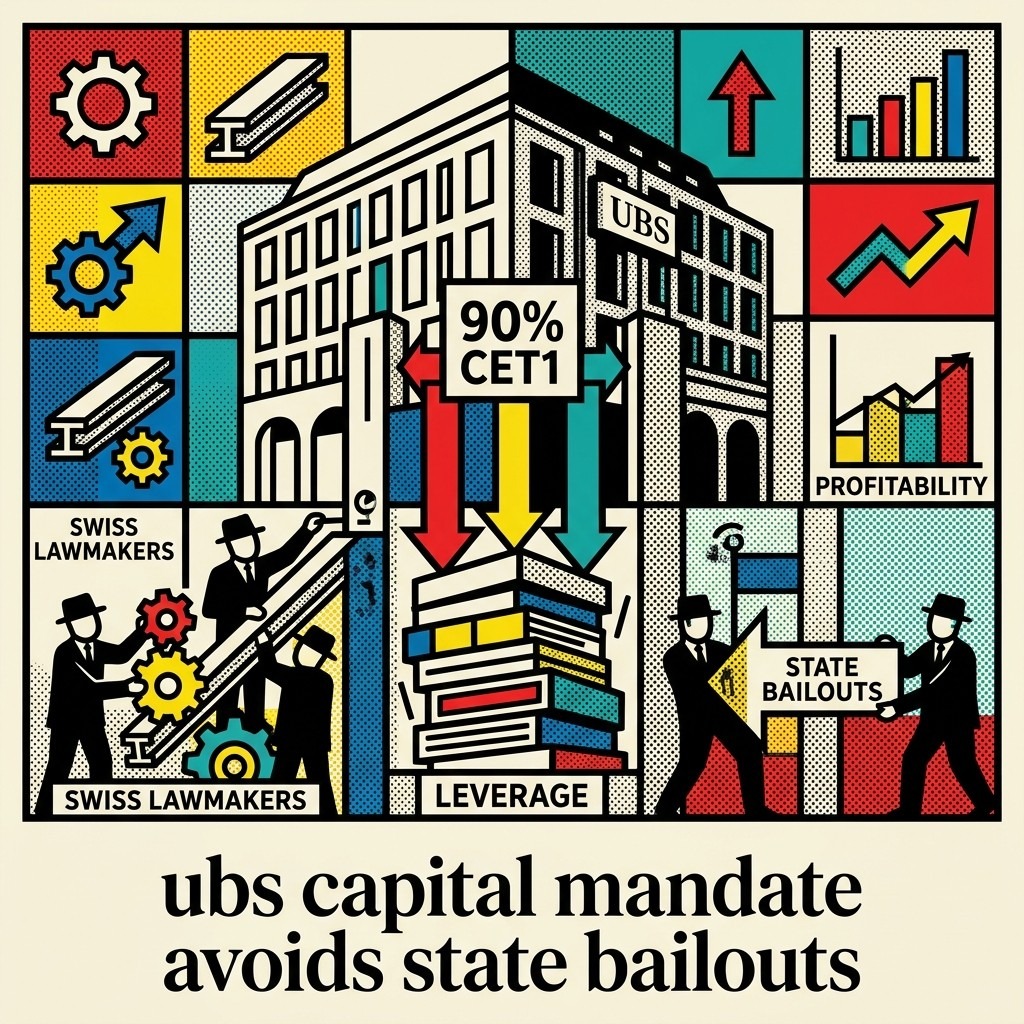
On September 23, 2026, the Swiss upper house ordered UBS to back its foreign subsidiaries with 90% Common Equity Tier 1 (CET1)—core regulatory capital of common stock and retained earnings. When a protected institution’s balance sheet outgrows its host economy, state-backed international expansion acts as a deferred tax on the public. By demanding hard equity over cheaper convertible debt, lawmakers stripped away the financial engineering megabanks use to obscure leverage.

UBS fought the mandate because it gains by socializing catastrophic downside while privatizing foreign yields. Reserving $18 billion in extra equity certainly handicaps its profitability against US competitors operating under looser rules. Yet Bern chose a clear tradeoff: preserving stability requires forcing an oversized champion to pay its own insurance premiums.

During the Credit Suisse collapse in March 2023, regulators wiped out $17 billion of alternative tier-one bonds because those synthetic instruments failed to absorb losses before necessitating a state rescue (Financial Times).

The Gist AI Editor

The Global Overview

Swiss Senate Restricts UBS Capital Risk

On September 23, 2026, the Swiss upper house voted 29 to 16 mandating UBS back foreign units with 90% Common Equity Tier 1 (CET1)—regulatory capital from common stock. Officials refuse to underwrite a bank outsizing the economy. UBS anticipates holding $18 billion in extra equity (FT). This correctly forces the bank to internalize catastrophic risks, sacrificing global competitiveness.

Canada Challenges EU Deforestation Rules

Canada petitioned Brussels regarding the European Union Deforestation Regulation (EUDR), requiring importers to prove products avoid forest degradation. Mandating expensive geolocation traceability by late 2026, North American exporters argue the rule acts as a non-tariff trade barrier (Politico), exposing how European regulations create structural friction for commodity flows.

DeepSeek Advances Autonomous AI Training

On September 23, 2026, Chinese startup DeepSeek detailed methodologies to minimize erratic behavior in AI agents (Bloomberg). DeepSeek’s technical focus on aligning agents through efficient training validates our argument that market-driven engineering, rather than blunt EU liability rules, provides the most effective safeguards against model misbehavior.

Stay tuned for the next Gist. The Gist remains independent and reader-supported. If you value news free from corporate or state interests, consider supporting our mission with a donation.

The European Perspective

Norway Delays Rare-Earth Extraction

As of September 23, 2026, Norway delayed Europe’s largest rare-earth mine until 2028 over disputes concerning forested processing facilities (Euronews). This exposes how the EU’s mandate for mineral sovereignty is derailed by environmental maximalism. The delay undermines strategies to bypass China, which controls approximately 60% of global rare-earth supply (MINING.COM). Europe thus continues outsourcing the severe ecological costs of refining to Chinese operations. Rushing processing facilities without strict vetting risks permanent ecological degradation for resources securable via allied trade, but this bottleneck enforces dependency.

French Candidates Turn to Private Banks

French 2027 presidential candidates are scrambling for private loans after public financing guarantees collapsed (Politico). Marine Le Pen’s National Rally—France’s leading nationalist, right-wing populist political party—seeks a domestic loan amid scrutiny of past operations, directly shifting campaign viability toward private financial approval rather than state support.

Italian Football Reports €9 Billion in Losses

A September 2026 report reveals Italian professional football clubs accumulated over €9 billion in aggregate losses over two decades, exposing severe mafia infiltration and 49 separate club bankruptcies (Il Sole 24 Ore). Separately, the culture war within the Alternative for Germany (AfD)—the country’s prominent right-wing populist political party—over co-leader Alice Weidel’s same-sex partnership highlights structural fractures within the recent regional populist surge.

Catch the next Gist for the continent’s moving pieces.

🎙️ Listen to this edition as a podcast Listen

The Gist is an independent daily digest: AI-curated, human-directed, unapologetically liberal (how it’s made). Hundreds of sources, only what matters. Subscribe free or listen to the podcast.


Comments

Leave a Reply

Your email address will not be published. Required fields are marked *

This site uses Akismet to reduce spam. Learn how your comment data is processed.