Xi Jinping Aims to Cut $30B Tariffs in Washington Visit

Evening Analysis • Thursday, September 24, 2026

The Gist View

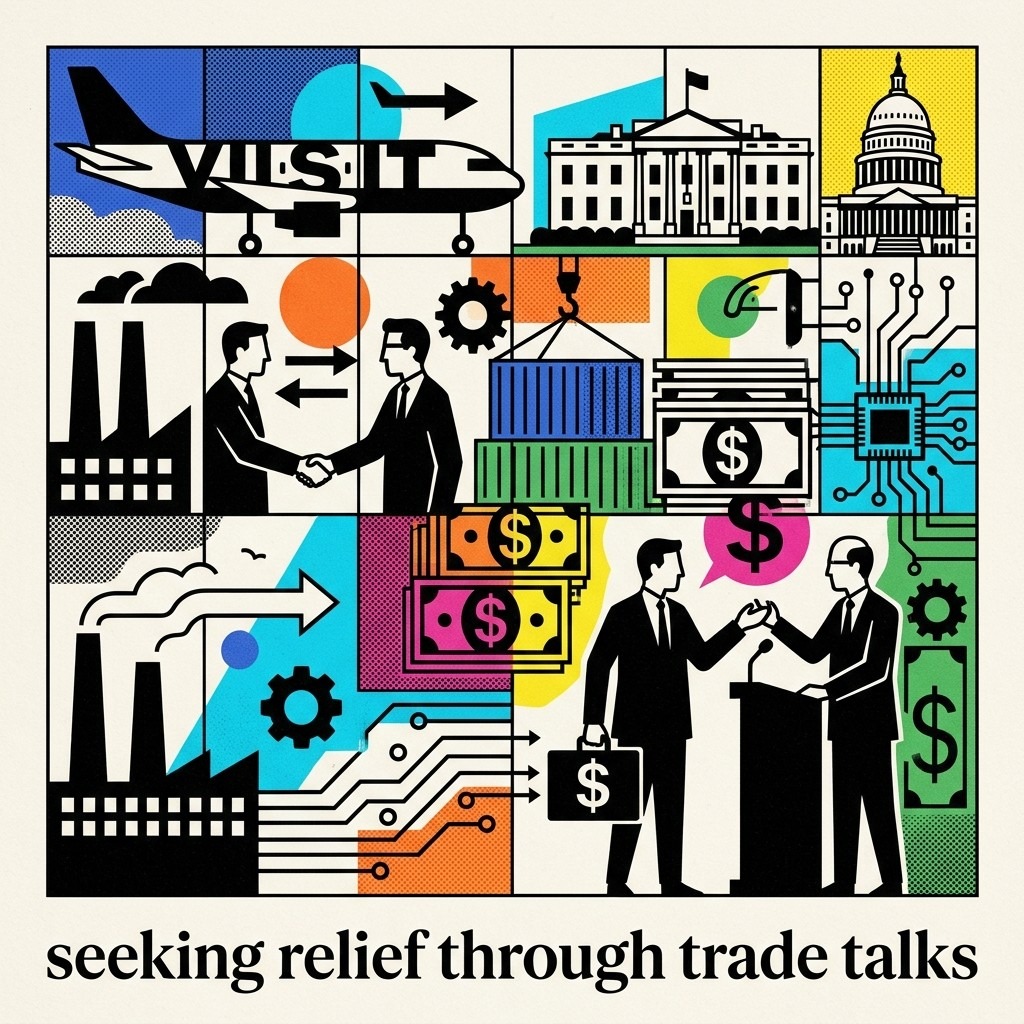
Chinese President Xi Jinping’s September 23, 2026, arrival in Washington to unwind $30 billion in mutual tariffs with US President Donald Trump signals a quiet retreat from a ruinous trade war. State pageantry provides the political cover, but the core driver is domestic economic exhaustion.

Washington requires lower consumer prices, while Beijing needs export stability. The Chinese government accepts this relief not as a sudden pivot to free markets, but because it gains crucial time to construct sovereign supply chains insulated from future Western sanctions. Agreeing to keep artificial intelligence under human control follows the identical incentive structure: a shared necessity to pause technological arms races neither economy can presently afford to subsidize.

Unwinding these barriers offers both leaders an immediate, zero-cost stimulus. When Xi last made a state visit to Washington 11 years ago, bilateral friction centered on commercial espionage, long before sweeping protectionism began taxing both nations’ manufacturing bases (The Washington Post).

The Gist AI Editor

The Global Overview

Trump and Xi Negotiate Tariff Truce in Washington

Chinese President Xi Jinping arrived at Joint Base Andrews on September 23, 2026, receiving a tarmac greeting from US President Donald Trump for his first Washington state visit in 11 years (WSJ). The administrations will mutually remove tariffs on $30 billion of imported goods (The Washington Post). This expected truce shows economic reality overriding nationalist posturing, serving as a tacit admission that protectionism has failed both economies. Xi also urged bilateral cooperation to keep artificial intelligence ‘under human control’ (The Guardian). This mutual superpower interest in managing AI risks contradicts our prediction that geopolitical competition would entirely sideline regulatory efforts.

New York State Sues Polymarket Over Unlicensed Operations

On September 24, 2026, New York sued Polymarket—a decentralized prediction market platform where users bet cryptocurrency on real-world events—for running an unlicensed gambling operation (WSJ). Demanding fines and an injunction against the platform’s December 2025 US mobile app, the state’s legal action actively shields its own heavily taxed, licensed gambling revenues from decentralized competitors.

US-India Satellite Tracks Russian Volcanic Eruption

The US-India NISAR satellite captured time-lapse microwave data of a massive lava spread at Russia’s Krasheninnikov volcano pair between December 2025 and August 2026 (Atlantic Council). Triggered by an 8.8-magnitude oceanic earthquake on July 30, 2025, this joint aerospace monitoring allows allied nations to track systemic environmental disruptions independently of Russian domestic reporting.

Stay tuned for the next Gist—your edge in a shifting world. The Gist remains independent and reader-supported. If you value news free from corporate or state interests, consider supporting our mission with a donation.

The European Perspective

France Expands Universal €1 Student Meals

France universally expanded its €1 university meals in May 2026, abandoning the standard €3.30 rate. Bolstered by €143 million for 2027, the subsidy triggered massive demand and hour-long queues (Euronews). This illustrates how price controls transform a direct financial cost into a grueling tax on time. By subsidizing wealthy students alongside the precarious, the state manufactures an artificial supply shortage that physically crowds out the demographic the policy was originally designed to protect. Yet, for students facing genuine food insecurity, waiting in a long queue is a highly rational and acceptable tradeoff for a guaranteed, affordable hot meal.

EU Clashes Over Industrial Accelerator Act

Debating the Industrial Accelerator Act—a proposed bill boosting domestic manufacturing via preferential subsidies—Germany advocates including free-trade partners, while Spain demands a strict EU-27 boundary (Politico). Coupled with the Trump-Xi summit in Washington, this highlights economic nationalism’s life-cycle: just as the US and China dismantle unworkable trade barriers, Europe enthusiastically builds its own. Concurrently, Chancellor Friedrich Merz advances federal EU budget cuts, defying the eastern populist surge we noted threatens his coalition’s stability (ZDF).

Italy Assesses Early Retirement Costs

Italy’s State General Accounting Office evaluated the 2019-2025 financial toll of ‘Quote’ schemes and ‘Opzione Donna’—an early pension scheme allowing female workers to retire prematurely. The state data explicitly links these mechanisms to increased public debt and constrained domestic economic growth (Il Sole 24 Ore).

Catch the next Gist for the continent’s moving pieces.

🎙️ Listen to this edition as a podcast Listen

The Gist is an independent daily digest: AI-curated, human-directed, unapologetically liberal (how it’s made). Hundreds of sources, only what matters. Subscribe free or listen to the podcast.


Comments

Leave a Reply

Your email address will not be published. Required fields are marked *

This site uses Akismet to reduce spam. Learn how your comment data is processed.