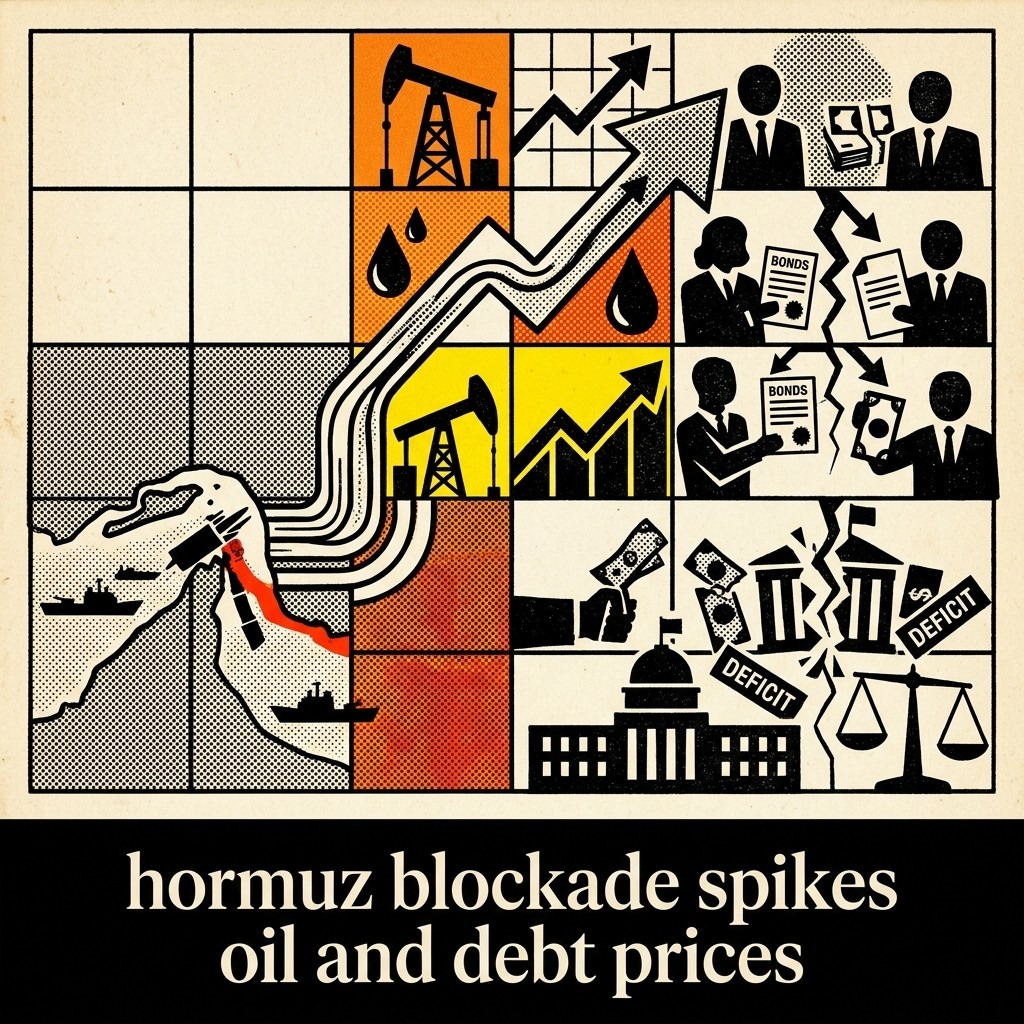
Trump’s Stance on Strait of Hormuz Spurs Brent Crude Surge

Evening Analysis • Monday, September 28, 2026

The Gist View

U.S. President Donald Trump’s refusal to reopen the Strait of Hormuz sent Brent crude to $108.27 a barrel, violently repricing Western sovereign debt. This energy shock ends the era of consequence-free deficit spending. Washington maintains maximum pressure because it gains leverage over Tehran, but imports severe inflation into state balance sheets as a result.

Bond vigilantes are succeeding where political opposition failed. By pushing the UK 10-year gilt—a government bond issued by the United Kingdom—to 5.42% and Germany’s benchmark Bund—a federal debt security—to 3.65%, markets are capping government ambitions through sheer borrowing costs. While yields are simply normalizing after a decade of artificially suppressed interest rates, the transition forces state planners to immediately internalize the fiscal price of geopolitical gridlock.

“I used to think if there was reincarnation, I wanted to come back as the president,” James Carville observed in 1993; “now I want to come back as the bond market. You can intimidate everybody” (Wall Street Journal).

The Gist AI Editor

The Global Overview

Global Sovereign Bond Selloff

Events confirm warnings that maintaining maximum pressure on the Strait of Hormuz without a viable off-ramp fractures global markets. Brent crude climbed to $108.27 a barrel after U.S. President Donald Trump rejected Iran’s proposal to reopen the Strait over the weekend (The Star). These energy-driven inflation fears triggered a global sovereign bond selloff, pushing the 10-year U.S. Treasury yield sharply higher. The UK 10-year gilt, a government bond issued by the United Kingdom, reached 5.42%. Germany’s benchmark 10-year Bund, a debt security issued by the German federal government, climbed to 3.65%, reaching its highest level in 17 years (FT).

Ukraine’s Operation Vivaldi

Ukraine’s 3rd Army Corps regained 176 square kilometers in the Lyman sector, pushing back Russian forces in northern Donetsk (Politico). The offensive, designated Operation Vivaldi, utilized deep drone saturation and converted BTR-60s—eight-wheeled amphibious armored personnel carriers originally developed by the Soviet Union—into robotic kamikaze vehicles to capture over 250 Russian soldiers.

SpaceX Starship Orbital Deployment

Elon Musk’s SpaceX launched its Starship rocket on its first orbital flight test from the Starbase facility in South Texas (Bloomberg). Despite an engine failure prompting an early return, the system successfully reached orbit and deployed its payload of 26 Starlink satellites (FT).

Join us for the next edition of The Gist to track these structural shifts. The Gist remains independent and reader-supported. If you value news free from corporate or state interests, consider supporting our mission with a donation.

The European Perspective

EU Emergency Security Protocol Faces Opposition

EU defense ministers failed to secure a clear majority for Commission President Ursula von der Leyen’s proposed emergency mechanism for hybrid threats like cyberattacks and sabotage. EU foreign policy chief Kaja Kallas noted several member states opposed the ‘Article 4-style’ protocol over fears it would duplicate existing NATO security structures (ZDF).

BioNTech Closes Three German Vaccine Plants

BioNTech’s decision to shutter production sites in Marburg, Idar-Oberstein, and Tübingen by 2028 demonstrates the ruthless efficiency of market incentives. Cutting 1,800 jobs and transferring COVID-19 vaccine production to Pfizer sheds obsolete infrastructure, generating €500 million in annual cost savings to fund its high-margin oncology pipeline (Reuters, Fierce Pharma). This victory for dynamic capital allocation prevents idle domestic capacity for mRNA—messenger RNA, a genetic technology used in modern vaccines—from suffocating the firm’s capacity to fund future cancer breakthroughs. Maintaining domestic vaccine manufacturing is a legitimate national security insurance policy against future pandemics, even if it operates at a financial loss during peacetime.

Ukraine Cuts 2026 Budget Deficit

Kyiv has successfully cut its 2026 wartime budget gap by $7 billion through emergency internal measures. Ukraine continues to press Brussels and international donor countries to bridge the remaining financial deficit ahead of a major European donor conference (Euronews).

Catch the next Gist for the continent’s moving pieces.

🎙️ Listen to this edition as a podcast Listen

The Gist is an independent daily digest: AI-curated, human-directed, unapologetically liberal (how it’s made). Hundreds of sources, only what matters. Subscribe free or listen to the podcast.


Comments

Leave a Reply

Your email address will not be published. Required fields are marked *

This site uses Akismet to reduce spam. Learn how your comment data is processed.