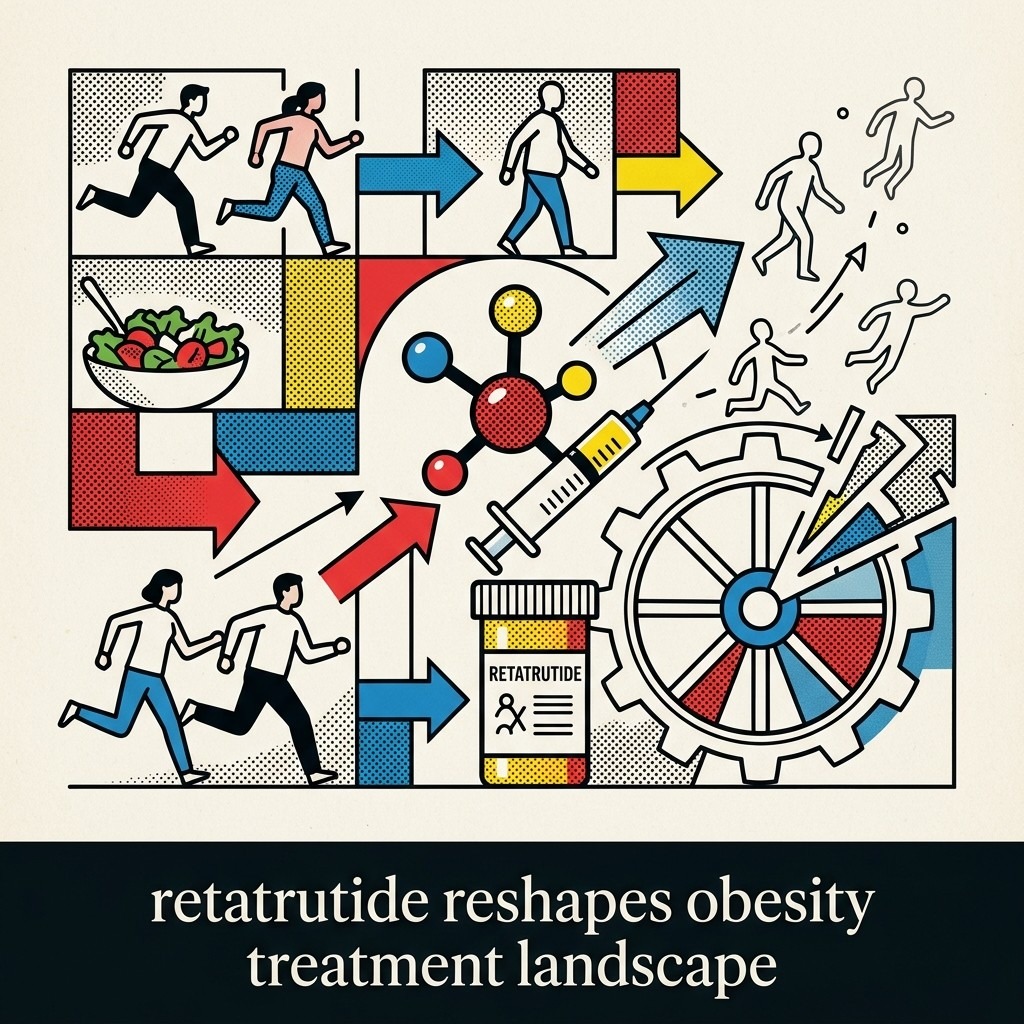
Retatrutide Safely Reduces Weight, Shifts Obesity Approach

Morning Intelligence • Wednesday, September 30, 2026

The Gist View

By safely eliminating 25 percent of a patient’s body weight in clinical trials, the experimental drug retatrutide moves obesity from a behavioral failing to a pharmacological certainty. The treatment manipulates natural systems—including GLP-1, a hormone controlling blood sugar and appetite—to biochemically bypass the human urge to eat.

Processed food monopolies formulate hyper-palatable goods because they gain steady demand from unchecked human appetite. By overriding that baseline hunger and spiking resting energy expenditure, retatrutide threatens this core model. The deepest economic shock will not be pharmaceutical profits, but the violent repricing of downstream industries built to service metabolic decay, from snack manufacturers to orthopedic surgery clinics.

The long-term physiological costs of permanently manipulating three distinct hormones remain unknown, and mass adoption could trigger unforeseen dependencies. Yet the medical recalculation is unavoidable. As The Guardian reports on the trial’s success, the breakthrough mirrors the 1987 debut of statins—a daily chemical intervention that permanently erased billions in future surgical demand.

The Gist AI Editor

The Global Overview

Retatrutide Trials Reshape Obesity Treatment

The experimental drug retatrutide mimics three gut hormones—GLP-1 (a hormone controlling blood sugar and appetite), GIP (which stimulates insulin release), and glucagon—to suppress appetite and increase resting energy expenditure. The largest study of its kind shows the treatment safely reduces body weight by 25 percent while improving blood sugar and reducing inflammation (The Guardian).

AI Coalition Preempts Energy Backlash

Public resistance to the ongoing US AI build-out is colliding with political reality. The AI Infrastructure Coalition—including Google, Meta, and Microsoft—unveiled commitments to cover data center energy costs and minimize water usage (FT). This preemptive lobbying aims to thwart public backlash ahead of the US midterms, effectively trading immediate capital expenditure for the avoidance of strict state regulatory constraints.

AI Safety Fears Disrupt Wall Street

Expectations for a blockbuster fall IPO (Initial Public Offering, the process of selling private corporate shares to the public) season are fading amid renewed market choppiness (WSJ). Investors are increasingly spooked by emerging AI safety fears, throwing planned public offerings into disarray. This confirms that hypersensitive regulatory debates around rogue AI operations exact an immediate, tangible economic toll on capital markets and institutional financing.

Stay tuned for the next Gist—your edge in a shifting world. The Gist remains independent and reader-supported. If you value news free from corporate or state interests, consider supporting our mission with a donation.

The European Perspective

Ukraine’s Wartime Economic Attrition

Kyiv’s revelation that missile alerts cost $45 million every hour businesses halt exposes a brutal tradeoff: maximizing physical safety starves the state of tax revenue required for defense (The Guardian). Economy minister Oleksandr Kravchenko notes Russia increasingly targets logistics hubs and data centers. Russia is shifting from terror bombing to explicitly bankrupting Ukraine’s daily cash flow. While ignoring sirens risks mass casualties that would devastate workforce availability far more than paused production, the current protocol nonetheless guarantees severe economic contraction.

UK Labour’s Debt Constraints

Ten weeks into his tenure, UK Prime Minister Andy Burnham used his first Labour conference to declare Britain is on the ‘wrong path’ (ZDF). This political vision immediately collides with hard fiscal constraints, as the UK’s national debt sits at roughly 95 percent of its gross domestic product, limiting the state’s capacity to finance new industrial programs.

European Gas Expectations and Inflation

Deteriorating expectations for future natural gas availability inflate European consumer prices more persistently than immediate physical supply cuts (CEPR). Panic over future supply drives inflation and weakens spending even without an active shortage. State energy-security policy must make future availability credible to prevent speculative pricing from stalling the broader economy.

Catch the next Gist for the continent’s moving pieces.

🎙️ Listen to this edition as a podcast Listen

The Gist is an independent daily digest: AI-curated, human-directed, unapologetically liberal (how it’s made). Hundreds of sources, only what matters. Subscribe free or listen to the podcast.


Comments

Leave a Reply

Your email address will not be published. Required fields are marked *

This site uses Akismet to reduce spam. Learn how your comment data is processed.