RBI Raises Repo Rate to 5.50% Amid US Borrowing Concerns

Evening Analysis • Wednesday, October 07, 2026

The Gist View

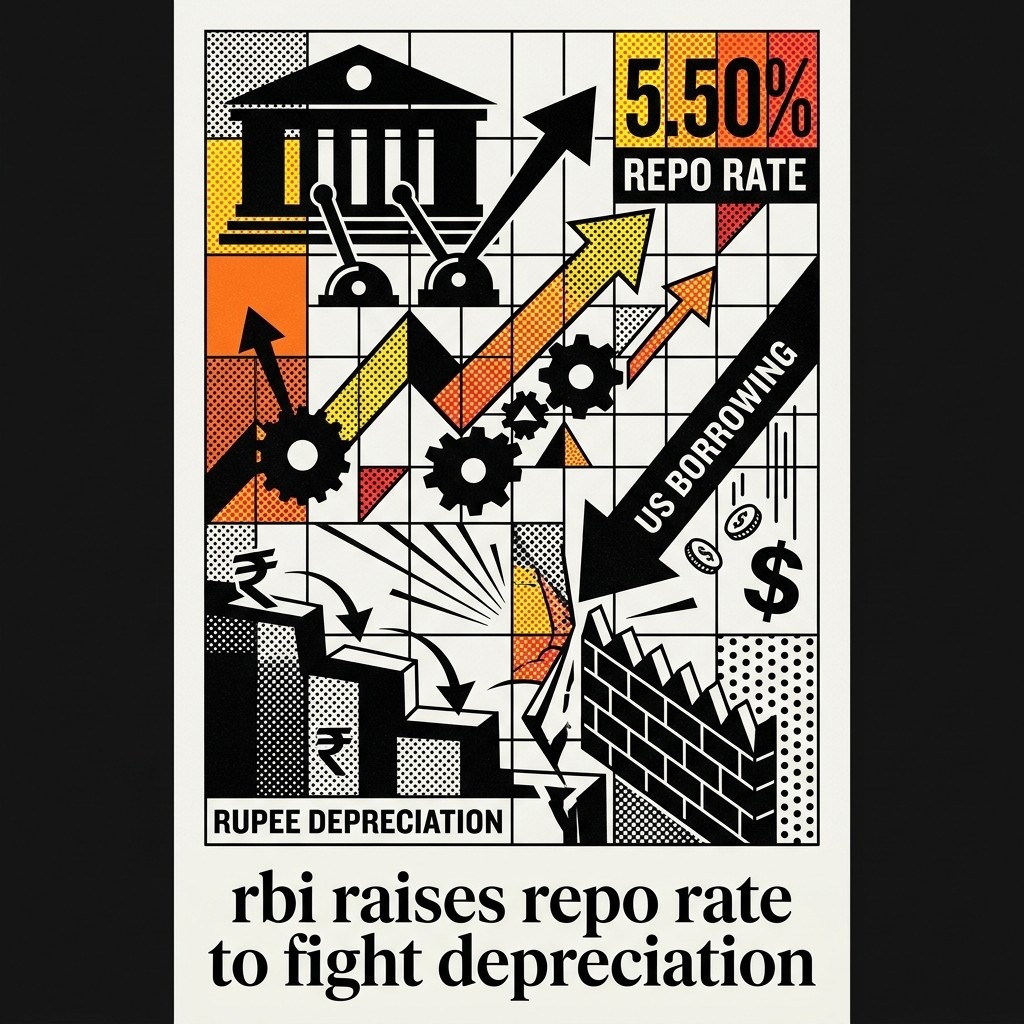
The Reserve Bank of India, the country’s central bank, raised its benchmark repo rate by 25 basis points to 5.50% today, officially shifting its policy stance to ‘calibrated tightening’. The move captures the immediate toll of American borrowing on developing markets. With the US 10-year Treasury yield sitting at 5.26%, investors demand steeper premiums to hold debt anywhere else in the world.

Emerging market authorities face a narrow mandate. The RBI intentionally limits domestic credit growth because it gains a necessary shield against currency depreciation; keeping borrowing costs flat while American yields climb guarantees a rapid sell-off of the rupee. India must suppress its own industrial expansion simply to match the premium Washington pays to fund its deficits.

This defensive posture leaves regional economies highly vulnerable to prolonged debt servicing costs. “Banking stress can build quickly and take years to resolve,” warned RBI Governor Sanjay Malhotra.

The Gist AI Editor

The Global Overview

Alibaba Pushes Open-Source AI for Europe

Alibaba is urging Europe to adopt open-source artificial intelligence to reduce reliance on US and Chinese proprietary systems (Bloomberg). This strategy incentivizes European governments to build independent computing infrastructure. Crucially, backing open-source models fragments Western technological consolidation, lowering regulatory barriers for foreign tech entities to integrate into European digital supply chains while undercutting American market dominance.

China Initiates Corporate Tax Crackdown

Beijing launched a broad tax enforcement campaign targeting domestic corporations (FT). This aggressive capital retrieval mechanism signals a structural shift from subsidizing corporate growth to extracting immediate revenue. As local municipalities face severe budget deficits, tightening tax compliance forces capital out of private cash reserves and into state coffers, centralizing financial leverage to manage mounting sovereign liabilities.

France Pivots to Short-Term Debt Issuance

France announced a shift toward issuing short-term government debt, specifically targeting sub-12-month durations, following recent bond-market volatility (WSJ). Borrowing on shorter timelines prevents the government from locking in elevated long-term interest rates. However, this strategy exposes Paris to constant refinancing risks, actively trading long-term stability for immediate liquidity to maintain operational funding without triggering broader European market panic.

Australian Court Links Coal to Climate Liability

An Australian court delivered a ruling linking a specific coal project directly to global warming (FT). This establishes a legal mechanism holding fossil fuel producers liable for downstream emissions. The verdict forces institutional investors to fundamentally reprice extraction risks, shifting capital away from coal infrastructure as mounting legal friction steadily erodes future profit margins.

Stay tuned for the next Gist—your edge in a shifting world. The Gist remains independent and reader-supported. If you value news free from corporate or state interests, consider supporting our mission with a donation.

The European Perspective

Finland Pauses Google Data Center Expansion

Finland halted Google’s artificial intelligence data center over environmental compliance. This regulatory pause creates a structural bottleneck for US tech capital scaling European computing infrastructure, forcing multinational firms to price in higher regional compliance costs and delay deployment timelines. (Euronews)

Cisco Books $9 Billion in AI Orders

Cisco logged $9 billion in enterprise orders despite broader market hesitation regarding AI monetization. This capital flow signals a structural pivot: institutions are upgrading physical network hardware rather than solely funding software startups. Corporate integration is accelerating, with Cisco directly targeting Italian infrastructure to close regional digital efficiency gaps. (Il Sole 24 Ore)

UK Seeks Exemption from Made in Europe Rules

The UK government initiated October 7 negotiations to secure exemptions from upcoming “Made in Europe” regulations. London’s systemic incentive is preventing European Union industrial protectionism from excluding British manufacturers from continental supply chains. This leverages existing Brexit trade frameworks to maintain cross-border capital liquidity. (Politico)

Italy Pushes EU for Fiscal Flexibility

Italian Prime Minister Giorgia Meloni is lobbying the European Commission to loosen spending rules to absorb inflation shocks, specifically evaluating mobile fuel excise taxes to manage domestic costs. By aligning with other Mediterranean EU members, Italy aims to shift Brussels’ fiscal enforcement, prioritizing sovereign consumption stability over strict deficit targets. (Il Sole 24 Ore)

Catch the next Gist for the continent’s moving pieces.

🎙️ Listen to this edition as a podcast Listen

The Gist is an independent daily digest: AI-curated, human-directed, unapologetically liberal (how it’s made). Hundreds of sources, only what matters. Subscribe free or listen to the podcast.


Comments

Leave a Reply

Your email address will not be published. Required fields are marked *

This site uses Akismet to reduce spam. Learn how your comment data is processed.