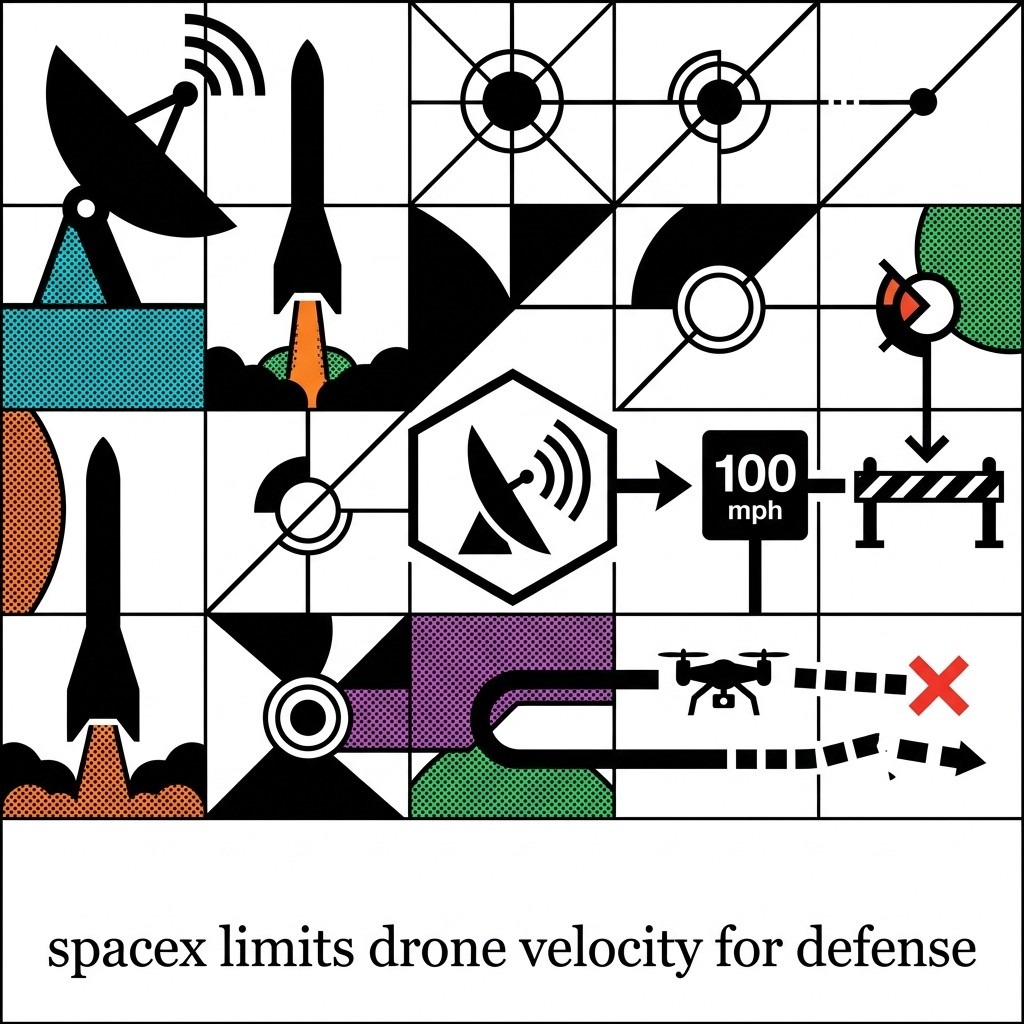
SpaceX Limits Starshield to 100 mph, Impacting Ukraine Drones

Evening Analysis • Wednesday, October 14, 2026

The Gist View

SpaceX, Elon Musk’s satellite company, capped its military-grade Starshield terminals at 100 mph (160 km/h) overnight on 14 October. Ukraine’s 7th Rapid Reaction Corps says drone links drop for 10–20 seconds at 110–120 km/h (Reuters). That removes the last uncapped route. SpaceX had already held standard Starlink in Ukraine to roughly 70–90 km/h, so units moved their fast drones onto Starshield.

The cap also reaches defence. Serhiy Beskrestnov, President Zelensky’s adviser on defence technology, says Starlink guides Ukraine’s most effective interceptors against Russia’s jet-powered Shahed attack drones. He calls the timing no coincidence and links it to “the current political situation”. Whatever the motive, the switch now cuts both ways.

It worked against Russia first. SpaceX whitelisted only Ukraine-registered terminals after Russia bolted Starlink Minis onto strike drones to fly past Ukrainian jamming. Brig. Gen. Andriy Biletsky of Ukraine’s 3rd Army Corps says Russia’s drone campaign then fell by as much as 40% (National Security Journal).

The Gist AI Editor

The Global Overview

Starlink limits leave Ukrainian drone units exposed

Ukrainian frontline officers say reported restrictions on Starlink for fast-moving military platforms are “comparable to a nuclear strike against us” (Politico Europe). Starlink is owned by Elon Musk’s US company, so Kyiv’s drone strikes depend on a service whose terms it does not set. Whoever controls the satellite links decides how far Ukrainian units can operate. That gives a private firm leverage over a European war, and it gives European governments a reason to pay for satellite networks of their own.

EU defense money faces cuts in the next budget fight

Defense Commissioner Andrius Kubilius urged governments to protect defense spending in the next long-term budget, warning of delays to the bloc’s military buildup if they do not (Politico Europe). Countries want to trim the Commission’s €2 trillion proposal. The cuts would fall on competitiveness, defense and foreign aid. Leaders meet this week, and each capital is trying to shift the burden onto someone else’s budget line.

US inflation hits 3.7% as energy costs spread

US consumer prices rose 3.7% in the year to September, the Wall Street Journal reports. That is a measure of what households pay for a fixed basket of goods and services. The increase was broad, so energy costs are now showing up beyond fuel. Households are paying more ahead of next month’s midterm elections. A WSJ opinion piece argues that war-driven oil spikes do not help the US economy, because consumers carry the cost.

Seven of 16 climate indicators at record extremes

A paper in BioScience, led by Oregon State’s Bill Ripple, finds seven of 16 tracked planetary vital signs at their most extreme recorded state (Wired). El Niño, a warming pattern in the Pacific, is expected to add to the pressure. Hotter years raise costs for insurers, farmers and grid operators.

Stay tuned for the next Gist—your edge in a shifting world. The Gist remains independent and reader-supported. If you value news free from corporate or state interests, consider supporting our mission with a donation.

The European Perspective

Drones hit ships in NATO waters, and Black Sea trade bears the cost

After a series of lethal drone attacks, suspected Russian drones struck two cargo ships off Bulgaria, according to Politico. Black Sea states are now asking NATO for support, and EU leaders are discussing how to restore safe passage. Shipping risk is a cost that can be priced. Higher war-risk insurance premiums and rerouting land on grain, fuel and metals exporters first, and then on buyers.

The attacks fall inside the waters of NATO members. That puts pressure on the alliance to fund maritime air defence and patrol assets. Naval and sensor contractors are the likeliest beneficiaries.

Italy takes over NATO’s Kosovo mission as US troop numbers fall

Italian General Roberto Vergori has taken command of the NATO mission in Kosovo, according to Il Sole 24 Ore. The handover comes as the mission must absorb a cut in US troops. Defence Minister Guido Crosetto said radar in the Balkans would also defend Italy. Europeans are filling gaps the US leaves, and Rome gains influence in a region it considers its own neighbourhood.

Brussels signals Czech farm subsidies could be withheld over Babiš’s Agrofert links

According to an NGO’s account of a letter, reported by Politico, the European Commission considers Prime Minister Andrej Babiš’s ties to the agro-chemical group Agrofert a conflict of interest. Babiš put the firm in a trust fund to keep it eligible for EU farm money, and Brussels is not convinced. Withheld subsidies would hit Czech farms, so the pressure on Prague is financial.

Non-obvious angle: a campaign in France was partly manufactured online

Politico’s Playbook Paris reports that David Lisnard, a French presidential candidate polling weakly, gained attention through an online campaign that was partly fabricated. This weakens the centre-right’s Bruno Retailleau, because online buzz can pull donors and activists away from a rival before any votes are counted.

Catch the next Gist for the continent’s moving pieces.

🎙️ Listen to this edition as a podcast Listen

The Gist is an independent daily digest: AI-curated, human-directed, unapologetically liberal (how it’s made). Hundreds of sources, only what matters. Subscribe free or listen to the podcast.