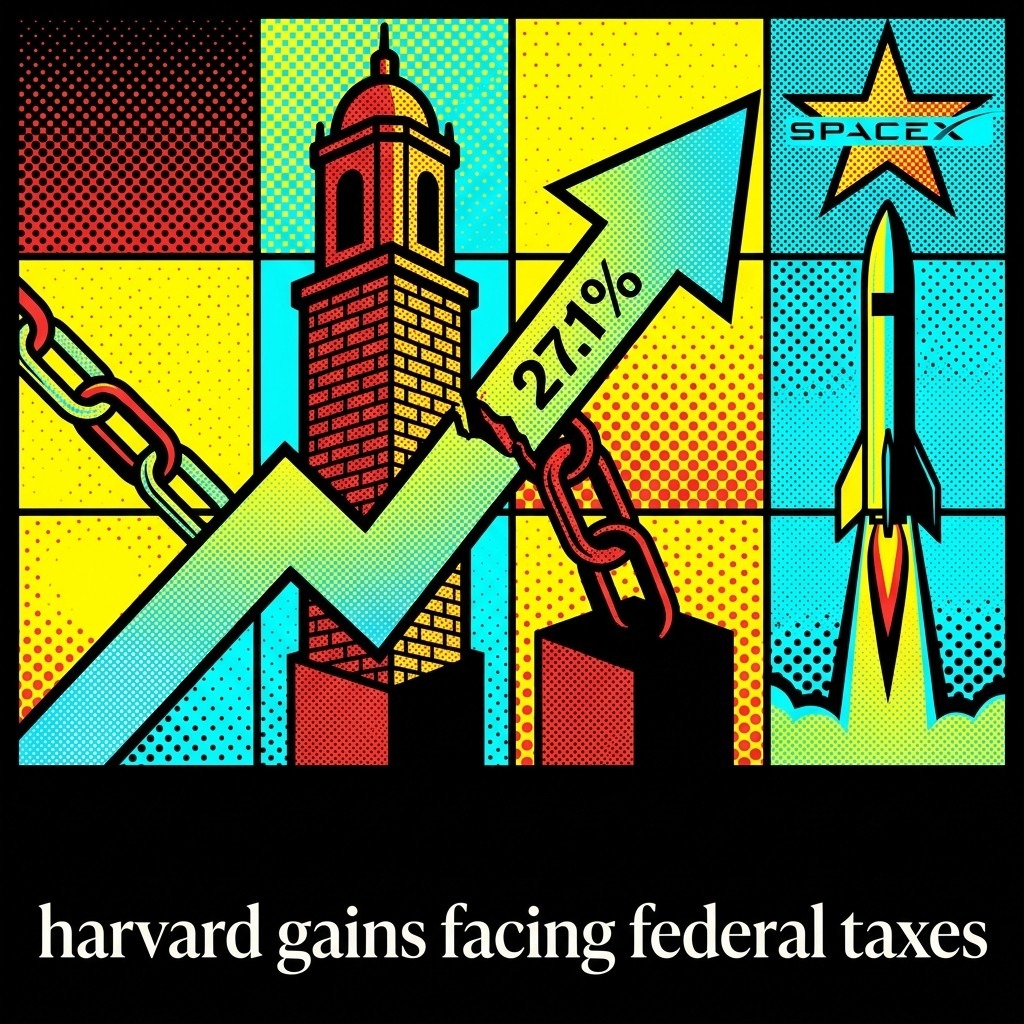
Harvard Endowment Up 27.1%; SpaceX Stake Impacts Returns

Morning Intelligence • Friday, October 16, 2026

The Gist View

Harvard’s endowment returned 27.1% in the year to June 30, yet the university will feel little of it soon, because Washington taxes the gains. From fiscal 2027 the federal levy on Harvard’s net investment income rises to 8%, Quartz reports. Ritu Kalra, Harvard’s chief financial officer, says the university has held its payout flat to absorb it.

Both sides have reasons. Harvard smooths payouts on purpose, so budgets do not swing with markets it cannot control. The Trump administration, which is seeking penalties against Harvard and threatening to withhold funding over diversity commitments, according to CNBC, collects the tax whatever Harvard decides. Each extra dollar of return raises the bill.

The result also leans on one name. Harvard’s $2.2bn stake in SpaceX, Elon Musk’s rocket and satellite company, is more than six times its next-largest disclosed holding, the chipmaker Taiwan Semiconductor, at just under $350m. “Markets can take back what they give,” Kalra told the Harvard Gazette.

The Gist AI Editor

The Global Overview

Harvard’s endowment gains 27.1% on AI and SpaceX stakes

Harvard’s fund rose 27.1%, lifting total assets to $68bn as its private capital holdings rebounded (FT). Much of the gain came from private AI and SpaceX positions. Investors in those companies can only cash out when the companies choose to list or sell shares.

Capital Economics sees more late-cycle signs in US stocks

The recent selloff may prove another temporary setback, but Capital Economics says a growing number of late-cycle signals are emerging (WSJ). In plain terms, the firm sees more evidence that the long run of gains is maturing.

Gold slips before Warsh speaks in Bangkok

Gold fell in early Asian trade as investors waited for Fed Chairman Kevin Warsh’s remarks at the IMF meeting in Bangkok (WSJ). Gold pays no interest, so traders watch what the Fed signals on rates.

Starshield makes SpaceX a government supplier

SpaceX’s secure network for governments comes in several forms, and some services are vital to Ukraine’s war effort (WSJ). SpaceX therefore controls infrastructure that a military relies on. Separately, Tesla unveiled its Roadster after a decade in development, with SpaceX rocket thrusters fitted (FT).

Europe stops scrambling over Trump’s provocations

Politico’s columnist argues European leaders now shrug off the US president’s provocations instead of rushing to contain the fallout. That lowers the cost of his statements for Brussels.

Stay tuned for the next Gist—your edge in a shifting world. The Gist remains independent and reader-supported. If you value news free from corporate or state interests, consider supporting our mission with a donation.


The European Perspective

Brexit returns to Labour’s agenda

Andy Burnham reopened the Europe question at the Labour conference. Customs union, single market, rejoining and a second referendum are all back in Westminster debate (Politico). Cecilia Malmström, a former EU trade commissioner, said any new deal would need to be “Nigel Farage-proofed”, meaning it should survive a Reform government. The EU’s incentive is to avoid concessions that a later British government could reverse. Labour’s incentive is to find trade gains without handing Reform an opening.

Trump attacks Ukraine’s refinery strikes as a threat to world energy prices

Ukraine has announced a resumption of attacks on Russian refineries. Donald Trump called the plan a “disgrace” in an interview with Newsmax, arguing that the strikes push up global energy prices (ZDF). The incentives are clear. Russian refined fuel feeds Moscow’s war budget, so Kyiv gains by cutting it. A US president who wants lower pump prices gains from keeping those refineries running. Europe sits between the two positions, as an importer exposed to any fuel price spike and as Ukraine’s main financial backer. Neither the size of the planned strikes nor any price effect has been confirmed.

German rents are rising faster than inflation

Rents are climbing faster than inflation, fastest in Hamburg, and the tenants’ association and the DGB union federation are demanding stronger tenant protection (ZDF). The legislation is still pending. Landlords keep the gains for now, while tenants lose spending power.

A non-obvious angle: climate deaths run through the economy

A CEPR column argues that estimates based only on local heat exposure miss part of the toll. Global temperature swings also affect mortality indirectly, by cutting economic activity and living standards. Counting that channel raises estimated damages substantially. The policy point is that economic resilience limits the health harm.

Catch the next Gist for the continent’s moving pieces.

🎙️ Listen to this edition as a podcast Listen

The Gist is an independent daily digest: AI-curated, human-directed, unapologetically liberal (how it’s made). Hundreds of sources, only what matters. Subscribe free or listen to the podcast.