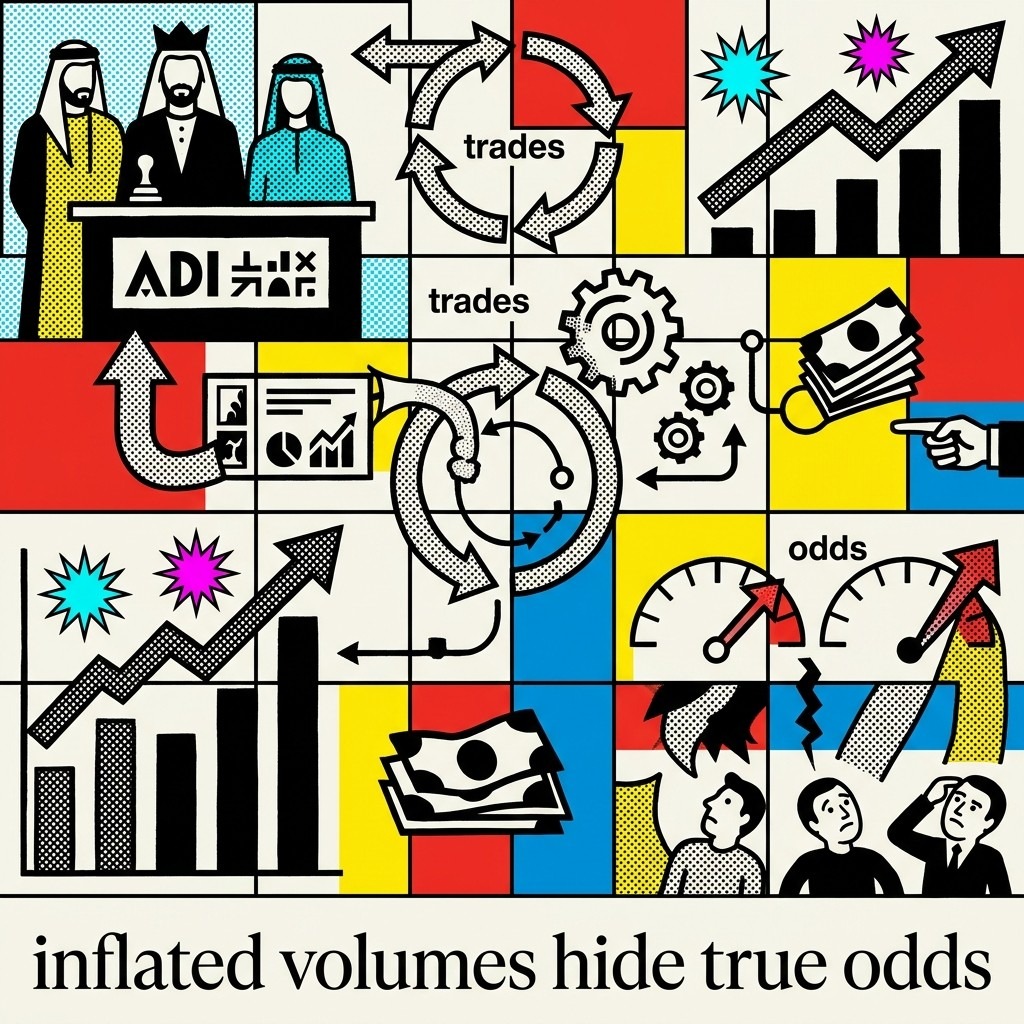
ADI Predictstreet Inflates Volumes with Internal Trading

Evening Analysis • Saturday, October 17, 2026

The Gist View

ADI Predictstreet, a World Cup betting market backed by Abu Dhabi’s royal family, does nearly all its trading with itself, the WSJ reports. It paid close to $150 million for advertising rights. Inflated volume is the smaller problem. A prediction market sells one product: a price that stands for the crowd’s odds. With little outside trading, that price reflects whoever funds the loop.

Circular volume costs little if one backer sits on both sides. Any fees it pays return to its own platform, so the real outlay is the sponsorship. Any outlet that quotes ADI’s odds as what fans think is repeating the backer’s number. The test comes after the final. If volume collapses once the tournament ends, the demand was bought.

Crypto has run this play before. Bitwise, a crypto fund manager, told the US Securities and Exchange Commission, the markets regulator, in March 2019 that 95% of reported bitcoin trading volume was fake.

The Gist AI Editor

The Global Overview

Abu Dhabi-backed World Cup prediction market is mostly trading with itself

According to the WSJ, nearly all trading volume on ADI Predictstreet is circular trading. That means the same parties are buying and selling to each other, which produces large volume figures without real outside demand. The platform is backed by Abu Dhabi’s royal family. It paid close to $150 million for advertising rights during the World Cup.

Volume is the number advertisers, regulators and later investors use to judge whether a market is liquid, meaning whether an ordinary user can place a bet and find someone to take the other side. Inflated volume makes a new venue look established. It also gives a sponsor with deep funding a way to buy that credibility in public. Whoever funds the circular flow benefits most, because the sponsorship spend buys reach while the activity looks organic.

Zelenskyy calls Starlink speed limits in Ukraine a “planned operation”

The FT reports that Zelenskyy says the restrictions apply only in Ukraine. He says they are hampering efforts to intercept Russian attacks. This extends the dispute over satellite throttling that readers already know. The new element is that Kyiv is now describing the limits as deliberate, not as a technical fault. Last edition, Ukraine was shown seeking European satellite capacity. The accusation raises the cost of waiting for that capacity. A single US-controlled supplier decides how fast Ukrainian drone defences can communicate, and Kyiv has no contractual way to overrule it.

Microplastics may react with water, a new study says

Wired reports a new study finding that tiny plastic fragments can react with water. Plastic has long been treated as chemically stable, which is why it is used for food packaging and water bottles. If the finding holds, current safety testing built on that assumption may miss effects inside living tissue. Producers and packaging buyers would have the most to lose if regulators asked for new testing.

Non-obvious angle: AI is limited by missing biological data, not by compute

Wired, republishing Quanta, reports that AI models cannot yet decode the three-dimensional folding of DNA. The reason is a shortage of data. Researchers have only scratched the surface of how that folding shapes gene function. Money spent on more computing power will not fix this. Experimental labs that generate the measurements hold the leverage.

Stay tuned for the next Gist—your edge in a shifting world. The Gist remains independent and reader-supported. If you value news free from corporate or state interests, consider supporting our mission with a donation.

The European Perspective

Brexit residency paperwork now threatens a seriously ill Briton in Sweden

Mark Smith, 60, who has a history of heart attacks and strokes, was told by phone to leave Sweden by 17 October as an “alien” without permission to stay, according to the Guardian. He says officials told him three times that he needed to do nothing to remain after Brexit. He is now in hiding.

Post-Brexit residency in several EU states depends on the person having applied for a status that is recorded in a national database. Where officials told residents no action was needed, the gap between that advice and the legal requirement now falls on the resident. Each case that reaches the press raises pressure on Stockholm and London to settle who answers for the advice given.

Many NHS trusts decline Palantir’s £330m data platform

NHS bodies across England are rejecting the US firm’s federated data platform, according to freedom of information responses seen by the Guardian. The platform is a shared system for waiting lists and surgery scheduling. Trusts from Gateshead to Truro have declined it or tried it and gone back to their old systems. Greater Manchester’s care board called it “duplicative”.

Some trusts say it has improved scheduling. The contract is worth £330m, but its value depends on adoption, which is optional. If trusts keep refusing, the firm’s UK revenue grows more slowly than the headline figure suggests. Existing suppliers keep their contracts.

Zelenskyy says Starlink slowdown applies only to Ukraine

Zelenskyy said Starlink is still throttled over Ukraine and that tests in European countries showed no slowdown there (ZDF). He said the satellites do not track antennas moving faster than 161 km/h. That limit hampers Ukrainian drones, both against Russian jet drones and in strikes at medium range.

He also called Trump’s pause on Russia sanctions a “reward” for Putin and urged Europe to open its own talks with Moscow (Guardian). Russia meanwhile hit Ukrainian power plants in one of its worst strikes yet.

India’s opposition challenges the removal of 130 million voters

India’s opposition has gone to court, saying the election commission removed about 130 million names from voter lists while revising them (ZDF). Months of youth protests have also continued, and the founder of the “Cockroach” movement was arrested.

Catch the next Gist for the continent’s moving pieces.

🎙️ Listen to this edition as a podcast Listen

The Gist is an independent daily digest: AI-curated, human-directed, unapologetically liberal (how it’s made). Hundreds of sources, only what matters. Subscribe free or listen to the podcast.