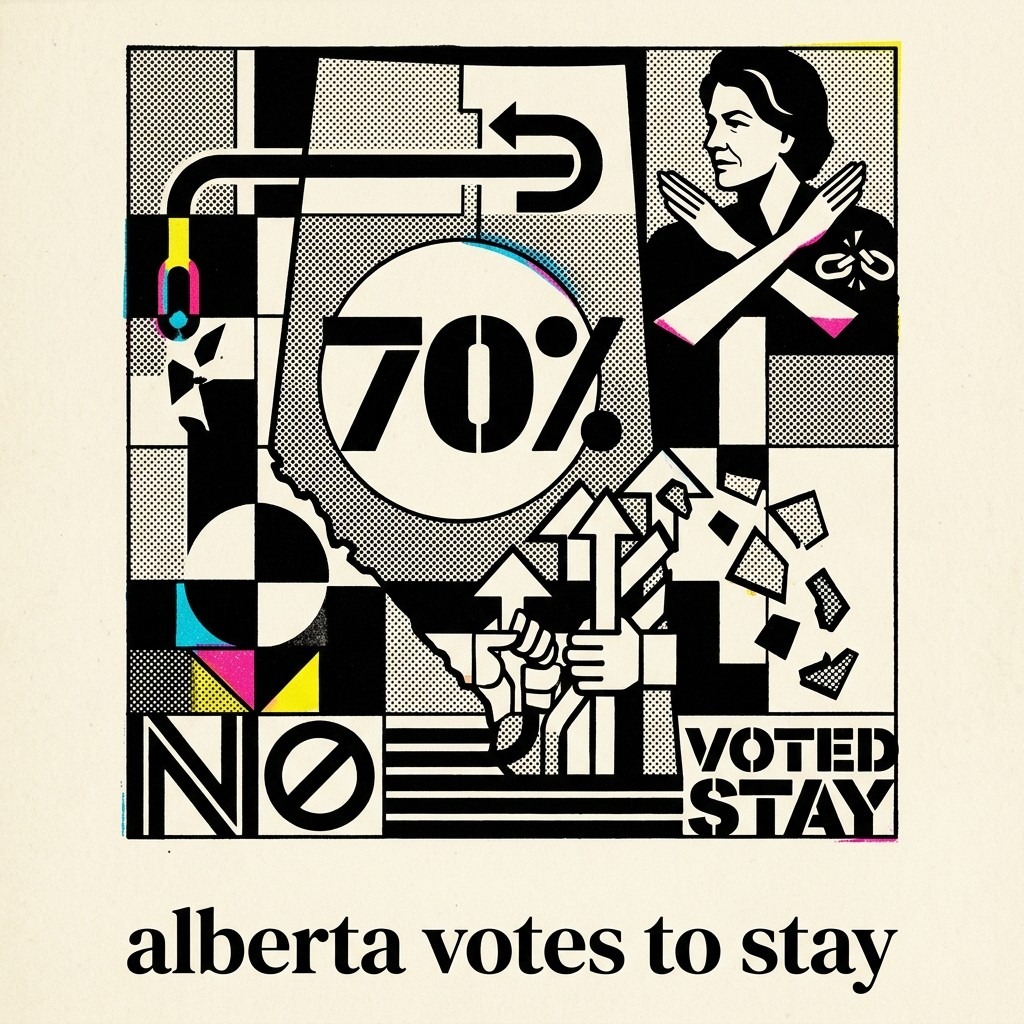
Alberta Referendum: 70% Oppose Separation

Evening Analysis • Sunday, October 18, 2026

The Gist View

Alberta votes Monday on whether its government should begin the legal process toward a separation referendum, and most polls, CBC reports, show about seven in 10 voters saying no. The ballot is non-binding and is not independence itself. So the margin matters more than the winner.

Premier Danielle Smith opposes leaving but called the vote. If “stay” wins, she says, she will approve no second referendum. That gives separatists a reason to chase a share, not a win. Mitch Sylvestre, who heads the separatist Alberta Prosperity Project, told AFP he would be “very surprised” by under 40%. A “yes” near that level can become a bargaining figure in every later talk with Ottawa, which is why Prime Minister Mark Carney keeps asking for a “decisive” result.

Quebec shows how long such numbers last. It voted No with 59.6% in 1980, then with just 50.6% in 1995, according to Élections Québec.

The Gist AI Editor

The Global Overview

Alberta’s secession vote splits Canada’s oil heartland from Ottawa

Prime Minister Mark Carney is campaigning to keep Alberta inside Canada, according to the WSJ. The province is Canada’s main oil producer, so a split would take most of the country’s crude export revenue and its largest source of federal transfer payments with it. Carney’s difficulty is that Alberta’s leverage grows when Ottawa needs unity most, because any concession on pipelines or revenue sharing will be demanded by other provinces too.

St Petersburg hit by Ukraine’s largest drone attack yet

The FT reports that the strikes hit tech infrastructure in St Petersburg. They followed Russian attacks on electricity substations in Ukraine. Both sides are now targeting the systems that keep an economy running, not only military sites. Russia’s second-largest city and its computing capacity are now within reach of cheap drones, which raises the cost of air defence across a very large territory.

Energy prices are turning Trump’s affordability promise against him

The FT reports that voters increasingly link rising energy prices to the administration’s policies. Fuel and power bills are paid monthly and are hard to avoid, so they shape political judgment more than any other price. That puts pressure on the White House ahead of elections, and it will push it toward measures that lower prices quickly, even at a cost to other goals.

The non-obvious angle: screen time got better, not cheaper

Research highlighted by Marginal Revolution finds that the quality-adjusted price of screen time has fallen 39% since 2000. Almost all of that comes from better devices and services, not lower prices paid. People are spending more hours on screens because each hour delivers more, not because it costs less. Lego has applied a similar logic, according to the WSJ, by building adult sets around gaming and Formula One.

Stay tuned for the next Gist—your edge in a shifting world. The Gist remains independent and reader-supported. If you value news free from corporate or state interests, consider supporting our mission with a donation.

The European Perspective

Italian protests leave 50 detained in Milan as nine mayors warn the government

Cost-of-living marches on Saturday turned into street clashes, and about 50 people were detained in Milan, according to Euronews. Clashes were also reported in Turin and Bologna, and several demonstrators were injured. Mayors of nine centre-left-run cities then wrote to the government, warning that social stability is now at risk (Il Sole 24 Ore).

The incentives are plain. City halls handle policing pressure, housing and local services, but rely on Rome for the money. Writing jointly gives the mayors a way to press for central funds while the opposition is not in government.

Lega leadership bid tests the party’s economic line

Senate Finance Committee chair Massimo Garavaglia says he will run for Lega party secretary. He told La7 that the Lega is “not an extreme-right party” and that, if forced to choose between the economic lines of Giancarlo Giorgetti and Claudio Borghi, he would back Giorgetti (Il Sole 24 Ore). Giorgetti is the economy minister, so the contest is partly over whether the party keeps defending budget discipline or leans toward Borghi’s more confrontational stance.

Japan loosens its arms export ban and builds drones and chips

Prime Minister Sanae Takaichi has relaxed Japan’s postwar limits on weapons exports, so “any defence equipment” can now be sold abroad (ZDF). Tokyo describes its security situation as the most dangerous since the Second World War. Its build-up centres on drones, tanks and semiconductors. Export access widens the customer base for Japanese contractors and gives them a way to spread development costs beyond the domestic budget.

Russian strikes cut power to tens of thousands of Ukrainian families

Volodymyr Zelensky said overnight attacks hit substations in four regions, leaving “tens of thousands of families” without electricity, and accused Moscow of trying to leave Ukrainians without heat before winter (ZDF). Two people were killed at a farm in Volyn. Substations are costly to replace and need imported equipment, which increases Ukraine’s reliance on European financing.

Non-obvious angle: US district maps set the midterm result in advance

The midterms fall on 3 November 2026. Redistricting disputes over the boundaries of the 435 House districts are the main fight, because district lines are redrawn to favour one party (ZDF). Redrawn lines can decide control of the House before any vote is cast, so campaign donors increasingly fund map fights rather than competitive races.

Catch the next Gist for the continent’s moving pieces.

🎙️ Listen to this edition as a podcast Listen

The Gist is an independent daily digest: AI-curated, human-directed, unapologetically liberal (how it’s made). Hundreds of sources, only what matters. Subscribe free or listen to the podcast.