Moderna Shares Drop on Modest Melanoma Vaccine Results

Evening Analysis • Friday, October 23, 2026

The Gist View

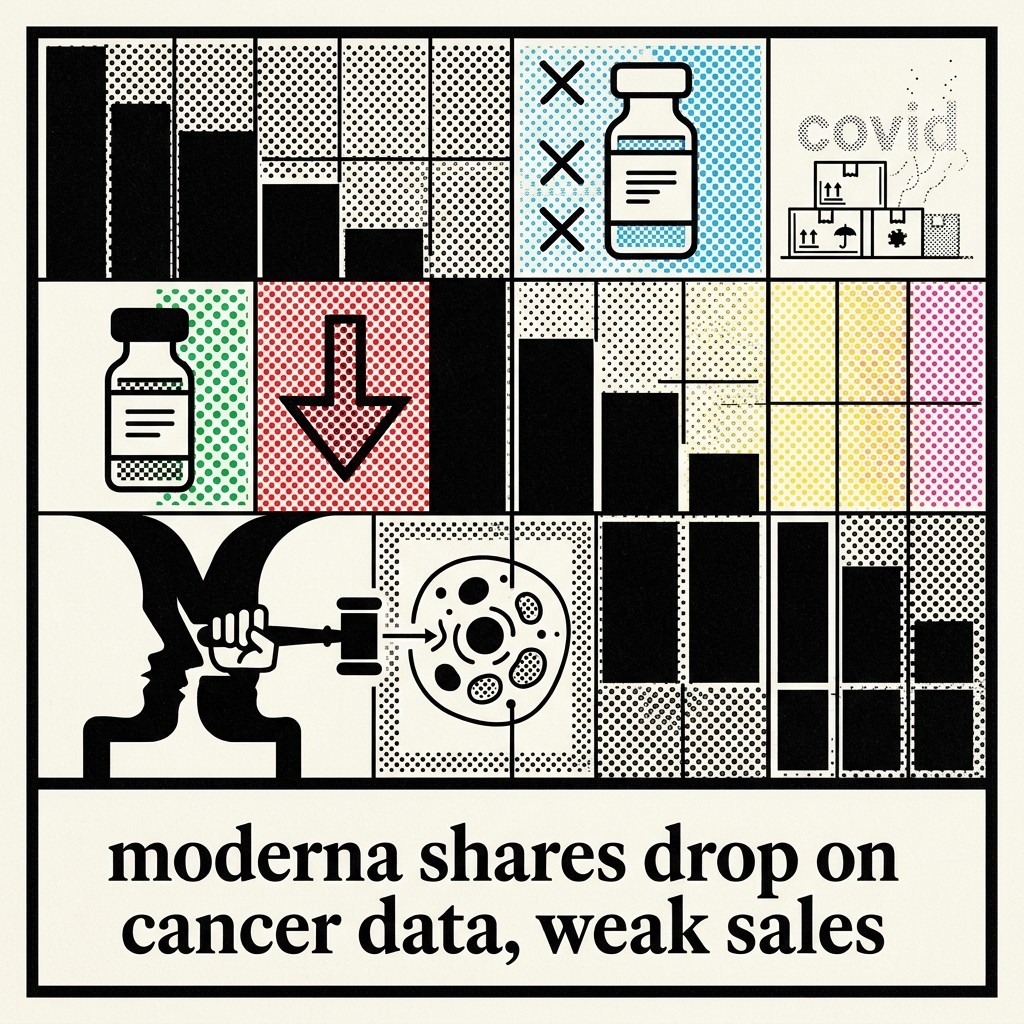
Moderna, the US mRNA vaccine maker, saw its shares plummet on melanoma results that showed its vaccine works. Its sales have already fallen from about $19bn in 2022 to $3.2bn in 2024 as COVID demand faded. The share price assumed cancer vaccines would replace that revenue. A modest benefit cannot.

The partners want different things. Moderna needs a result large enough to justify its valuation. Merck, the US drugmaker that shares costs and profits with it, needs only enough benefit to keep patients on Keytruda, its cancer immunotherapy. Insurers will decide the rest. Each dose is made for one patient, and they will ask what it adds to Keytruda alone.

Merck’s patience has a deadline. Keytruda earned it $29.5bn in 2024, according to Merck’s annual results, and it loses US patent protection in 2028.

The Gist AI Editor

The Global Overview

Moderna’s melanoma data sinks the stock despite a working vaccine

Moderna shares plummeted after results for its melanoma vaccine, according to Bloomberg. The data showed the vaccine worked, but not by enough to persuade investors that a new era of cancer treatment has arrived. The share price had been paying for a breakthrough, so a good result that falls short of one is treated as a loss.

Kering, Decker and Amex show consumer-facing firms cutting back

Kering shares slumped as growth at Gucci slowed further in the third quarter, with North America slower and China still weak (Bloomberg). Decker Outdoor fell after cutting its full-year net sales guidance below analyst consensus. American Express plans to cut 5% of its global headcount, about 3,500 jobs, its chief executive told Bloomberg TV. Companies selling to consumers are protecting profit by trimming costs rather than expecting demand to recover.

SLB shows where oilfield money is going

SLB’s third-quarter revenue rose 5.8% to $9.45 billion (WSJ). The growth came from its data-center division and a gradual recovery in the Middle East. An oilfield services company is now earning growth from the power and cooling needs of computing, alongside its traditional energy work.

Drone strike near Romania and Starlink failures keep the war’s risks high

A drone hit a commercial ship about 13 nautical miles off Romania’s coast, just outside its territorial waters. At least one crew member was killed and three are missing, according to Romanian President Nicușor Dan, who called it Russian escalation (Politico). Shipping insurers and Black Sea port operators now face higher risk near a NATO member’s coast. Separately, Ukrainian soldiers and officials say Starlink connections still fail when drones fly at high speeds, despite Trump’s promise to restore the service (WSJ). That undercuts the earlier European testing that found no throttling.

Stay tuned for the next Gist—your edge in a shifting world. The Gist remains independent and reader-supported. If you value news free from corporate or state interests, consider supporting our mission with a donation.

The European Perspective

France deploys 70,000 officers for Saturday protests

Interior Minister Laurent Nuñez said 70,000 police and gendarmes will be on duty nationwide, after last weekend’s violence (ZDF). The deployment shifts policing costs onto a national budget already under pressure.

French lawmakers reject the Social Security revenue bill

Deputies in the National Assembly voted down the revenue section of the Social Security financing bill, in a chamber largely empty of government supporters (Le Monde). The text is not dead. The government hopes to attach it to the state budget. That would force the health and pension funding and the state budget into one negotiation. Opposition parties would then hold more leverage over both.

Eni caps pump prices through year-end as energy costs spread

Eni will keep a ceiling on retail fuel prices until the end of the year, according to Il Sole 24 Ore. The cap started in late September. It holds petrol at €1.99 per litre and diesel at €2.25 per litre. Drivers are the immediate beneficiaries. Eni takes on the gap between the cap and market prices on its retail margins. The cap also blunts the fuel-price anger that has fed truck blockades in southern Italy.

The ifo institute (Germany’s main business-survey body) shows why costs keep passing down. Its price-expectations index rose to 22.7 points in September from 21.4 in August, meaning more firms plan to raise prices (ifo). It expects inflation to climb above 3%. It also says power and gas suppliers are likely to raise tariffs this winter.

Greece bans social media for under-15s from 1 January 2027

Parliament passed the ban on Thursday, with only the governing New Democracy party voting in favour (DW). Platforms will have to build age checks for a further EU market. That raises their compliance costs, and the pressure to adopt common EU rules grows.

Non-obvious angle: Ebola tracing runs through a European-linked airport record

Health officials are checking whether the first Ebola patients in Kenya and Nigeria both passed through Uganda’s Entebbe airport on 3 October (DW). New information from Switzerland contradicts Uganda’s account of the Nigerian patient’s travel. Uganda reports no active cases. The gap between those accounts shows how little shared travel data supports early detection.

Catch the next Gist for the continent’s moving pieces.

🎙️ Listen to this edition as a podcast Listen

The Gist is an independent daily digest: AI-curated, human-directed, unapologetically liberal (how it’s made). Hundreds of sources, only what matters. Subscribe free or listen to the podcast.