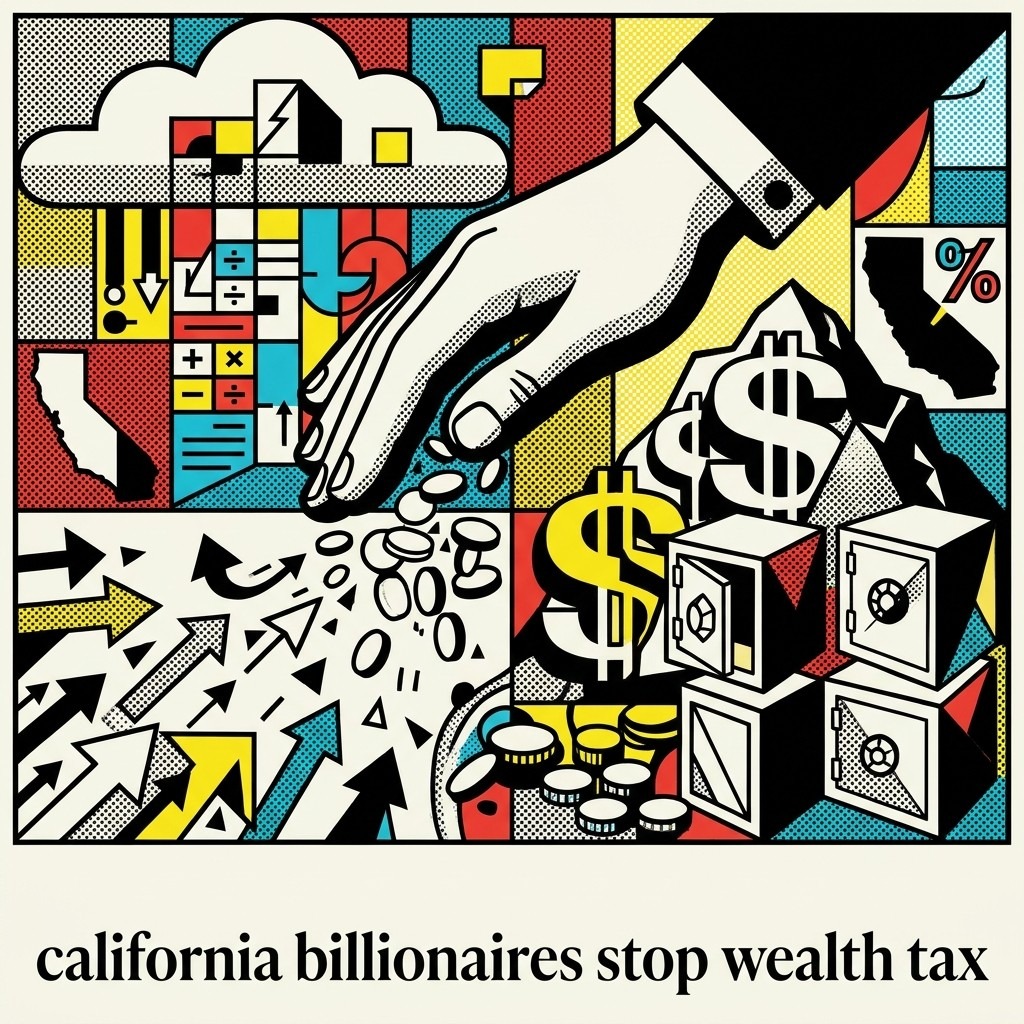
California Billionaires Spend $612M to Block 5% Wealth Tax

Evening Analysis • Wednesday, October 28, 2026

The Gist View

More than 70 California billionaires have spent $612 million to defeat a wealth tax, according to POLITICO. That is under $9 million each on average. The measure, as drafted, is a one-time 5% levy on net worth above $1bn, so even the smallest fortune would owe about $50 million. Fighting costs a fraction of paying, even at long odds.

The sponsor, the SEIU-UHW healthcare workers’ union, wants the revenue for health care. The donors are a tiny minority facing a majority vote, so money is their only lever. Moving out is the alternative, but it protects only the mover. A defeat in California shields the whole class from copycats in other states, which is why so many are paying in.

The record favours their bet. The OECD, the rich-country economic club, counted 12 members with net wealth taxes in 1990 and only four in 2017, according to its 2018 review.

The Gist AI Editor

The Global Overview

Billionaires spend a record $612 million to fight California’s wealth tax

$612 million has come from more than 70 current and former California billionaires, according to a POLITICO analysis. It is the most they have ever spent on one political cause in the state, and it is flowing into this year’s state elections. Billionaires rarely coordinate this closely. The spending shows how much a state-level asset tax could cost them, and how much a precedent in the world’s fifth-largest economy would matter to wealthy residents elsewhere.

Researchers build an AI “Sim Fed” to forecast the rate decision

Economists Tara Sinclair and Sophia Kazinnik built Sim Fed, a system in which AI agents play the 12 officials who vote on US interest rates, including “Sim Powell” and “Sim Cook.” Its forecast, reported by Bloomberg, is that the Federal Reserve holds rates steady on Wednesday. The benchmark rate sets borrowing costs for mortgages, company loans and government debt, so banks and traders pay for any edge in predicting it. The test is whether a model trained on public statements anticipates committee decisions better than human analysts do.

Investors are putting money into defense, AI and French banks

Sarah Ketterer, CEO of Causeway Capital Management, told Bloomberg she sees opportunity in aerospace and defense stocks. She also said “this is the time to accumulate French banks.” Governments are still raising military budgets, so defense contractors have orders booked years ahead. French banks are the contrarian pick, since France’s unrest and budget fights have made investors cautious. Baker Hughes, the energy equipment maker, beat third-quarter profit forecasts, but Bloomberg reports the result fell short of the high expectations investors had set.

Netanyahu’s party wins the most votes but loses its majority

The WSJ reports that Israeli voters gave Benjamin Netanyahu’s party the most votes while taking away his parliamentary majority. He now needs coalition partners, and each one can demand ministries, budgets or policy concessions in return.

Stay tuned for the next Gist—your edge in a shifting world. The Gist remains independent and reader-supported. If you value news free from corporate or state interests, consider supporting our mission with a donation.


The European Perspective

UK pledges 3% of GDP for defense by 2030, without naming a funding source

Chancellor John Healey told parliament on October 28 that Britain will lift defense spending to 3% of GDP by 2030, to “set the direction” toward a NATO target, according to Politico. He gave no detail on where the money comes from. Defense contractors gain from a dated spending commitment, because it lets them plan factories and hiring. Taxpayers and other departments carry the uncertainty until the cuts or tax rises are named.

Berlin switches on AI cameras at Kottbusser Tor in November

Thirty cameras will watch the square around the clock and flag violence or emergencies automatically, Politico reports. A trial phase runs first, with full operation planned for early December. Politico also reports the system is less anonymous than first presented. The structural change: police gain automated detection, and the public gets a test of how much identifiable data a city system keeps.

Energy costs are moving into shop prices

The ifo institute’s price-expectations index, which tracks the share of firms planning price rises, reached 22.7 points in September, up from 21.4 in August (ifo). Its economist Timo Wollmershäuser expects German inflation to climb above 3% in coming months. Crude oil rose after the Bab al-Mandab strait blockade, and gas and power prices hit their highest since late 2022 (ifo). Utilities are expected to raise household bills this winter, so retailers and service firms are passing on costs ahead of that.

EU approves €319 million for an Austrian chip plant

Brussels cleared €319 million in state aid for a semiconductor factory in Austria (Euronews). Public money lowers the plant’s build cost, and it shifts the balance of European chip capacity toward Austria.

Non-obvious angle: Moscow is attending a G20 meeting in the US

Foreign Minister Sergei Lavrov will lead Russia’s delegation to the G20 foreign ministers’ meeting in Atlanta on Friday and Saturday (ZDF). It comes before new talks among Moscow, Kyiv and Washington on ending the war. Russia is using a US-hosted venue as a diplomatic channel.

Catch the next Gist for the continent’s moving pieces.

🎙️ Listen to this edition as a podcast Listen

The Gist is an independent daily digest: AI-curated, human-directed, unapologetically liberal (how it’s made). Hundreds of sources, only what matters. Subscribe free or listen to the podcast.