U.S. Expels Cuban Diplomat; Embargo Stays Since 1962

Morning Intelligence • Thursday, October 29, 2026

The Gist View

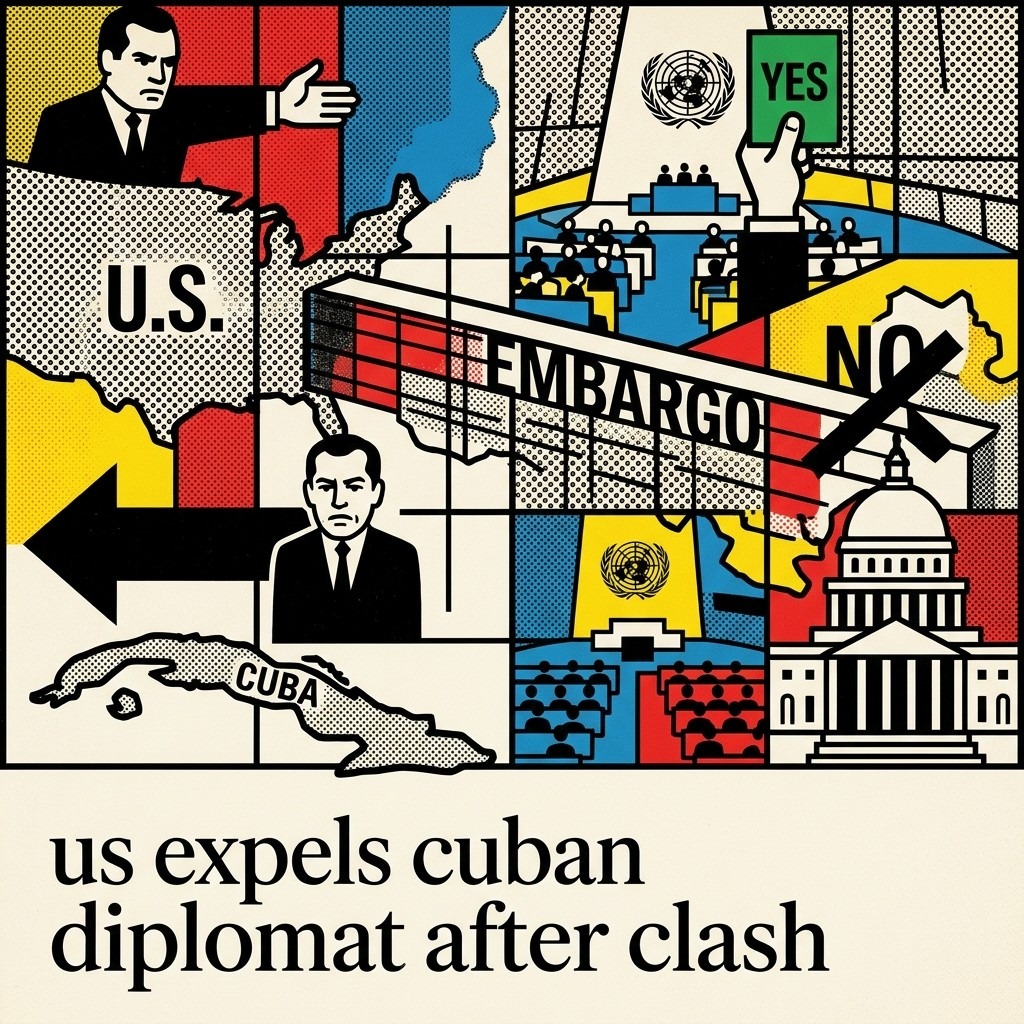
Washington has expelled a Cuban diplomat from the United Nations after a verbal clash between Ambassador Mike Waltz and Cuba’s foreign minister. It is one more gesture in an embargo that has stood since 1962. The embargo already withholds almost everything Washington has to give, so one more penalty costs it nothing.

Havana’s best weapon is the annual vote in the UN’s 193-member General Assembly, which is non-binding. Members condemned the embargo 59 to 3 in 1992, with 71 abstentions, and 187 to 2 in 2024. Washington has lost that argument by a widening margin and changed nothing, so it treats the tally as noise. Cuba treats it as its one dependable win, and its New York mission is where that support is tended. Expect Havana to cast the expulsion as harassment of that mission before the next vote.

Diplomacy alone cannot end the stalemate. The Helms-Burton Act of 1996 wrote the embargo into U.S. law, so only Congress can lift it (Helms-Burton Act, 1996).

The Gist AI Editor

The Global Overview

U.S. expels a Cuban diplomat after a shouting match at the U.N.

Washington expelled a Cuban diplomat after U.S. Ambassador Mike Waltz and Cuba’s foreign minister clashed verbally at the United Nations (WSJ). The expulsion costs Havana a working channel at the U.N., where it relies on votes against the U.S. embargo. Washington pays little for the move, since it has few other dealings with Cuba to put at risk.

Ukraine truce talks hinge on the U.S.-Iran war

Volodymyr Zelenskyy fears that a new escalation in the U.S.-Iran war could derail truce negotiations, according to Politico Europe. Ukraine needs American attention and air-defense supplies going into another winter of fighting. Every Middle East flare-up pulls both toward Iran. Oil traders are pricing the same risk: crude fell in early Asian trade after settling higher overnight (WSJ), which shows the market has no settled view on whether supply will be disrupted.

Microsoft’s cloud growth eases doubts about AI spending

Microsoft reported higher quarterly profit as cloud growth accelerated, which eased investor worries about whether the AI build-out will pay back (WSJ). Customers are paying for the data-center capacity, so the spending is turning into revenue. Tencent’s cloud chief Dowson Tong said AI demand justifies his company’s capital spending. He said Tencent is shifting from consumer AI agents toward enterprise customers, and prioritizing computing power for its own model training and products (Bloomberg).

Chinese chip sales jump 1,800% but shares fall, and Samsung slips

Chinese tech hardware stocks tumbled even though some chipmakers reported sales up 1,800%, because investors doubt the fundamentals and global AI sentiment is weak (Bloomberg). A jump that size usually comes off a very small base, so it reveals little about profit. Samsung shares fell because it announced no new buybacks, according to CLSA’s Sanjeev Rana (Bloomberg). Investors wanted cash returned, not only chip promises.

Stay tuned for the next Gist—your edge in a shifting world. The Gist remains independent and reader-supported. If you value news free from corporate or state interests, consider supporting our mission with a donation.

The European Perspective

Russia plans its own Starlink as Putin courts Musk

Speaking at a Moscow summit with African leaders on 28 October, Putin praised Elon Musk’s “genius” and said he was in touch with Starlink’s controlling shareholder. He made the remarks while describing Russia’s slow build-out of its Rassvet satellite constellation, which is meant for military use against Ukraine (The Guardian). The benefit is practical. Whoever controls a communications network controls access to it on the battlefield. A Russian network would reduce Moscow’s reliance on commercial systems and strengthen its position in any talks with the African states in the room.

Finland and Norway talk to Putin while Helsinki goes to Washington

On Tuesday, Finnish President Alexander Stubb and Norwegian Prime Minister Jonas Gahr Støre phoned Putin. It was one of the few direct calls between European leaders and him in more than four and a half years of war. Finnish Foreign Minister Elina Valtonen meets US Secretary of State Marco Rubio today about Ukraine (ZDF). Northern European states are opening their own channels to Moscow and to Washington at the same time, so they are no longer waiting for a common EU line.

Energy costs are moving into consumer prices

The ifo institute’s price-expectations index, which measures how many firms plan to raise prices, rose to 22.7 in September from 21.4 in August. It links the rise to the blockade of the Bab al-Mandab strait, which pushed crude oil higher. Gas and power prices hit their highest level since late 2022 in mid-September. Ifo expects German inflation to climb above 3% in the coming months, with utilities raising electricity and gas prices in winter (IFO).

Rome budget: €26bn, with banks paying €5.5–6bn

Italy’s cabinet approved a budget bill that has grown to €26bn to fund income-tax cuts for earners up to €55,000. Most of the tax cuts are guaranteed only for 2027. The financial sector is expected to pay €5.5–6bn (Il Sole 24 Ore). Banks and middle-income households are therefore pulled in opposite directions, and the later years of the cuts are not yet funded.

Non-obvious angle: shareholder base predicted who cut investment in 2020

CEPR research finds that euro area listed firms are still mostly owned by domestic investors. In the sectors hit hardest by COVID-19, firms with more domestically concentrated owners cut investment more, lost more value and raised less equity than peers with diversified owners (CEPR). That gives the EU’s capital markets union a measurable economic case, beyond a financial one.

Catch the next Gist for the continent’s moving pieces.

🎙️ Listen to this edition as a podcast Listen

The Gist is an independent daily digest: AI-curated, human-directed, unapologetically liberal (how it’s made). Hundreds of sources, only what matters. Subscribe free or listen to the podcast.