Radev’s Party Secures 131 Seats; Runoff to Decide Power Check

Morning Intelligence • Sunday, November 01, 2026

The Gist View

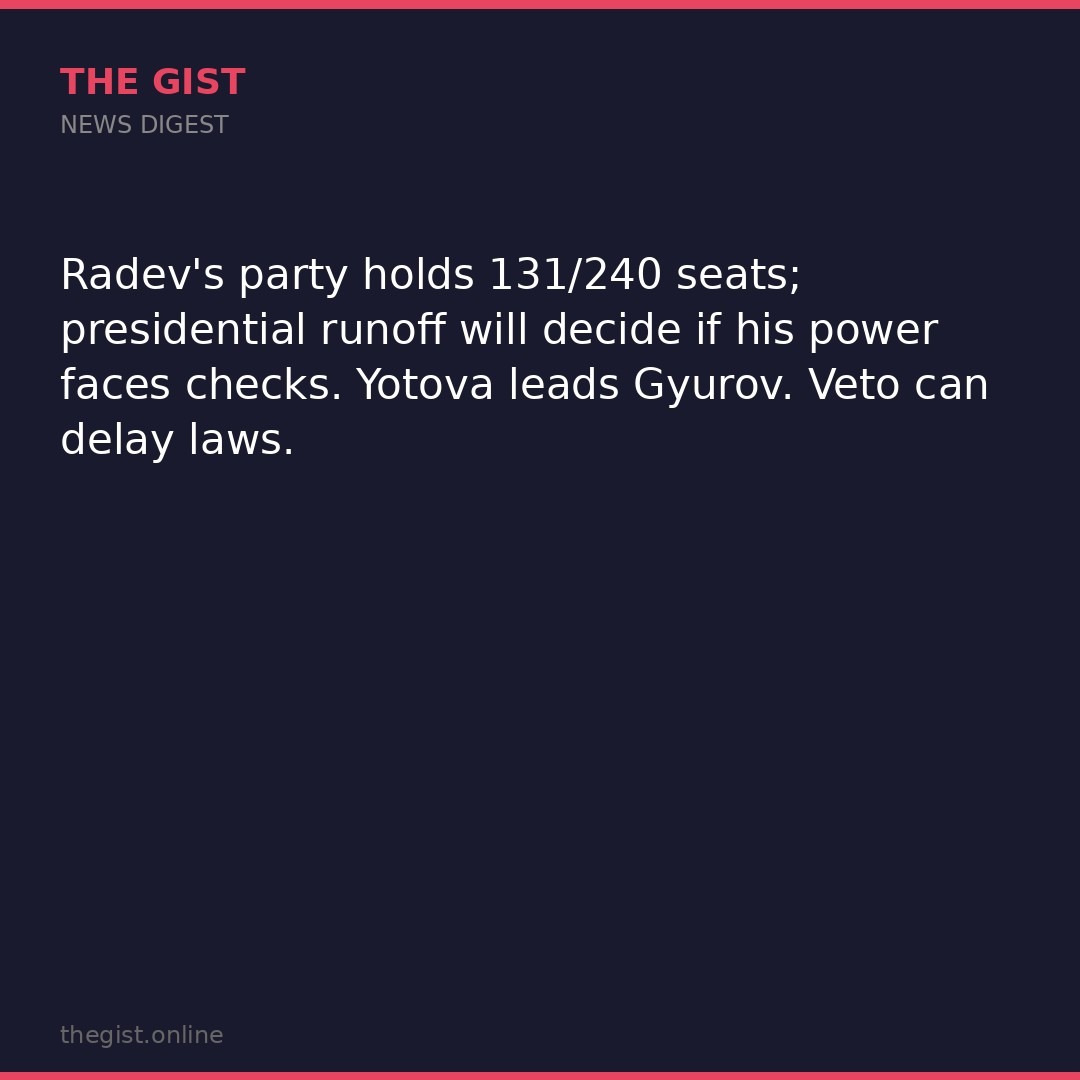
Prime Minister Rumen Radev’s party, Progressive Bulgaria, holds 131 of 240 parliamentary seats, so Sunday’s presidential runoff decides whether the presidency stays a brake on him. Round one drew a record-low 22.98% turnout. Radev’s ally Iliana Yotova led Andrey Gyurov, the opposition’s former caretaker prime minister, by under 43,000 votes.

That brake is weak. A veto only delays a law, because Radev’s majority can repass it with 121 votes. The president still commands the armed forces and can send laws to the Constitutional Court. Yotova owes her candidacy to Radev’s party. Gyurov gains only if he uses every lever. Radev’s pull is thinning: 1.4 million voted for his party in April, against about 500,000 for Yotova in round one.

Yotova does veto: in February she returned an Electoral Code change as unconstitutional. In July she signed the 2026 budget instead. On 20 October the Constitutional Court struck down two provisions inserted into it, EUobserver reports.

The Gist AI Editor

The Global Overview

Bulgaria votes on a government that refuses Ukraine arms

Bulgaria elects its president on Sunday, and the vote is a direct test of a government that has denied military aid to Ukraine and sought friendlier ties with Moscow (Bloomberg). Bulgaria sits on the EU’s eastern edge and on the Black Sea. A government that stays out of arms supply reduces the EU’s room to act together on Ukraine. The result will show whether voters back that position or want it reversed.

Turkey puts a tax inspector in charge of its market regulator

Erdogan appointed Muhsin Atci, head of the tax inspection board, to lead the market regulator after an investment fund crisis shook financial markets (Bloomberg). Picking a tax investigator over a markets specialist suggests the response will focus on enforcement and tracing money. Investors will watch whether that restores confidence or adds uncertainty.

Australian home auctions hit a six-year low

Australia’s auction clearance rate, the share of homes that sell at auction, fell to a six-year low. Bloomberg attributes this to a Melbourne public holiday and the threat of higher interest rates. Higher rates raise mortgage costs, so fewer buyers can bid. Sellers either cut prices or withdraw their homes.

AI starts refereeing economics papers

Economist Matthew Kahn uploaded a prominent Quarterly Journal of Economics paper and his own critique to an AI tool, then asked for an “impartial verdict” and said he would publish it (Marginal Revolution). If researchers adopt this, AI reports could sit alongside peer review, a process that currently takes months. The open question is who controls the tool and what it was trained on.

Stay tuned for the next Gist—your edge in a shifting world. The Gist remains independent and reader-supported. If you value news free from corporate or state interests, consider supporting our mission with a donation.

The European Perspective

Oleshky truce and a possible Black Sea ceasefire put Turkey at the centre of Ukraine diplomacy

A US-brokered local ceasefire let civilians leave Russian-occupied Oleshky in Kherson region on Saturday. It was expected to last until Sunday evening (The Guardian). Zelenskyy said it shows de-escalation is possible when Russia is pressed. After meeting Erdoğan in Istanbul, he said trilateral talks with Russia and the US were discussed for early November (The Guardian).

Marco Rubio said the US is reviewing Turkish and Indian proposals to restart grain shipments. He described interest in a limited Black Sea deal as growing, “if not momentum” (The Guardian). Ankara and New Delhi gain leverage as grain intermediaries.

US approves 500 Patriot missiles for Ukraine, worth about $2.1 billion

Washington approved the sale of 500 Patriot air-defence missiles worth almost $2.1 billion (ZDF). Zelenskyy is exploring swaps with partner countries so Kyiv gets part of the stock before the US deliveries arrive (ZDF). The money flows to US manufacturers. European holders of Patriots become suppliers, and their stocks are replaced later.

German price expectations hit their highest reading in this series since September

The ifo price-expectations index, which measures the share of German firms planning price rises, climbed from 23.0 in September to 25.9 in October (ifo). Crude oil and gas prices reached their highest since 2022 in the second half of October (ifo). Ifo expects producer and consumer inflation to keep rising (ifo). In September it had forecast inflation above 3%, after the Bab al-Mandab strait blockade (ifo). Energy suppliers are expected to raise household power and gas prices in winter (ifo).

Non-obvious angle: European research funding builds US companies’ patents

Ifo president Clemens Fuest and more than 50 scientists argue in Science that publicly funded European research often ends up in US start-ups’ patents, which then drive those firms’ market success (ifo). They want grants directed to where results can become marketable products (ifo). The payoff from European public money currently goes to US investors.

Catch the next Gist for the continent’s moving pieces.

🎙️ Listen to this edition as a podcast Listen

The Gist is an independent daily digest: AI-curated, human-directed, unapologetically liberal (how it’s made). Hundreds of sources, only what matters. Subscribe free or listen to the podcast.